
Krux
Krux
VERDICT: Fear grips a small east German village in the fading days of WWII in this gripping look at wartime paranoia.
The line between certainty and hysteria can sometimes be vanishingly small. A seed of doubt can flower into an unsettling air, one that rings like a constant hum. Krux, the debut film by Tony Vahl, evocatively captures that atmosphere in this cloistered drama set in the waning days of World War II.
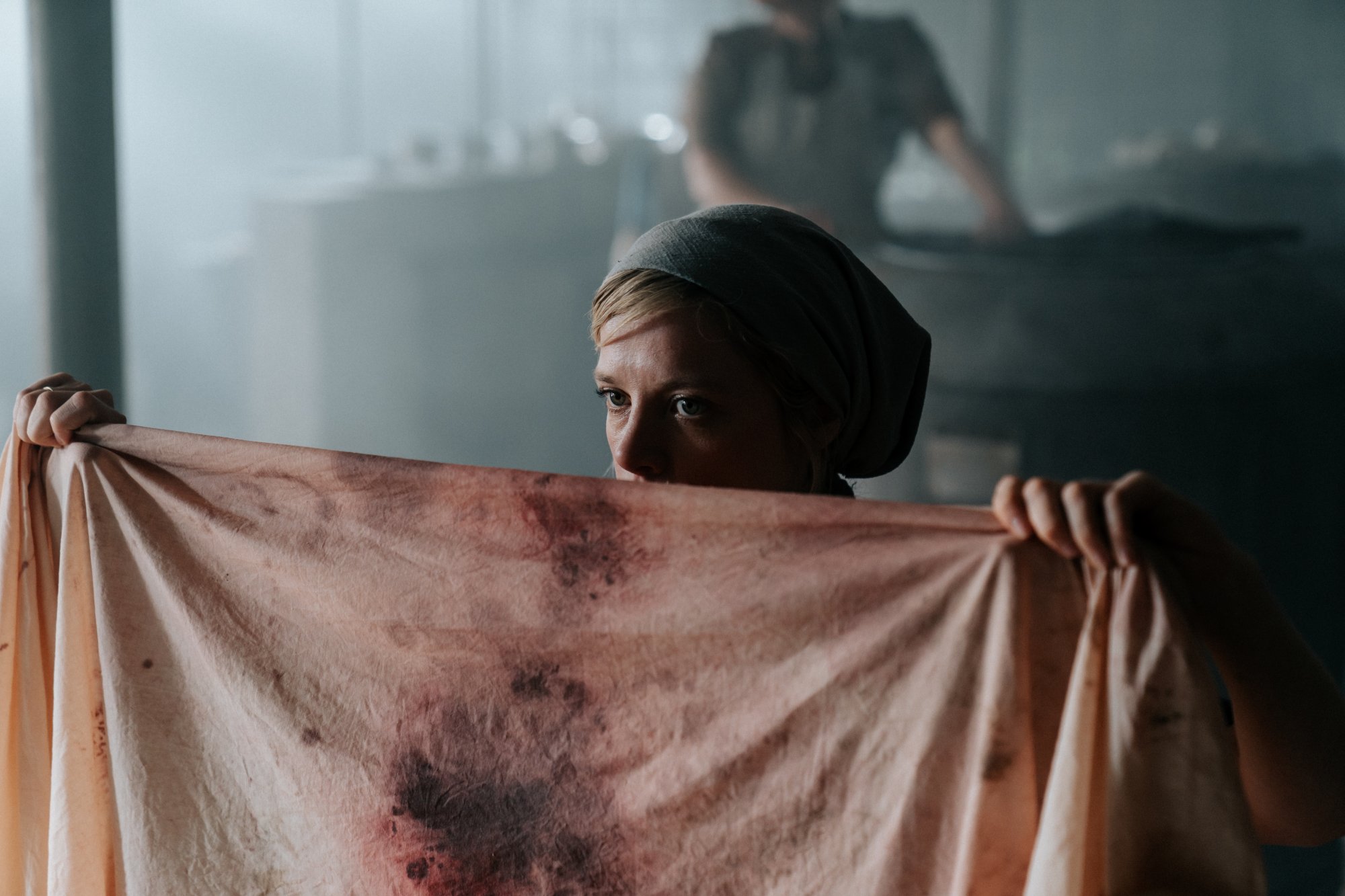
It’s spring 1945 in a remote village in eastern Germany. The only sign of the conflict gripping the world is the large absence of men from the community and the linens the women launder as part of the war effort. Little by little, however, signals that the war will soon be on their doorstep are becoming harder to ignore. Greta (Jella Haase) receives news her husband has died. The enemy’s propaganda leaflets flutter from the sky. Thomas Mann, in a radio broadcast from abroad, pleads with his countrymen to find reason. But when a German soldier, bloodied and near death, stumbles into town late one night, the villagers can’t look away from what’s right in front of them. “We behaved like barbarians,” he cries, sparking immediate worries about the measure of vengeance the advancing Russian army will take on the German people. Those concerns intensify as more bodies began to wash up on the banks of the nearby river.
Walter (Lukas Milo), the town’s mayor, immediately sets into motion his emergency plan to ensure the Russians can’t take pleasure in their victory: he orders the slaughter of all livestock, the destruction of material goods, and finally, the suicide of every member of the community. Walter marvels that a cyanide capsule could smell as inviting as a piece of cake, but his mania isn’t embraced by everyone. Fritz (Clemens Schick), the local headmaster, shudders at teaching the children how to make their own noose. While Albert (Martin Wuttke), the priest, grieves the loss of humanity around him. “Fear breeds monsters,” he warns Walter.
The film’s portrayal of an unseen, horrific war raging beyond the walls of a community recalls The Zone of Interest (one of the film’s producers, Ewa Puczscy?ska, worked on Jonathan Glazer’s film as well). So too does the throbbing score by Lorenz Dangel. The picture also occasionally flirts with Michael Haneke-esque austerity, but never quite fully commits. While the result is neither as singular or masterful as either filmmaker — in fairness, few could be — Vahl nonetheless delivers a memorable and assured first feature.
Working in concert with cinematographer Piotr Soboci?ski Jr., the pair deliver a string of stirring images: a human heart in a mason jar; a gun hidden in a beehive; a dead woman floating in a pond, reminiscent of Millais’ Ophelia. Meanwhile, the film’s tension is drawn from the careful yet subtly realized struggle for power and ideology that emerges between Walter, Fritz, and Albert. This unease — underscored by wavering considerations about how far commitment to the fatherland must be followed — is bolstered by the story that never leaves the confines of the village. Dahl’s confidence as a screenwriter is illustrated by its sensible economy.
In the film’s opening moments, a strange ceremony unfolds. Greta participates in a funeral for her husband that turns into a wedding; it was his final wish to be wed with her, even in death. She goes into mourning with a ring on her hand. It’s the perfect encapsulation of the surreal nature of warfare. Loyalty must be given to the dead, yet life must continue marching forward. “For the fatherland,” is a rallying cry heard with a continually withering passion in Krux. But as each day marches by and the war winds to a close, what that means becomes harder to discern.
Director: Tony Vahl
Screenplay: Tony Vahl
Cast: Jella Haase, Frida-Lovisa Hamann, Clemens Schick, Lukas Miko, Martin Wuttke
Producers: Martina Haubrich, Ewa Puczscy?ska, Claudia Schröter, Peter Hartwig
Cinematography: Piotr Sobocinski Jr
Production design: Katarzyna Sikora
Costume design: Aleksandra Staszko
Editing: Nikodem Chabior
Music: Lorenz Dangel
Sound: Johannes Hampel
Production companies: CALA Filmproduktion GmbH (Germany), Extreme Emotions (Poland), CALA Film Central GmbH & Co KG (Germany), Kineo Film (Germany)
World sales: Global Constellation
Venue: Toronto International Film Festival (Discovery)
In German
92 minutes