
Miari Texas
Gwanlicheobungyehoeg – Miali tegsaseu pyeon
VERDICT: Korean filmmaker Jang Yun-mi’s first feature-length documentary, 'Miari Texas', is an immersive, empathetic experience about Seoul’s oldest red-light district as demolition nears.
Today, the oldest and biggest “pleasure zone” in Seoul is no more. A small shantytown on the northern fringes of the Korean capital which was once home to more than 1,000 sex workers, Miari Texas – its name partly down to the American GIs who once frequented it – has now been largely demolished to make way for a modern residential and commercial complex. In her first feature, Jang Yun-mi captures first-hand testimonies and images that chronicle its inhabitants’ struggle to earn a living, maintain their integrity and finally secure compensation, while the authorities unleash state-backed goons and bulldozers on their disappearing neighbourhood.
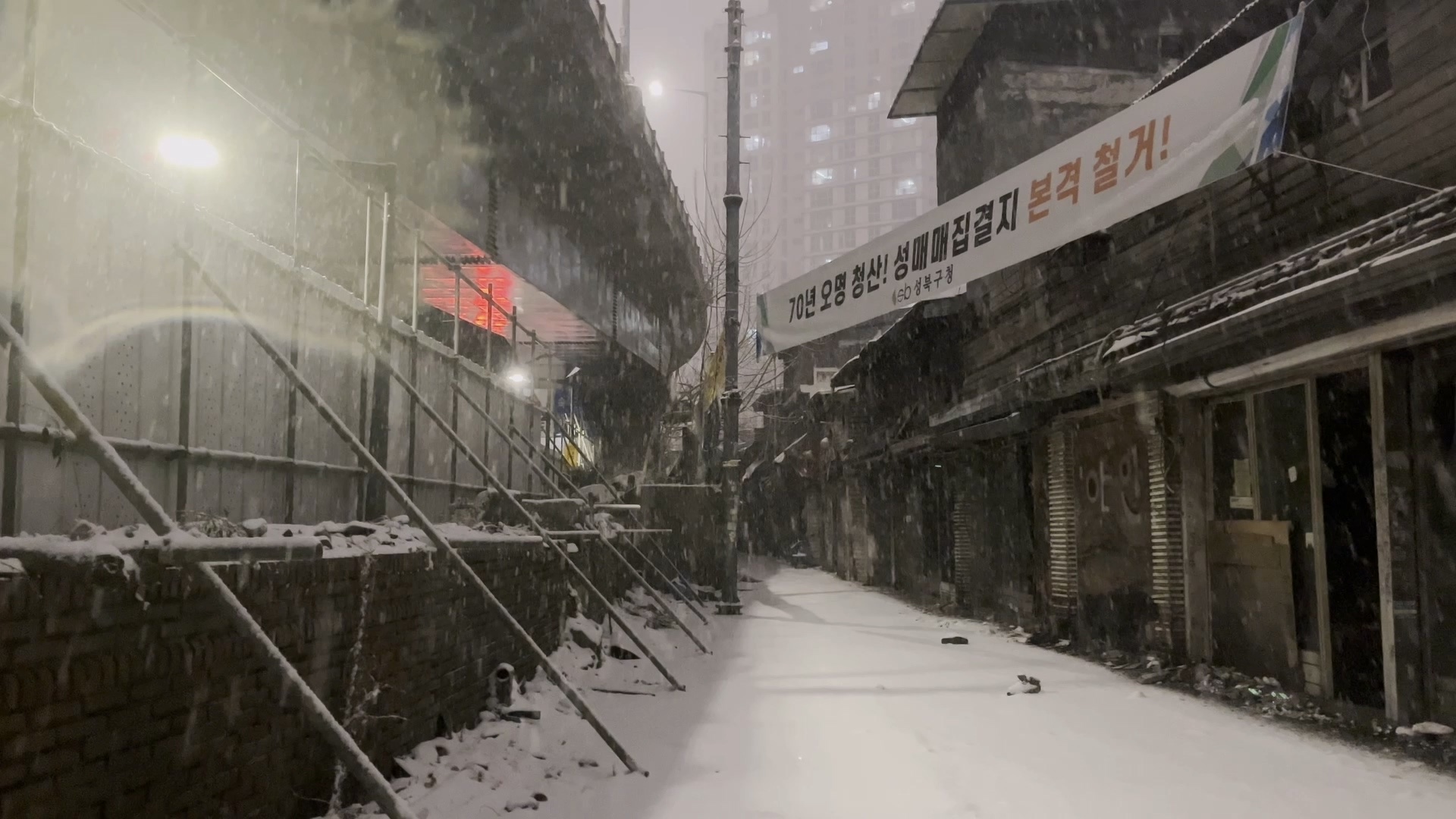
Unfolding in three chapters of very different moods and ways of storytelling – first through a combination of melancholic narration and photographs, then frontline video journalism of street scuffles, and long takes of wintry streetscapes over an off-screen conversation between the director and one of her subjects – Miari Texas is a bold visual experiment which plunges the viewer into the past, present and future of a district which has flowed and ebbed in the course of contemporary Korean history.
Though admittedly raw at the edges and perhaps in need of a tighter edit, Jang’s film remains a very important visual document for its domestic audience and for human rights festivals abroad. Local audiences should warm to it and understand its contexts and nuances, but non-Korean viewers should be able to follow the goings-on without much difficulty. Its world premiere at the JEONJU International Film Festival should serve as a good jumping-off point for a run at the kind of festivals which once embraced Kim Dong-ryung and Park Kyoung-tae’s thematically similar Tour of Duty (2012).
The first section of the documentary, titled “The Alley”, is anchored by a voiceover in which a (fictional) forty-something sex worker reads letters addressed to an older peer in the red light district. An actor’s delivery of Jang’s well-written text, backed by Won Tae-woong’s evocative sound design, is rich with details, spanning from sights and smells to facts and figures. Jang accompanies this lyrical half-hour soliloquy with images illustrating the neighbourhood’s darkness and destitution, along with the sex workers’ resilience, community spirit, and dark humour. Otherwise, what can we make of wall stickers asking, “Should This Life Sometime Deceive You”?
The title of the next chapter is self-explanatory. In “The Struggle” we see the mostly middle-aged sex workers confronting the police as the latter start erecting metal fences around the area. After fending them off, the women bring the battle to the town hall, where they protest vigorously against the authorities’ so-called “management and disposal plan” and their failure to assist in the relocation of the remaining residents. Chaos abounds in all senses of the word: following the action closely, Jang really makes the viewers’ heads reel with her handheld camerawork and her frequent injection of graphics and photos onto the screen.
Whatever is missing from the first two parts of the film, “The Auntie” fills us in. As we observe imagery of Miari Texas in deep winter and in its death throes, we hear Jang’s straightforward interview with a veteran of the area who professes to have seen and experienced nearly everything a Miari Texas sex worker could over her four decades in the district. Probed by the director’s off screen questions, the woman recalls the peaks and troughs of her career. There is the confusion of being a teenage castaway, the joys and horrors of making the wrong decisions and friends, her inability to leave the profession because of the money she needed for a sick sister. She also reflects on her own interactions with the law, the property developers erecting luxurious towering blocks next door and the scornful residents who moved into them.
Perhaps reluctant to cast her subject-turned-friend as a victim – as the protagonist of the first part certainly is – Jang gives her room to dream about the future. And the “auntie” does aspire to something more in the future. She talks about what she couldn’t do; for example, convenience stores are out of the question because she doesn’t know how to use computers, she says. But she also imagines the possibles: a job at a teahouse or opening a small corner shop, maybe – something a bit on the horizon At least Jang makes us look at and listen to this marginalized community in a different way.
Director, screenwriter, producer, cinematography, editing: Jang Yun-mi
Sound: Won Tae-woong
Production company: cicimimi film
Venue: Jeonju International Film Festival (Korean Cinema)
In Korean
120 minutes