
Possible Love
Ga-neung-han Sa-rang
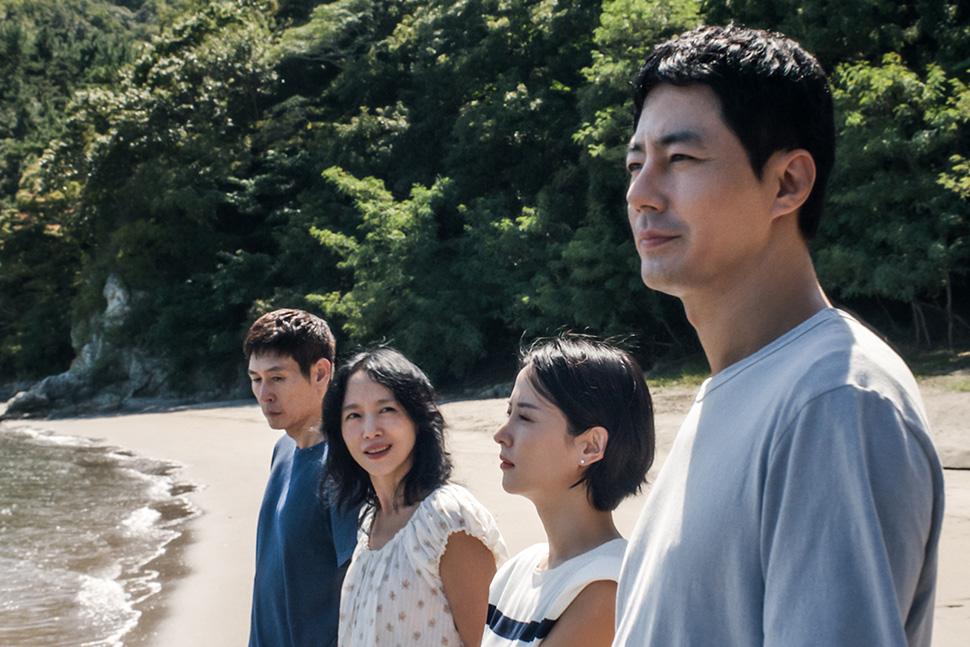
VERDICT: A working class family fallen into poverty becomes embroiled with a wealthy married couple who have a creepy agenda in Lee Chang-dong’s heartfelt depiction of the aftermath of a failed strike, ‘Possible Love’, whose understated delicacy is its power.
At the beginning of Possible Love (Ga-neung-han Sa-rang), there’s a brief reminder of the Biblical commandment, “Thou shalt not covet thy neighbor’s goods”. It offers a key to the story of two families, one rich and one poor, whose complex neuroses, desires and illusions are peeled off in progressive layers.
Over the course of close to three leisurely hours, two married couples who are on opposite ends of the K-shaped economy learn many hard lessons, chief among them that true friendship is impossible in an unequal society. Lee Chang-dong’s deep dive into South Korean lifestyles takes the viewer on a long journey from the noisy shop floor of a heavy industry factory to a birdsong-filled woods leading to a hidden private beach, without trying to mask the shattering bitterness of unemployment or the psychological damage workers accrue along the way. It is a rewarding trip but not an easy one, and this challenging entry in Venice competition will give the audience much to ponder.
Apart from the odd exception, no one has been able to portray the human cost of modern society’s widening economic gap with the compassion and conviction of Asian cinema. Hirokazu Kore-eda’s melancholic 2018 Shoplifters, about a loving family who steal to survive, and Bong Joon-ho’s 2019 black comedy Parasite, tracing a lower-class family’s scheme to work for and freeload off a rich family, both won the Palme d’Or at Cannes, while Parasite went on to become the first non-English language film to win the Best Picture Oscar.
In Possible Love, humor takes a back seat to poignant drama and emotions that can no longer be repressed. The story begins with the making if a film-within-the-film that puts the power squarely in the hands of the director, in this case the chic Ye-ji (played by Cho Yeo-jeong from Parasite.) She studied filmmaking in the U.S. where she met her husband, Sang-woo (Zo In-sung). He is a rich, good-looking stock trader who one character says reminds her of Steve Jobs, but if anything he exudes the privilege and easy success of a Jared Kushner. He supports his wife’s independent documaking by ferrying crew around in his Porsche.
We first meet the characters at the funeral of a worker who has committed suicide. Mi-ok (much-awarded Jeon Do-yeon from The Housemaid and Secret Sunshine) has a hard time getting her out-of-work husband Ho-seok (Sul Kyung-gu) into the funeral home, which is full of his old colleagues. Some, the “living”, still have jobs at the company; others, the “dead”, have been made redundant and fired.
Ye-ji is there, unobtrusively filming every sign of grief or tension, no holds barred. She hits it off with the naïve Mi-ok and persuades her to do an interview for the doc. It will turn out to be a Trojan horse that grants her entry to the woman’s mind and family. The two women actually share a common background, having both grown up in poverty. But marriage has placed Ye-ji in a place of safety, and her husband recognizes she is play-acting with Mi-ok to win her trust.
In the first part of the story, Ho-seok remains a silent presence in the background. He has been doubly traumatized by the failure of a factory-wide strike meant to push back on mass firings related to restructuring and selling the company. During the strike, the police were called in to beat up the strikers, and Ho-seok was seriously injured. But what hurt the most was being abandoned by his coworkers, who fled the scene without him. Sul Kyung-gu (Memoir of a Murderer) is frightening even when he is holding in his repressed anger, and when he finally explodes on screen it feels like something final has happened, a last layer of civility has been removed. It is a performance that leaves the viewer shaken.
Equally notable is Jeon Do-yeon, whose emotional roles in The Housemaid and Secret Sunshine have won her numerous awards. Although Mi-ok has a far greater openness to life and its beauty than her husband, and bonds with people more easily, she can recognize falseness when she sees it. As the story draws to its close, she pulls back from the illusion of freedom offered to the rich – skinny-dipping on a deserted beach, in this case – and sees the trap, which even her timid son Cheol has spotted.
The constantly shifting relationships of the characters speeds up in the final scenes set at Sang-woo’s childhood estate, now a vacation home where they daringly invite Mi-ok and her family, in the hope that Ho-seok will finally agree to be interviewed for the documentary. The violent explosion is not long in coming. Cinematography by Kim Ji-yong adapts to the film’s many moods, connecting them with camerawork that often has a loose, hand-held feel. Kim Da-won’s editing also helps pull together the multiple emotional and narrative threads.
Director: Lee Chang-dong
Screenplay: Lee Chang-dong, Oh Jung-mi
Cast: Jeon Do-yeon, Sul Kyung-gu, Zo In-sung, Cho Yeo-jeong
Producers: Lee Joon-dong, Lee Chang-dong, David Levine, Chadwick Prichard, Lee Joon-dong, Lee Chang-dong
Cinematography: Kim Ji-yong
Editing: Kim Da-won
Production design: Jang Min-woo
Costume design: Yi Choong-yun
Music: Jung Jaeil
Sound: Lee Seung-chul, Han Myung-hwan
Production companies: Pinehouse Film, Anonymous Content, NOWFILM
Venue: Venice Film Festival (Competition)
In Korean
164 minutes