
Queen at Sea
.
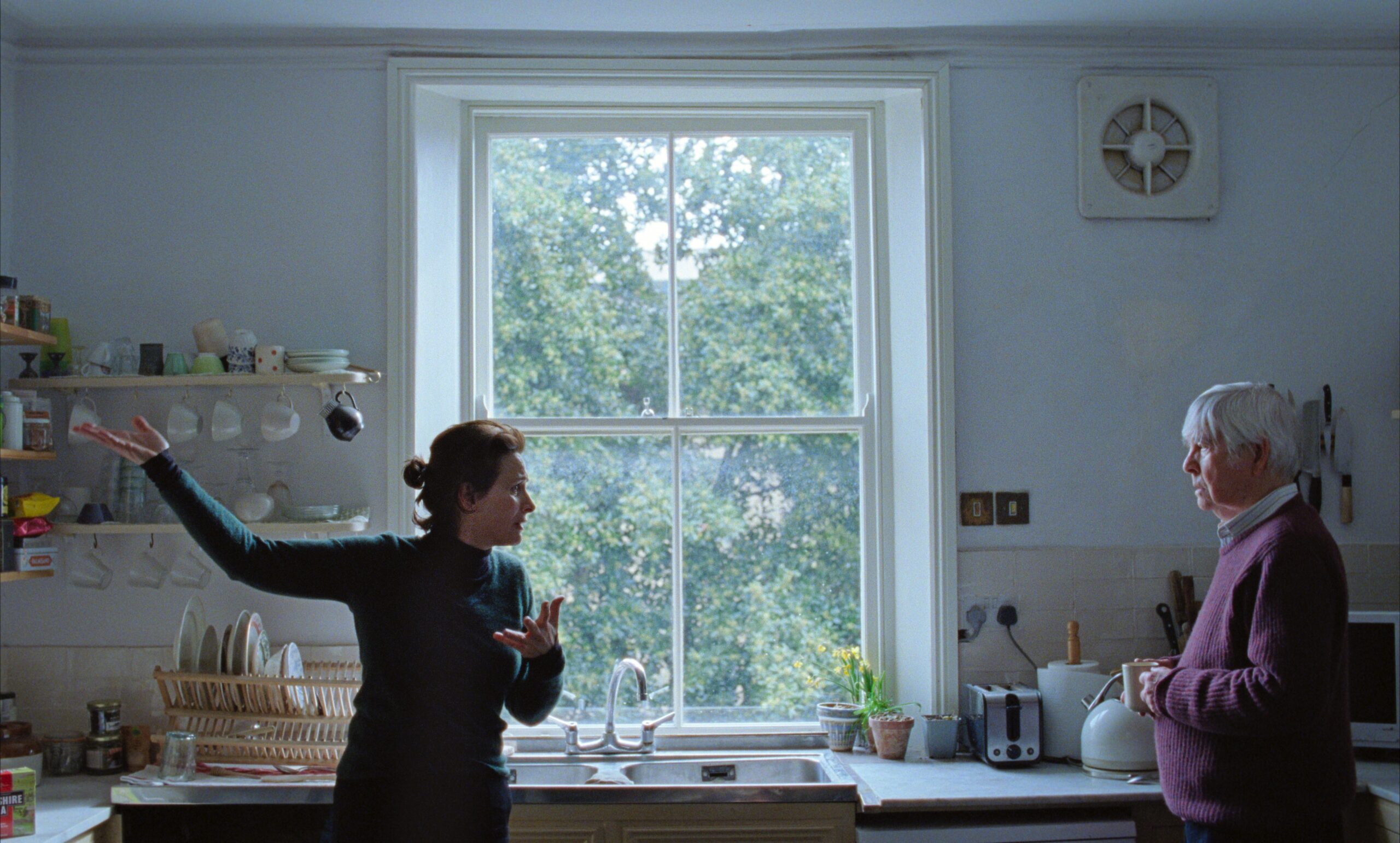
VERDICT: The issues of living with a relative with cognitive decline are at the core of Lance Hammer’s quietly devastating ‘Queen at Sea’.
Eighteen years after his feature debut Ballast, American director Lance Hammer is back behind the camera with the UK co-production Queen at Sea, set and shot in London. Carried by a committed cast that includes Juliette Binoche and boasting a familiar yet efficiently handled topical premise, it should have no issue traveling far and wide after its prestigious premiere in the Berlinale’s main competition.
Binoche plays Amanda, who is on sabbatical from her work in academia in Newcastle and currently lives in London with her teenage daughter Sara (Florence Hunt), while her estranged husband is teaching in Canada. It soon becomes clear Amanda’s decision to move to the English capital comes with a certain emotional baggage: her mother Leslie (Anna Calder-Marshall) suffers from advanced dementia, and there have been discussions about putting her in an assisted living facility.
The main obstacle to this, although Amanda can overrule him since she has power of attorney, is Leslie’s second husband Martin (Tom Courtenay), who refuses to accept his spouse requires specialized care. In fact, when we first meet them, as Amanda is checking in on their wellbeing, she catches them in flagrante delicto and calls the police. As it turns out, Martin has been told he’s no longer supposed to engage in sexual activity since Leslie’s condition makes it virtually impossible to establish consent, but he thinks he knows better, having read articles online.
From there on, the film follows two plot strands: one deals with Amanda and Martin coming to terms with what would be best for Leslie, while acknowledging the other’s point of view and their emotionally driven reasons for favoring one approach over another; the other storyline concerns Sara, who’s not quite sure what she wants to do with her life (in part due to her mixed feelings about the relocation and her parents’ separation), and has to think about whether she wants to act on the attraction she feels vis-à-vis a friend who’s similarly into her.
One body is still figuring out its autonomy, the other has all but lost it. Agonizingly tight close-ups show the anguish and frustration of each family member, including Leslie whose fragmented state of mind is tactfully conveyed by Calder-Marshall’s carefully judged performance: her eyes, at times fully expressive and at times a blank slate, provide valuable glimpses into the everyday tribulations the character must deal with, as well as the progression of the film’s main emotional arc. Though technically a bit more showy as he gets to shout on occasion, Courtenay – in his first film role in four years, and arguably his most important since 2015’s 45 Years – is also cleverly measured in his portrayal of a man who, be it out of habit or a certain “old school” about his role in the household, is not ready to let go of his wife.
Various notions of intimacy overlap and come into conflict as Hammer delicately explores the nuances of three generations dealing with the realization their family is broken in multiple ways. Much of it is upsetting, but never in a cruel way. Instead, the director finds the right shade of sincerity from the get-go, making even the harder-to-watch moments an organic part of the characters’ quest for clarity and not gratuitous depictions of misery designed solely to hit the viewer in the gut (in that regard, it’s not unlike Michael Haneke’s Amour). In a way, we’re on the same journey as Amanda and her family, discovering things alongside them and preparing for the same catharsis, which eventually strikes with honest precision.
Director, Screenwriter: Lance Hammer
Cast: Juliette Binoche, Tom Courtenay, Anna Calder-Marshall, Florence Hunt
Producer: Tristan Goligher, Lance Hammer
Cinematography: Adolpho Veloso
Production design: Soraya Gilanni Viljoen
Costume design: Saffron Cullane
Sound: Kent Sparling
Production companies: The Bureau, Alluvial Film Company
World sales: The Match Factory
Venue: Berlinale (Competition)
In English, French
121 minutes