
Tender Loving Care
Tender Loving Care
VERDICT: Small but engrossing, Mike Leigh’s ‘Tender Loving Care’ casts a harsh light on the underfunded British health and welfare system, which divides even death unequally into its haves and have-nots.
Said to be Mike Leigh’s farewell to filmmaking — but probably not, knowing the creative drive of the 83-year-old filmmaker — Tender Loving Care plays like a recap of the social themes and questions of inequality that have dominated his work over 50 years and 20-odd films, including masterpieces like Naked, Secrets & Lies, Vera Drake.
Given his focus on working class stories, the personal and professional tribulations of two London social workers may seem like well-trodden territory for Leigh, who also wrote the screenplay. But the mere fact we are seeing England’s hard-up welfare system from the exhausted eyes of its humblest employees gives Tender Loving Care a new point of view. However, the film is not just about their unfruitful labor: it is also the story of a happy lower middle class family where the shadow of death encroaches, in one of Leigh’s hardest reflections on mortality. A compact film with an excellent cast, it should find life beyond the festivals. It has earned mostly kudos at Telluride, Toronto and now San Sebastian, where the director’s 2024 Hard Truths was also in competition.
The pleasure of the film is how understated its message is and how Leigh’s mastery of his profession can hide deep meaning in banal dialogue, imperfect characters and cramped interiors. The film begins with a visit of bouncy social worker Rosie (Alice Bailey Johnson) to a hospital where a semi-conscious homeless man (Alan Williams) is recovering from a heart attack. Her barrage of questions aimed at getting him off the public dole and “back home” is cringe-worthy, and when he finally gives her some numbers that sound like a telephone number, she doesn’t even bother to write it down.
The negative impressions only multiply when Rosie goes home and celebrates the return of her old roommate Amy Spooner (Kate O’Flynn), who has just broken up with her married boyfriend. They polish off a bottle of white wine, which is the leitmotif of their alcoholic friendship. But if Rosie seems hopeless in her attempts to strike up conversation and inspire trust in her charges, or even get a decent date, Amy’s professional talents gradually emerge. She has the delicate job of dealing with child abuse and custody cases, and we see an admirable firmness in her approach.
At one point she has a face-to-face evaluation session with a burnt-out colleague who remembers when their office was able to offer family support, but “now it feels like we’re making it worse”, tearing families apart and destroying lives. The examples are there: a teenage boy whose foster parents won’t give him the chance to make friends, a paranoid woman with a garden that looks like a junkyard, a young mother who lost her twins due to her heroin addiction and now risks losing her son. Her faith in the child protection services vanished when they testified against her in court. The tragic thing is that the social workers can only afford to visit once a month, so even if they make headway their gains are soon depleted.
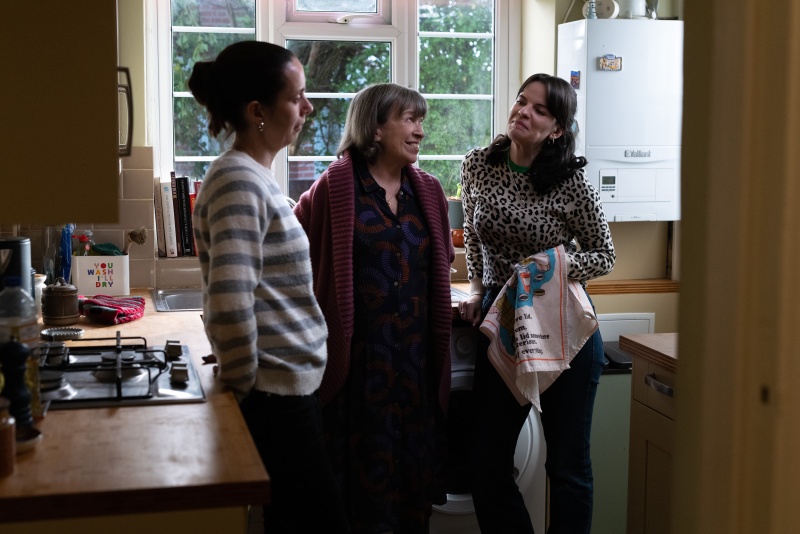
Most viewers will be feeling depressed, frustrated and hopeless by the time the film shifts into the story of Amy’s loving family, which is the polar opposite of these cases. Her mom Birdie (Marion Bailey) and dad Geoffrey (Paul Jesson) are very close even now, in their 70s, but they worry about their daughter’s happiness. They adore Amy and recall a slew of anecdotes about her childhood and teenage years, songs the family has obviously sung together many times, jokes that are funny only to themselves. In the loving arms of her family, O’Flynn’s Amy projects a goofy, fun-loving persona that is similar to Bailey Johnson’s Rosie. Although these 40-year-old women can’t seem to find a lasting mate – and Rosie, for one, wants children – they at least have each other to rely on.
But Leigh leaves us with a final injustice to ponder. It happens when the companionable stability of the small cozy rooms in the Spooners’ solid brick house are shaken by the poignant nearness of death. Family and friends gather around the sickbed and call the doctor – who makes a house call and a preliminary diagnosis. Every care will be taken to make the passing easy and painless. Then camera pulls into the same close-up of the homeless man the film began with, only now we read a bitter poignancy on his worn face.
The film is dedicated to the memory of Leigh’s long-time director of photography, Dick Pope, who died in 2024.
Director, screenplay: Mike Leigh
Cast: Marion Bailey, Paul Jesson, Kate O’Flynn, Alice Bailey Johnson
Producers: Georgina Lowe, Sally Lynn
Cinematography: Lucy Bristow
Editing: Tania Reddin
Production design: Jane Brodie
Costume design: Jacqueline Durran
Music: Gary Yershon
Sound: Lee Herrick
Production companies: Thin Man Films
World Sales: Cornerstone Films Limited
Venue: San Sebastian Film Festival (Competition)
In English
107 minutes