
The Ballet Lesson
The Ballet Lesson
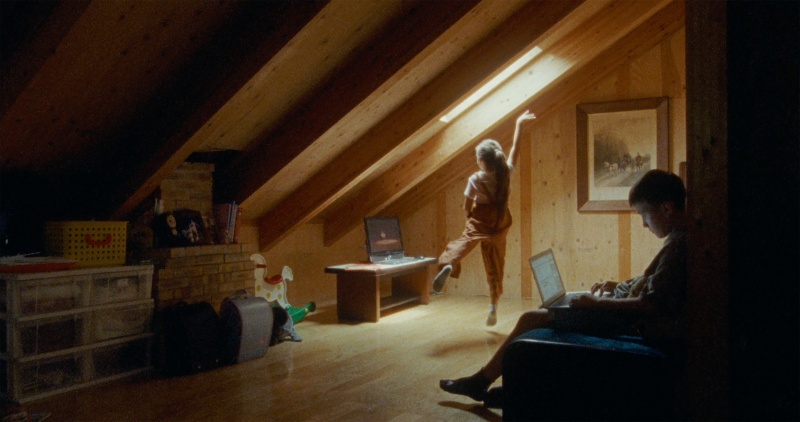
VERDICT: An absent father returns to take his two small children to their missing mother in a simple tale that blossoms into complexities about life and death like a piece of origami in Kazuya Murayama’s charming if at times overreaching ‘The Ballet Lesson’.
A new voice in Japanese cinema, Kazuya Murayama brings a poet’s sensibility to an empty world, where everyday objects and actions have a symbolic meaning and children reunite with their missing parents as though in a fairy tale. But this is a film that has no fear of grappling with mega-themes like war and peace, the meaning of life, animal rights.
The writer-director, who also produced and edited The Ballet Lesson, aims high with all that creative control. He doesn’t always succeed in getting the tone exactly right, yet those who follow little Nikita and Niina on their journey will overlook the film’s narrative uncertainties for the pleasure of its big reveal. Its bow in San Sebastian’s New Directors section should attract attentive programmers.
The setting, which is unspecified, may be somewhere between Japan and eastern Russia – possibly a dream space. The bilingual children Nikita (Nikita Kondo, around 10) and his little sister Niina (Niina Kondo) live in the countryside with their Russian grandparents. They don’t know where their parents are or if they’ll ever return, and obsess over them. Niina repeatedly watches a video of their Japanese mother Yuki dancing onstage in a glamourous tutu, and Nikita strains to remember that his dad had a stern face and was in the army.
Suddenly their father reappears and orders the kids into the car: they are going to see their mother. The grandparents say nothing. The trio of travelers is soon on the road, traveling through thickly forested lands of pristine nature where they will learn all sorts of lessons, and not just about ballet, in an enchanted atmosphere of empty roadside diners and deserted amusement parks. And little by little, the father’s somber, expressionless mask slips off and actor Vadim Bushmakin gives him a human face. It is satisfying to see him transition from a man-on-a-mission into a real, caring father as he interacts with his children.
The filming, lit by D.P. Chiyo Sugita, is simple and direct, taking its cue from the dark forest and the cloud-streaked sky; it has a concreteness that roots the journey in the natural world. Oddly, there seem to be almost no people in the area, which in retrospect could signal that some kind of natural or man-made disaster has depopulated the place. Or perhaps one could say there are exactly the number of people needed to tell the story and no more.
Dad takes the kids fishing and camping, where he bonds with his open-hearted daughter more than his comically awkward and self-conscious son. When their car breaks down, Dad calmly hitchhikes to a small dairy farm, where he leaves the kids overnight while he drives off with a mechanic. A young farmhand and his father, known as the Cow Master, school the children in the secrets of milking and cleaning the barn. Niina and Nikita coo over a cute calf, only to find it is being taken to market the next morning. As Dad points out, they eat meat and fish without thinking if it’s right to take another life. And what is living, anyway?
While Kazuya Murayama’s laid-back approach gives the first half of the film a deceptive simplicity, it’s clear he struggles to tie up the loose ends in the multiple endings. The first among these is the question, Where is the mother? Just when the journey turns into an uphill slog on foot and feels like an endless trek, a surprising solution wraps things up – if not on a realistic level, then on a symbolic one, which is the real key to this small but warm-hearted work.
Director, screenplay, producer, editing: Kazuya Murayama
Cast: Vadim Bushmakin, Nikita Kondo, Niina Kondo, Yukina Shimizu
Cinematography: Chiyo Sugita
Music: Setsu Tanaka
Sound: Masataka Ota
Production companies: Park 827
Venue: San Sebastian Intl. Film Festival (New Directors)
In Japanese, Russian
91 minutes