
The Beauty of the Donkey
La beauté de l’âne
VERDICT: Childhood memories and a lost homeland are the backbone of Dea Gjinovci’s powerful documentary ‘The Beauty of the Donkey’.
A Swiss director of Albanian origin, Dea Gjinovci enjoyed great (virtual) success on the festival circuit in 2020 with her documentary Wake Up on Mars, which screened at Tribeca and Visions du Réel. Five years later, she has returned behind the camera with The Beauty of the Donkey, which premiered in Zurich’s Documentary Competition and has since gone on to play at other events internationally. Its peculiar, emotionally bold approach to its subject matter should make it a hot ticket for documentary connoisseurs and people with an interest in the Balkans.
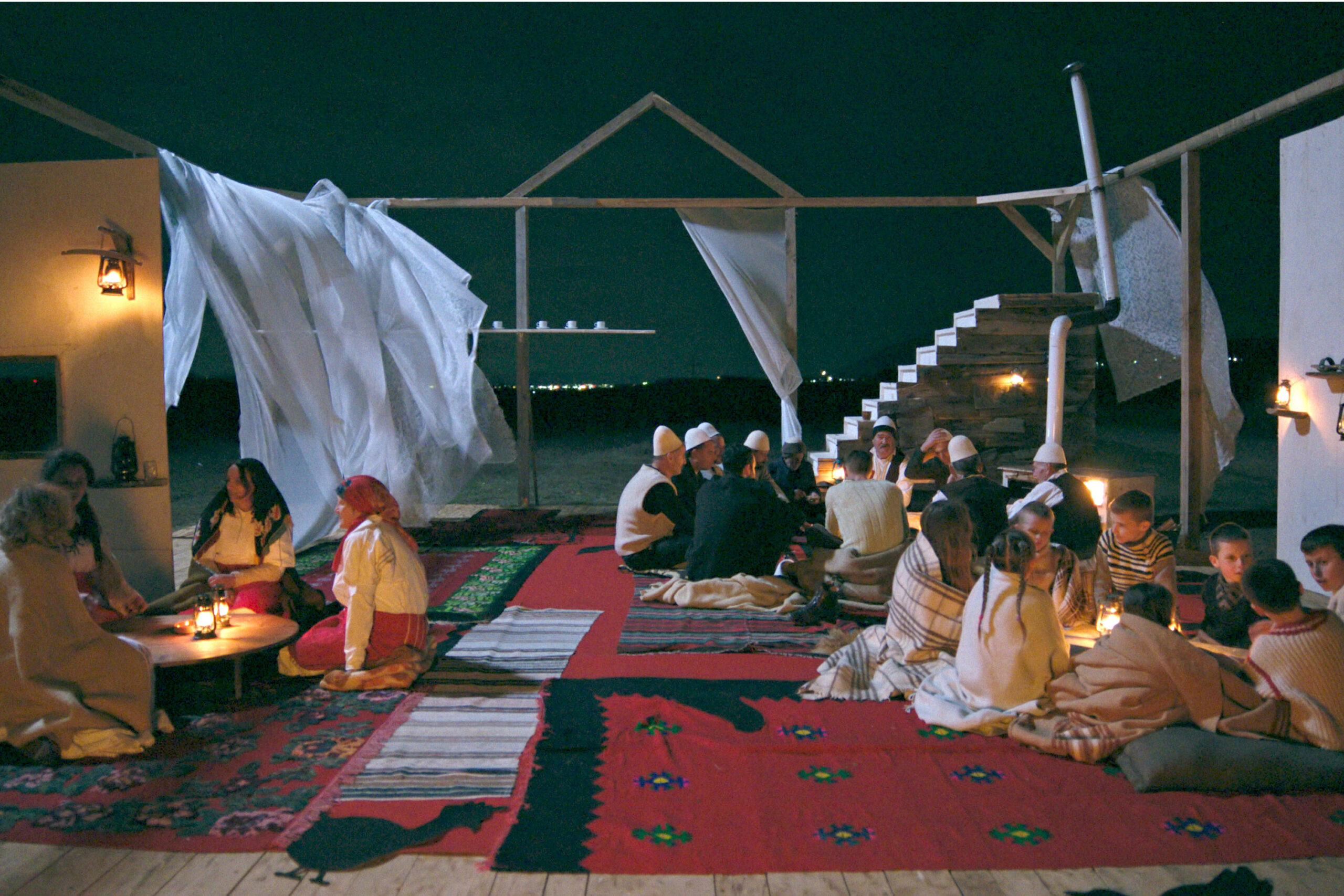
The director is a key presence in front of the camera as well, since the film chronicles her attempt to revive her father Asllan’s childhood memories. After sixty years of life in exile in Switzerland, Asllan returns to his hometown of Makermal, a village in Kosovo. Working with the locals, father and daughter reconstruct a place wrecked by war, with the intention of re-enacting moments from Asllan’s early years (the title refers to one of the family’s farm animals), while he observes the shoot sitting next to Dea on set. He nods approvingly, clearly enjoying the effort put into remembering the past via cinematic trickery.
But not all is well as the project keeps evolving. Memory and loss come even more to the forefront when Dea and Asllan come across possible new information about the disappearance of the family matriarch decades ago, and start trying to find answers to their newly pressing questions. What started as a joyful exercise in biographical homage turns into a painful investigation, a quest for the truth that vows to leave no stone unturned, no matter how devastating the outcome may be to the filmmaker and her parent.
The transition may seem jarring at first, making it perhaps ill-advised to go into a screening of The Beauty of the Donkey whilst completely unaware of its content. And yet, Gjinovci and her cinematographer Maxime Kathari (who also lensed her previous film) handle the balancing act gracefully, hinting at an underlying melancholy even as the lyrical recreation of lost childhood and bucolic bliss light up the screen in the early stages. The beauty of the landscape of yesteryear contrasts effectively with the drab grayness of modern bureaucracy, although in the end the present-day shocks and tears carry slightly more power than the reconstructed idyll, as all the ingredients come together to create a hybrid experience that is partly baffling, sometimes very moving, always cinematically stimulating.
Back in 2020, Gjinovci dealt with the topic of displacement via the story of a 10-year old boy living in Sweden and dreaming of building a spaceship that would allow him to leave it all behind. For her follow-up project, she chose to tackle her own family history head-on, resolutely refusing to let a potentially harrowing slice of the past fade into oblivion. It’s not always an easy watch, but the juxtaposition of idyllic nostalgia and hard-hitting uncomfortable truths makes for a compelling meditation on the role of filmmaking in preserving memories, as well as finding the art in one’s own life story.
Director, Screenwriter: Dea Gjinovci
Producers: Dea Gjinovci, Palmyre Badinier, Ilir Hasanaj, Emmanuelle Lepers
Cinematography: Maxime Kathari
Production design: Aurélia Martin, Jesse Wallace
Costume design: Njomza Haziraj
Music: Gaël Kyriakidis
Sound: Henry Sims
Production companies: Astrae Productions, Unseen SH.P.K., Haut et Court, RTS Radio Télévision Suisse, Facet LLC
World sales: Astrae Productions
Venue: Zurich Film Festival (Documentary Competition)
In Albanian, French
77 minutes