
The Housewife
The Housewife
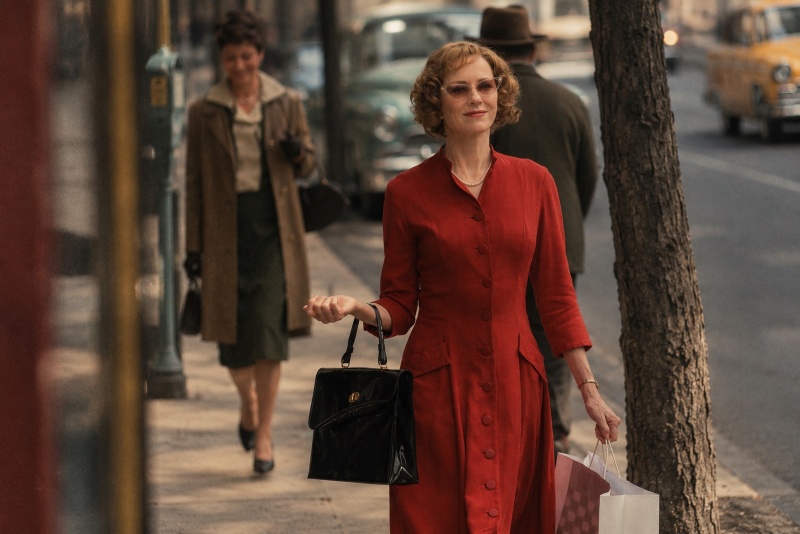
VERDICT: Naomi Watts plays a prim suburban housewife with a very dark past in director Ben Shirinian's good-looking but heavy-handed debut feature, a based-on-reality period thriller set in 1960s New York.
Naomi Watts stars in The Housewife as an Austrian immigrant in 1960s New York who conceals her dark past by role-playing the bright, shiny, soul-cleansing innocence of the American Dream. Also credited as co-producer, the Australian screen veteran is on strong mid-career form here, giving an aggressively prim performance that combines fastidious politeness with a compelling undercurrent of deranged intensity. But much like Canadian debutant director Ben Shirinian, first-time screenwriter Alyssa Hill betrays her lack of experience in a drama that ultimately feels too dry and flat for such juicy, chilling, real-life material.
The Housewife begins promisingly, circling meaty themes of guilt and redemption, complicity in hellish evil, and deep psychosis lurking beneath suburban respectability. All of this is wrapped in deliciously retro clothes, interiors and Montreal-shot street scenes: think Mad Men with a hint of vintage Hitchcock. Watts is also flanked by a solid supporting cast including Michael Imperioli (The Sopranos), Tye Sheridan and Luke Evans, plus Swedish icon Lena Olin in a scene-stealing cameo.
But as it reveals it secrets, this intriguing psychological thriller becomes a clunky legal procedural, sacrificing serious moral investigation for heavy-handed melodrama, clumsy plot twists and thinly drawn characters. Screening in San Sebastian this week following its Toronto world premiere, The Housewife feels destined to become a minor footnote in the grand canon of post-Holocaust cinema.
Billed in its opening credits as “inspired by real events”, The Housewife is actually a pretty faithful re-telling of the case of Hermine Braunsteiner Ryan. Born and raised in Austria, Braunsteiner worked in several Nazi concentration camps, committing crimes for which she earned a modest prison sentence and partial amnesty following Germany’s defeat in WWII. In 1958, she married American construction worker Russell Ryan (Evans), became a US citizen and settled down in suburban Queens. But after being exposed by legendary Nazi hunter Simon Wiesenthal, which triggered a story in the New York Times, she became the first ever war criminal to be extradited from the US to face trial in West Germany.
Spoiler alert: Braunsteiner was not actually a nurse in the death camps, as she tries to claim in The Housewife, but a guard whose sadistic relish in meting out lethal punishments, including whipping and kicking prisoners to death, was overlooked during her first court case due to lack of evidence. When Joseph Lelyveld (Sheridan), a dogged junior reporter for the New York Times, calls at her pristine suburban home, she is polite, friendly and even a little flirtatious, a fascinating subtext that the film-makers never develop. But Lelyveld, aided by rogue immigration official Anthony DeVito (Imperioli), gradually sees past this charm offensive and exposes Braunsteiner as a Nazi fugitive, opening the way to her extradition and deportation.
There is a lot of interesting back story to the Braunsteiner case that The Housewife blurs or skips altogether. The Jewish Lelyveld’s semi-estranged relationship with his rabbi father Arthur is shown as strained, but poorly explained. The real Arthur Lelyveld was also a wartime pacifist, fervent Zionist and anti-racist campaigner in America’s Deep South during the Civil Rights period, all of which might have added valid extra character shading here.
Hill’s screenplay strongly suggests the US government initially pushed to bury Braunsteiner’s extradition case over murky-sounding security concerns, an intriguing hint of state-level complicity that the film leaves unresolved. Her lengthy US court battle, denaturalisation and deportation process actually dragged on for almost a decade, which is also not clear from the film. It was followed by the longest and most expensive trial of Nazi war crimes in West Germany’s history, which uncovered much more graphic testimony about Braunsteiner’s record of murderous sadism in the death camps.
By comparison, Shirinian’s prosaic portrait of the banality of evil seems oddly timid. The only attempt to invoke the horrors of the Holocaust here are a few fleeting brief dream sequences and flashbacks, nightmarish in tone but brief and impressionistic. Some of the action almost feels comically absurd, with hot-headed Lelyfeld throwing shouty tantrums instead of addressing serious family and work issues, while Braunsteiner clumsily leaves her Nazi Iron Cross medal lying around to be discovered. Doh! Of course, Watts looks fantastic in a series of vintage outfits, but something is seriously amiss when the most memorable aspect of a film about monstrous genocidal evil is its eye-catching production design.
Director: Ben Shirinian
Screenwriter: Alyssa Hill
Cast: Naomi Watts, Tye Sheridan, Luke Evans, Michael Imperioli, Lena Olin, Debi Mazar
Cinematography: Michael Merriman
Editing: Jon Devries
Music: Kevin Lau
Producers: Jason de Beer, Lee Broda, Robbie Brenner
Production companies: LB Entertainment (USA), Escape Route Films (USA), RB Productions (USA)
World sales: Neon (US)
Venue: San Sebastian International Film Festival (Donostia Award Screening)
In English, Germany
102 minutes