
The Last Goodbye
Azken Agurra
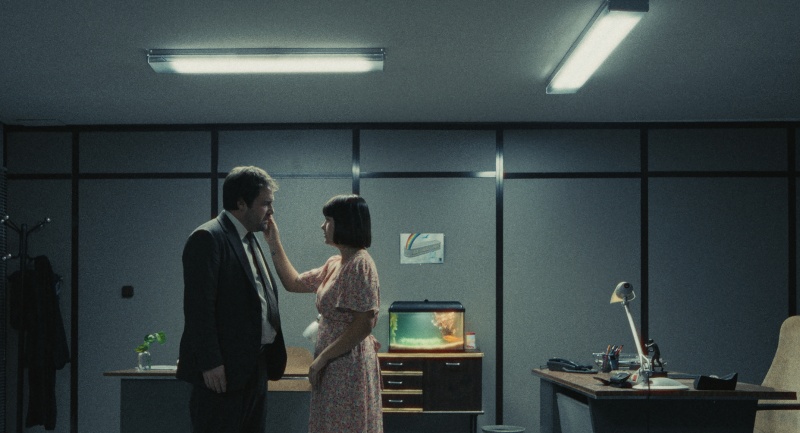
VERDICT: A feckless funeral director wrestles with financial, emotional and existential angst in this erratic but engaging tragicomedy from Basque writer-director Koldo Almandoz.
“Death is the last honeymoon,” says funeral parlour boss Tomás Martínez, hapless anti-hero of The Last Goodbye, the third feature from Basque writer-director Koldo Almandoz. It is a suitably glum, gnomic observation from a deeply unreliable narrator who is quietly struggling to find some meaning in his slow-motion car crash of a life. But even if its premise sounds like the kind of punishing art-house misery porn that typically fills festival programs, this San Sebastián world premiere is actually loaded with absurdist comedy and stylistic mischief, a mostly charming film about a mostly charmless man.
Of course, an existential tragicomedy shot entirely in the Basque language was never likely to be a breakout blockbuster smash, but The Last Goodbye has sufficient levels of universal underdog appeal, droll humour, visual flair and production polish to travel beyond niche regional audience. Like the director’s previous film, sombre rural thriller The Deer (2018), it should grab a few international festival slots following its hometown world premiere. It next screens at Warsaw film festival in October.
Charming and irritating in equal measure, Tomás (Iñigo Azpitarte) is a scruffy, boozy, unshaven, chain-smoking divorcée in his mid-forties. From his cramped office, he runs a one-man funeral business specialising in low-budget cremations and secular end-of-life ceremonies. These can involve scattering ashes around hillside wind farms, blasting them into the heavens on fireworks, sealing them inside penis-shaped amber sculptures, and other eccentric specialist options. A feckless fantasist and serial liar, Tomás can barely turn up on time for anything, including regular custody sessions with his feisty 12-year-old daughter Enera (Laia Escribano).
Fate seem to throw Tomás a shot at redemption when university student Sara (Izaro Nieto) arrives at his office to begin an internship linked to her anthropology degree project, an investigation of death rituals. She helps her feckless boss to smarten up, act more businesslike and attract new clients. But inevitably, his self-sabotaging impulses soon get in the way, especially when he develops a romantic crush on the much younger Sara.
Meanwhile, storm clouds are gathering in the shape of a thuggish boxing club boss (Josean Bengoetxea) who has funneled huge funds into the funeral business, part of an illicit money-laundering scheme that Tomás has unwisely diverted to finance his other debts, private projects and bad habits. A violent reckoning looms, with Sara caught in the crossfire.
The Last Goodbye feels tonally unsure at times, as Almandoz wobbles between light-headed farce, crime thriller and midlife crisis comedy. The zigzagging narrative keeps viewers guessing, ending with a series of gentle twists that feel too much like low-stakes, inconclusive whimsy. That said, this patchwork approach does have some advantages, with its unexpected digressions into magical realism, cinematic homage and random full-frontal nudity. The film’s more enjoyable stylistic detours include a slow-motion underwater sequence shot in a swimming pool, an unexpected fantasy musical number, and an extended discussion about the plot of Japanese director Hirokazu Kore-eda’s After Life (1998).
On a technical level, The Last Goodbye is a handsome package overall. Cinematographer Javier Agirre Erauso’s precise lensing give the film a bright, crisp, composed look which makes excellent use of the Basque region’s rugged mountain scenery and modernist architecture as backdrops. Aitor Etxebarria’s jaunty, bittersweet score is also spiced with a rich selection of eclectic musical choices, from traditional Basque folk songs to recurring blasts of English baroque composer Henry Purcell.
Director, screenwriter: Koldo Almandoz
Cast: Iñigo Azpitarte, Izaro Nieto, Josean Bengoetxea, Iñaki Beraetxe, Laia Escribano
Cinematography: Javier Agirre Erauso
Editing: Laurent Dufreche
Music: Aitor Etxebarria
Producer: Marian Fernández Pascal
Production companies: Garabi Films SL (Spain), Txintxua Films SL (Spain)
Venue: San Sebastián International Film Festival (Special Screenings)
90 minutes
In Basque, Spanish