
The President’s Cake
Mamlaket al-qasab
VERDICT: A child’s endeavor to find baking ingredients in 'The President's Cake' becomes a boldly vivid portrait of life in 90s' Iraq amid war, foreign sanctions, dictatorship, and childhood, with a commendable young cast and unique visual identity.
The politically sharp feature debut, The President’s Cake, is Iraqi director Hasan Hadi’s accomplished take on life in Iraq in the 1990s. He takes a very small detail in the modern history of the war-torn and politically rigid country to craft a solid story, a fresh approach in Arab cinema where the subaltern’s perspective becomes the vantage point from which power, poverty, and political violence are examined. Hadi’s debut premiered in the Directors’ Fortnight section at the 2025 Cannes Film Festival, scooping both the Caméra d’Or and the Directors’ Fortnight Audience Award. Continuing its international tour, it is competing in the Arab Feature Narrative Competition at the Amman International Film Festival.
Hasan Hadi’s script follows a nine-year-old girl, Lamia (Baneen Ahmed Nayyef), who is tasked to bake a cake in celebration of Saddam Hussein’s birthday. Dreadfully, she wins this privilege through a lottery in her school, and she cannot decline. The birthday cake becomes a scary and unwanted test of political loyalty to the regime. Lamia lives with her grandmother (Waheed Thabet Khreibat) in the Mesopotamian Marshes. After being chosen to bake the cake, she gets a warning from her teacher that this is not a mundane homework assignment but an obligation.
The film’s bold statement lies in showing how the devastation in Iraq is not solely the result of oppression, a narcissistic leader, and a police state. The semi-failed state is not an inexplicable local condition in Iraq; foreign sanctions and interventions also play a role, with the former being more brutal sometimes than military action.
In a country where eggs, sugar, and flour are scarce due to sanctions, the child protagonist is put, with much surrealism, in a survival mode. In addition, the background to the film incorporates the consequences of the Iraqi invasion of Kuwait later that year, enhancing the experience of the child living in conflict and deprivation, where the everyday stories of people can vanish and what remains are the visuals and narratives of decision-makers. Hadi sets the film in this way. As Lamia embarks on a journey to scramble to find the ingredients, she and others are bombarded with visuals of Saddam. His presence is overwhelming in posters, school oaths, songs, and on TV.
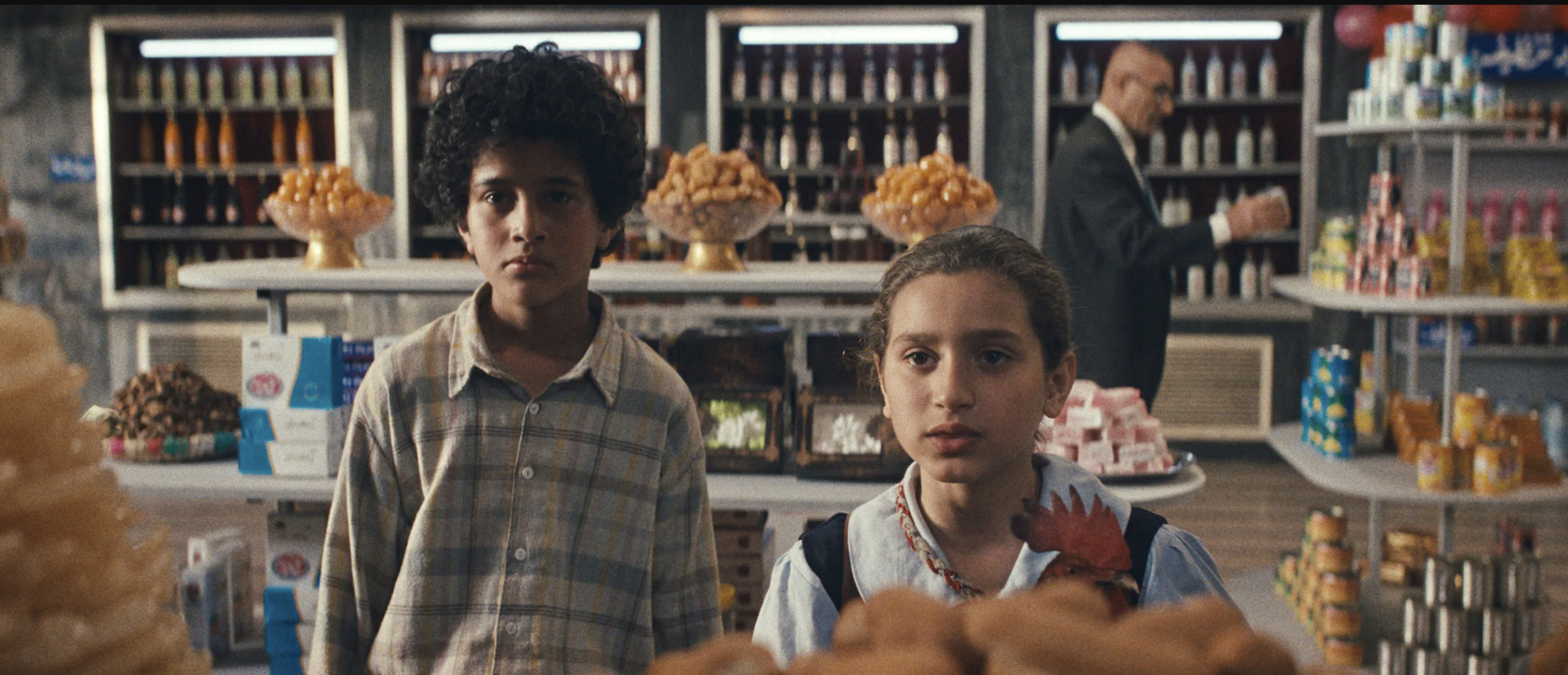
The cinematic tradition of works that cast children as spearheads to expose society spans everything from Italian neorealism to Iranian cinema, but Hadi sticks to the uniqueness of the Iraqi context when it comes to plot, accents, music, wardrobe, and ambiance. Lamia travels with grandma Bibi from the marshes, accompanied by their pet rooster Hindi, to a nearby city to buy the cake’s ingredients. There she gets separated from her grandmother and encounters her school friend Saeed (Sajad Mohamad Qasem), who knows the streets by heart and has the skills to survive in an overcrowded market, starting a journey of drama, humor, and absurdity.
Lamia’s friendship with Saeed carries the emotional weight of the film. The two non-professional actors are the pillars on which the film rests. Hadi’s direction demonstrates a gift for casting and directing children that recalls Fernando Meirelles and Kátia Lund and their inclusion of hundreds of children and teenagers from the favelas of Rio de Janeiro in the masterpiece City of God (2002). Both characters approach danger differently. She is grounded and calm, but slowly acknowledges the absurdity of the situation, while he acts like it is just another day in the streets. For both, the political context is not so apparent. Maybe that is why they can endure the journey to find the ingredients, while also doing everyday children activities like playing and arguing. Cinematographer Tudor Vladimir Panduru captures these moments in alleys, crowded markets, and police checkpoints, allowing the scarcity of goods to appear visually rather than through dialogue. Hadi is careful to show how scarcity and deprivation produce not only greed and control over others’ bodies, but can also create solidarity, generosity, and resistance.
The work of editor Andu Radu really cements the film’s main thesis. The celebration in which the children participate does not signify a school drama where kids are challenged with a difficult homework assignment. It becomes an embodiment of fear and absurdity in a police state ruled by an iron fist, where the line between a political extravaganza and private calamity is erased. Radu intercuts between the acted scenes of the celebration and documentary footage of Saddam Hussein’s birthday parties, putting the fictional fear face-to-face with the historical spectacle that produced misery for millions. This remains a reality. Behind the luxury and the familiar image that many leaders present on their social media accounts, lies suffering for millions.
The President’s Cake announces the arrival of a serious filmmaking talent who engages dynamically and authentically with local stories, without attempting to dilute his efforts for foreign critics or non-Arab audiences. Instead of turning Lamia into a spokesperson narrating a human rights report, she becomes an embodiment of intelligence, determination, and fear. Where compulsory adoration is expected from everyone, even children, she cannot defeat all the obstacles. But she quietly acknowledges the absurdity and perhaps laughs at it, a meaningful act of resistance for a nine-year-old.
Director, screenwriter: Hasan Hadi
Cast: Baneen Ahmed Nayyef, Sajad Mohamad Qasem, Waheed Thabet Khreibat, Rahim AlHaj
Producer: Leah Chen Baker
Cinematography: Tudor Vladimir Panduru RSC
Editor: Andu Radu
Production design: Anamaria Tecu
Sound: Tamás Zányi
Production company: TPC Film LLC
International sales: Films Boutique
Venue: Amman International Film Festival (Arab Feature Narrative Competition)
In Arabic
102 minutes