The Road to Jericho
The Road to Jericho
VERDICT: Noted filmmaker Amos Gitai adds another brick to his lifelong critique of Israeli government policies in ‘The Road to Jericho’, whose call for peace between Arabs and Jews has a striking timeliness as the Iran war rages on.
Throughout his long career as a documentarian and feature film director, Amos Gitai has engaged artistically and ceaselessly with the Middle East conflict in which his country is at the center. Trying every approach from a co-directed dialogue with Palestinian filmmaker Elia Suleiman War and Peace in Vesoul, 1997) to an on-camera interview with prime minister Yitzhak Rabin not long before he was assassinated in 1995, Gitai has shown an obstinate obsession with the topic that can only be admired. His 2015 documentary about Rabin, perhaps the most focused of his films, screened in Venice competition. Now he returns in the new Venice Open section with The Road to Jericho, whose loosely structured scenes urgently come together in a rejection of the experience of war in emotionally powerful bursts.
The France/UK/Israel production proves a good fit for the liberal Italian festival that has steadfastly refused to reject films on the basis of their country of origin. A big plus is the timing, which should get the film maximum audience attention in the midst of an escalating conflict that pits the U.S. and Israel against Iran, and whose outcome is still uncertain.
According to the UN, over 80% of all buildings in Gaza have been damaged or destroyed, and in the West Bank, where most of The Road to Jericho is set, Israeli settlers and army forces have renewed attacks on Palestinians and demolished their homes. The situation is so volatile it is impossible for any film to keep up with current developments, and Gitai wisely chooses instead to construct a work based on feelings and powered by great art: poetry and prose read by a host of intriguing “guest stars” who include Jeanne Moreau and Irène Jacob, and above all music.
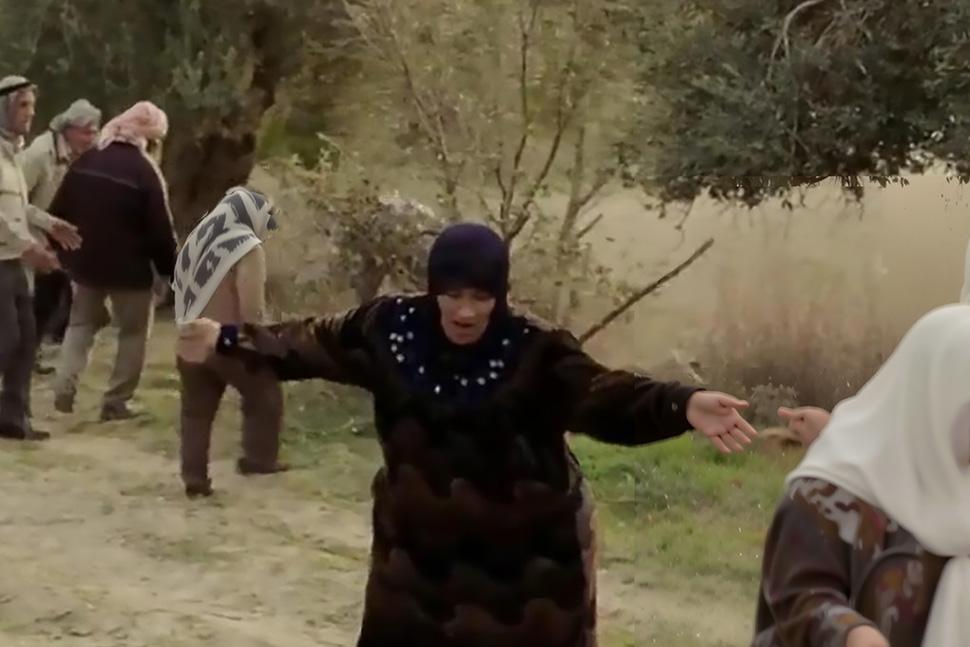
From the opening scene in which an unseen woman talks about the terror of lying awake listening to bombs drop during the night, any one of which could end her life, an operatic overture takes control of the audience’s emotions and heightens the anguish of the ongoing tragedy. The orchestral score casts a universal horror on the everyday stories recounted by Palestinians and Bedouins living in the harshly beautiful landscape of rolling desert around the shanty town of Khan El Ahmar, on the ancient way to Jericho. An elderly man recalls the carob and almond trees he climbed in his youth, while today we see extremist settlers run around with chainsaws cutting down olive trees. Children play happily with toy guns near the spot where a boy was hit and seriously injured by a settler’s tractor. Meanwhile, to put the timeline in perspective, the cult writer and director Samuel Fuller is filmed reading from Josephus Flavius’s 2,000-year-old book about the wars between the Romans and the Jews.
In his press notes, Gitai refers to himself as a “wanderer in these places” where “reality is a juxtaposition of past memory and present experience.” This is an apt description of the film’s sometimes rough and jagged collage of scenes, some shot years apart.
As in some other films, Gitai recycles a number of scenes from his own filmed archives. Not all of them feel well-chosen. The story of two young women who escape death at the hands of the Nazis and end up as immigrants to Palestine feels very tangential to the main storyline. The most relevant sequence is taken from his taped conversations with Rabin in 1994, in which the prime minister spoke of Gaza and Jericho and his will to give peace a chance, despite many doubts and disputes. A year later, newsreel footage shows the moment of his assassination by an Israeli extremist who disagreed with his ideas.
Music returns to center stage in the final scene, where Roman ruins from distant wars are observed and the soundtrack blasts out a cacophony of frightening notes, followed by the moving poem “Think of Others” by Palestinian writer Mahmoud Darwish, which ends with the plea, “If only I were a candle in the dark.”
Director: Amos Gitai
Screenplay: Amos Gitai, Marie-José Sanselme
Cast: Irène Jacob, Jeanne Moreau, Arthur Miller, Samuel Fuller, Muhammad Abu Jihad, Mohamad Said Alarj, Sara Arneberg, Bahira Ablassi, Sarah Adler, Agnes Garval Lavi
Producers: Amos Gitai, Laurent Truchot, Itaï Tamir, Alexander Rodnyansky, Ruth & Stephen Hendel, Mary & Luc Hardy, Vladimir Zemtsov, Laurent Truchot, Shuki Friedman
Cinematography: Dan Bronfield
Editing: Yuval Orr
Music: Alexey Kochetkov
Sound: Ronen Nagel
Production companies: Agav Films (France), Laila Films(UK), AR Content (USA), Gold Rush Pictures (Germany), Intereurop
Venue: Venice Film Festival (Venice Open – Out of competition – Non-fictiion)
In English, Hebrew, Arabic, French
76 minutes