Yellow Cake
Yellow Cake
VERDICT: Tiago Melo brings satirical bite to genre thrills in 'Yellow Cake', his delirious sci-fi mix of geopolitics and apocalyptic fears in Brazil’s Northeast.
Tiago Melo’s darkly satirical and punchy sci-fi sophomore feature Yellow Cake is a delirious mix of end-times fears, with Brazil’s political present offering up a ready abundance of potent ingredients. It had its world premiere in the Tiger Competition at the Rotterdam International Film Festival, in a strong return for the director after his 2018 Bright Future award win there for feature-length debut Azougue Nazaré. Melo again brings a flair for phantasmagorical twists and a taste for the strange mysteries that can take hold amid the hard reality of Brazil’s Northeast.
Brazil’s history of secret nuclear collaboration between a militarised regime and neocolonial western powers, the environmental contamination and tsunami of health problems that have come from uranium mining, and the rise of bug-borne disease epidemics, combine in a plot that is as in step with the stuff of the global population’s daily nightmares as it is off the wall, as state-led scientists contend with the deserved mistrust of citizens, seers and saboteurs in the town of Picui.
Rubia (Rejane Faria) is a nuclear physicist who spends long hours away from the woman she loves working on Yellow Cake, a foreign project that the Brazilian government is collaborating on in secret to use the power of radiation from uranium to sterilise mosquitoes. There’s been a dengue fever death spike, and Rubia wants to believe her work will help. But that’s hard to do when liaising between a shadowy regime and Bill Raymond (Spencer Callahan), the pushy, khaki-clad leader dropped in to helm the experiments. He wastes no time making his disdain for safety protocols known, in his hunger for fast results. What’s more, the potential of enriched uranium for bombs radically increases the stakes. Among local skeptics is Dona Rita (a show-stealing Tania Maria, who shot to fame in Kleber Mendonca Filho’s Oscar-nommed The Secret Agent). This elderly descendant of the region’s first prospector is tough as nails, an avid smoker who says if cigarettes were harmful, they would have killed her long ago.
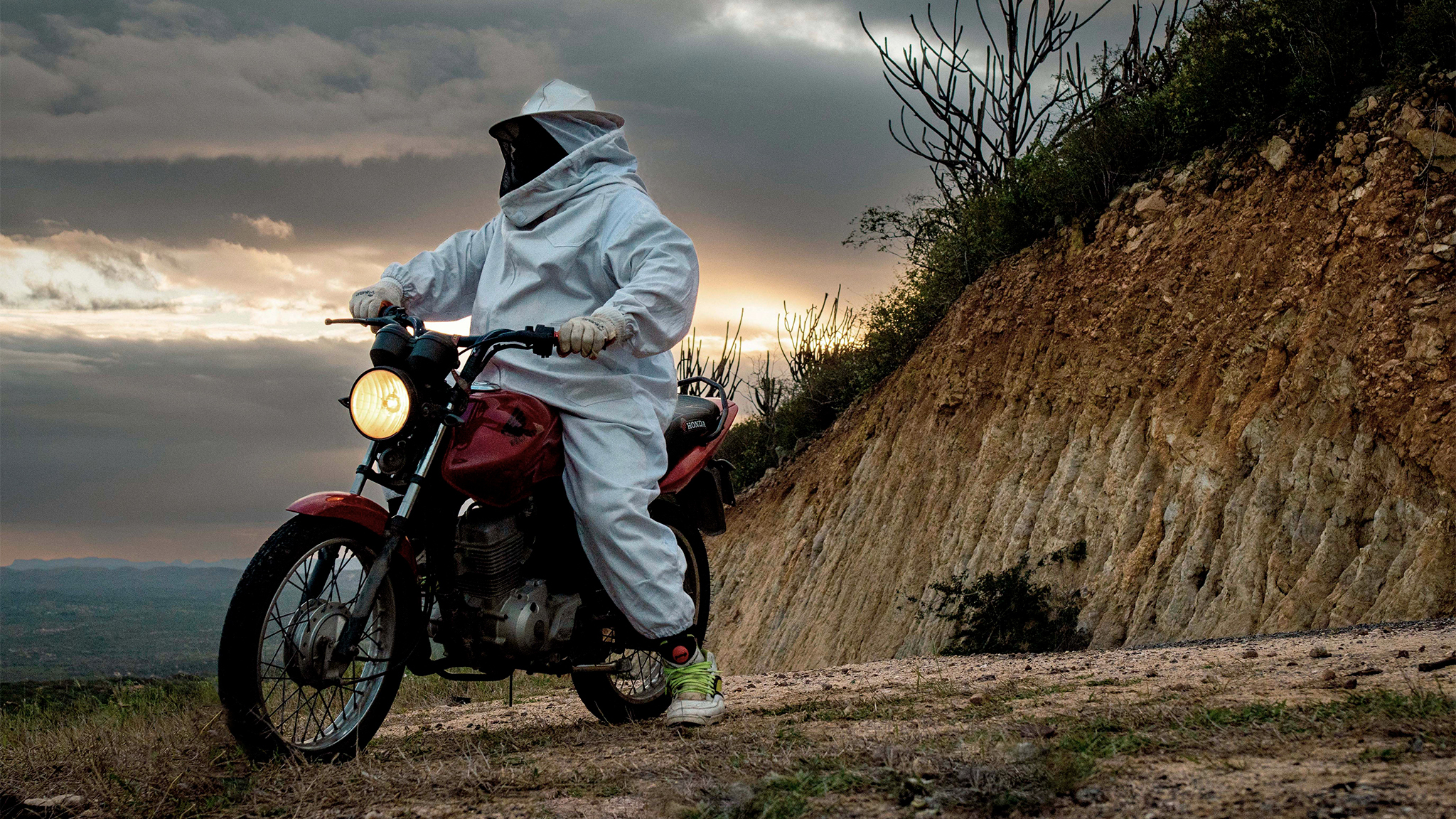
The arid land might look dead in Picui, but beyond the naked eye, nature is full of deadly power, in both the insects that carry disease, and the coveted but toxic minerals buried deep. Makeshift tents are set up in the arid landscape, in what to the “gringo” overseers seems like the middle of nowhere. But locals are on the lookout. The beaten-down workforce have had more than enough experience with the ravages of geopolitical exploitation and a mining industry that has never cared if they are poisoned in their own homes so long as a profit is turned, and the supposed wisdom of scientists who’ve brought nothing but pain is a subject of derision at the pub. Rubia must reexamine her loyalties when the project spins drastically off course, and the warning signs of an apocalyptic calamity accelerate to the more grotesque and visually lurid.
Insistent through the human drama is the buzzing of mosquito swarms, an ominous reminder of a fatal threat, and that nature’s cycles of renewal do not prioritise the human. A 1980 Catia de Franca song about the cycle of life, death and viruses closes out a satire-savvy soundtrack of Brazilian pop. Biohazard suits and labs lit in neon pinks and blues add an unfussy but effective otherworldly, sci-fi sheen to the north’s dry and dusty dirt expanses, cacti and cavernous mining shafts. DOPs Gustavo Pessoa and Ivo Lopes Araujo occasionally hone in toward insect-scale, or evoke other planes of fevered consciousness, in vivid experimental sequences that remind us that many cataclysmic shifts in nature are beyond our gaze, and that intuition, spirituality and dreams are a more ancient kind of knowledge not easily displaced by modern scientific ambition.
Director: Tiago Melo
Screenwriters: Amanda Guimaraes, Anna Carolina Francisco, Jeronimo Lemos, Gabriel Domingues, Tiago Melo
Producers: Carol Ferreira, Leonardo Sette, Luiz Barbosa, Tiago Melo
Cinematographers: Gustavo Pessoa, Ivo Lopes Araújo
Editor: Andre Sampaio
Cast: Rejane Faria, Valmir do Coco, Spencer Callahan, Tania Maria
Production design: Ananias de Caldas, Avelino los Reis
Sound Design: Miriam Biderman, Ricardo Reis
Music: O Grivo
Production companies: Uranio Filmes (Brazil), Lucinda Producoes (Brazil), Jaragua Producoes (Brazil)
Sales: Uranio Filmes
Venue: Rotterdam (Tiger Competition)
In Portuguese, English
97 minutes