
The Calf Doll
Khaal-Baccha
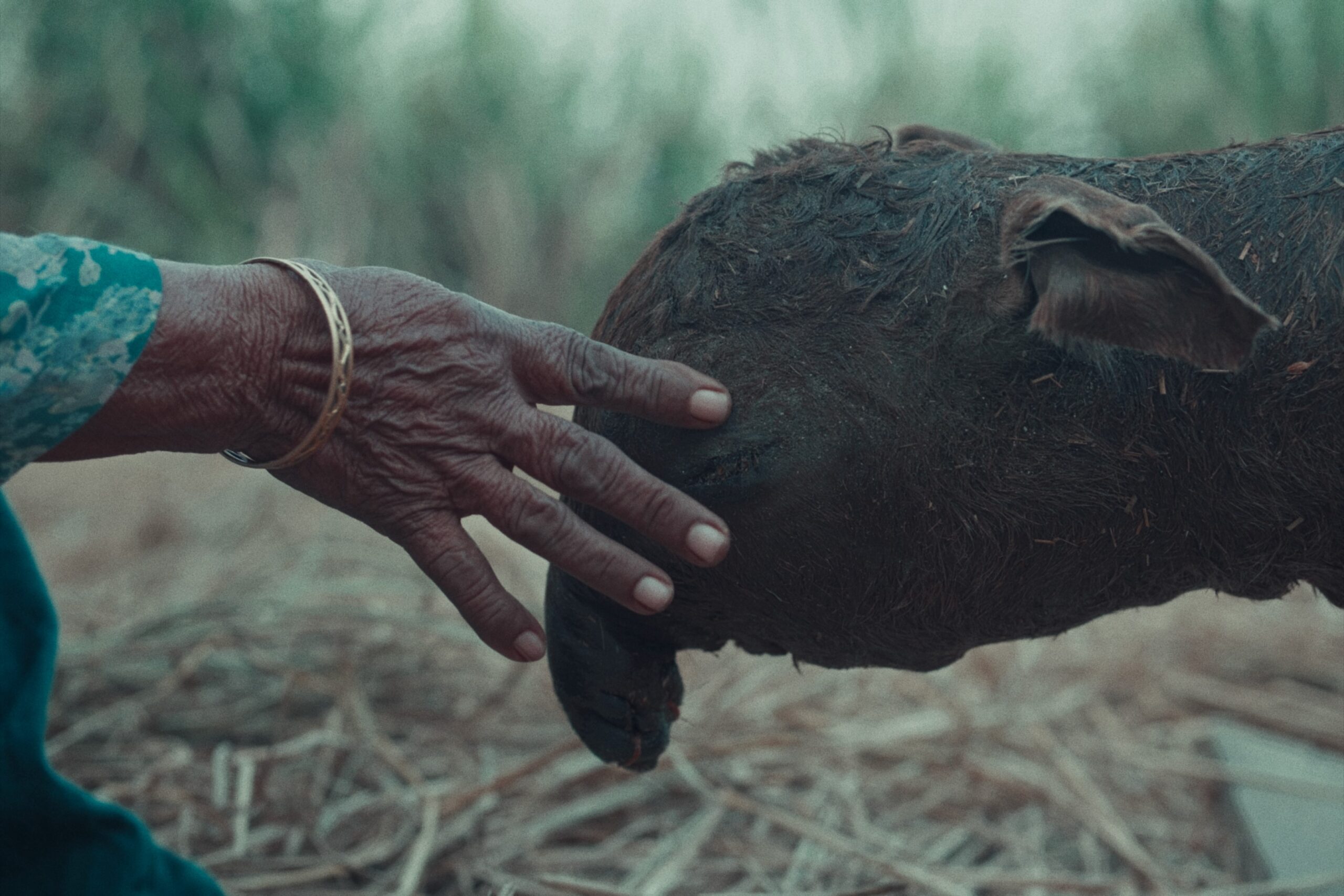
VERDICT: Revolving around an old teacher-turned-farmer’s doomed attempts to make his cow give milk, Ankur Hooda’s 'The Calf Doll' is a canny combination of aesthetics, atmosphere and subtle social analysis.
For his first feature, the 25-year-old Indian filmmaker Ankur Hooda wrote a screenplay based on tales of his own family, cast his close relatives to play versions of themselves, and recruited his best friend to lens the film. Belying the modesty of Hooda’s resources and his lack of film-school education and work experience, The Calf Doll is steeped in mesmerising images of his ancestral lands. It thrives in its sincere engagement with the lives of his characters, and seethes with subtle yet strong messaging about the impact of sweeping economic changes on India’s rural poor.
With The Calf Doll, which will bow in international competition at the JEONJU International Film Festival after its premiere at CPH:DOX in Denmark, Hooda offers the audience a panoramic view of the peasantry’s tribulations while steering clear of subjecting them (and the privileged viewer on the festival circuit) to simplistic emotional triggers. Combining a penchant to experiment with everything in his technical toolbox and a disciplined approach in configuring realistic scenarios for layered characters, he is the latest in a growing line of young Indian filmmakers (including Nidhi Saxena and Aranya Sahay) who shun straightforward social realism as they tackle tales about the provincial Indian underclass.
Set in the small northern Indian village of Dayalpur, The Calf Doll revolves around the aged Satbir (Satbir Singh Hooda), a retired schoolteacher now earning a meagre living with his wife on a small farmstead. They struggle in an increasingly depopulated and inhospitable region, a topography Hooda and his DP Anish Sarai convey vividly through static, widescreen shots of fogged-up, magenta-hued fields. The farmer is dealt a further blow when his only cow stops lactating after the stillbirth of her calf. Despite his educational credentials – his fellow villagers call him “Professor” – Satbir is at a loss about what to do. Finally he resorts to a ritual passed down in the family for generations: he creates a doll out of the calf’s cadaver, so as to try and soothe the cow’s feelings (and thus her udders). We only get a close look at the doll in the final third of the film, but even from afar it doesn’t look right: it’s mangled and grotesque, it stinks (the film’s only comic relief – if one can call it that – is the many different ways in which Satbir’s wife complains about the odor), and it leads to the farm becoming a meeting point for wild dogs.
Then again, it’s obvious how the doll – and the stillbirth, and the cow’s ability to give milk – is merely an allegory for something higher up in the capitalistic food chain. It is perhaps telling that Satbir’s struggle with the news of the stillbirth is preceded by another shock: his farmhand Dabbu – a young man more or less considered by the old couple as their own child – is shown trudging through the early morning mist to announce his imminent departure for the factories of Faridabad, a metropolitan area near Delhi branded by the authorities as a “smart city” and criticised by environmentalists for its pollution. While the doll is supposed to stand in for the dead calf to placate the cow, it is very much the object on which Satbir projects his own yearning for the young ones who left – as shown in the way he breaks down and hollers about how the rabid canines have “ruined my child” when they devour the doll. At various points of the film, Hooda injects interaction between Satbir and his acquaintances – the concerned vet treating his cow, a sneaky middle-man egging the old man to sell his only anima, and so on – which illustrate the exploitation and oppression the impoverished farmers have to live with.
But The Calf Doll is at its most enchanting when it zeroes in on Satbir’s solitude and the quiet psychosis that entails. Perhaps unsurprisingly for a media-savvy first-time filmmaker, Hooda utilises nearly every visual device to illustrate Satbir’s existence: stationary shots of his sitting alone, abstract dissolves between his states of mind, 360-degree pans of him in his gloomy pastures, monochrome dreams shown in time-lapse imagery – not to mention a long tracking shot, backed by a snippet of Madhav Agarwal’s eerie score, of the stern old man travelling along a dirt road aboard his long-gone daughter’s impossibly gaudy pink scooter. The humour here is hardly out of place: for all its gimmickry and experimentation, The Calf Doll is a humane film.
Director, screenwriter, editing: Ankur Hooda
Producers: Ankur Hooda, Ayushi Gupta, Anish Sarai Cast: Satbir Singh Hooda, Chameli Devi, Dheeraj Kumar, Mukesh Bhati
Cinematography: Anish Sarai
Production design: Achal Mishra
Music: Madhav Agarwal, Vishesh Kalimero
Sound: Bigyna Dahal
Production company: Qissa Ghar Films
World sales: Qissa Ghar Films
Venue: JEONJU International Film Festival (International Competition)
In Haryanvi
Running time: 90 minutes