
Dua
Dua
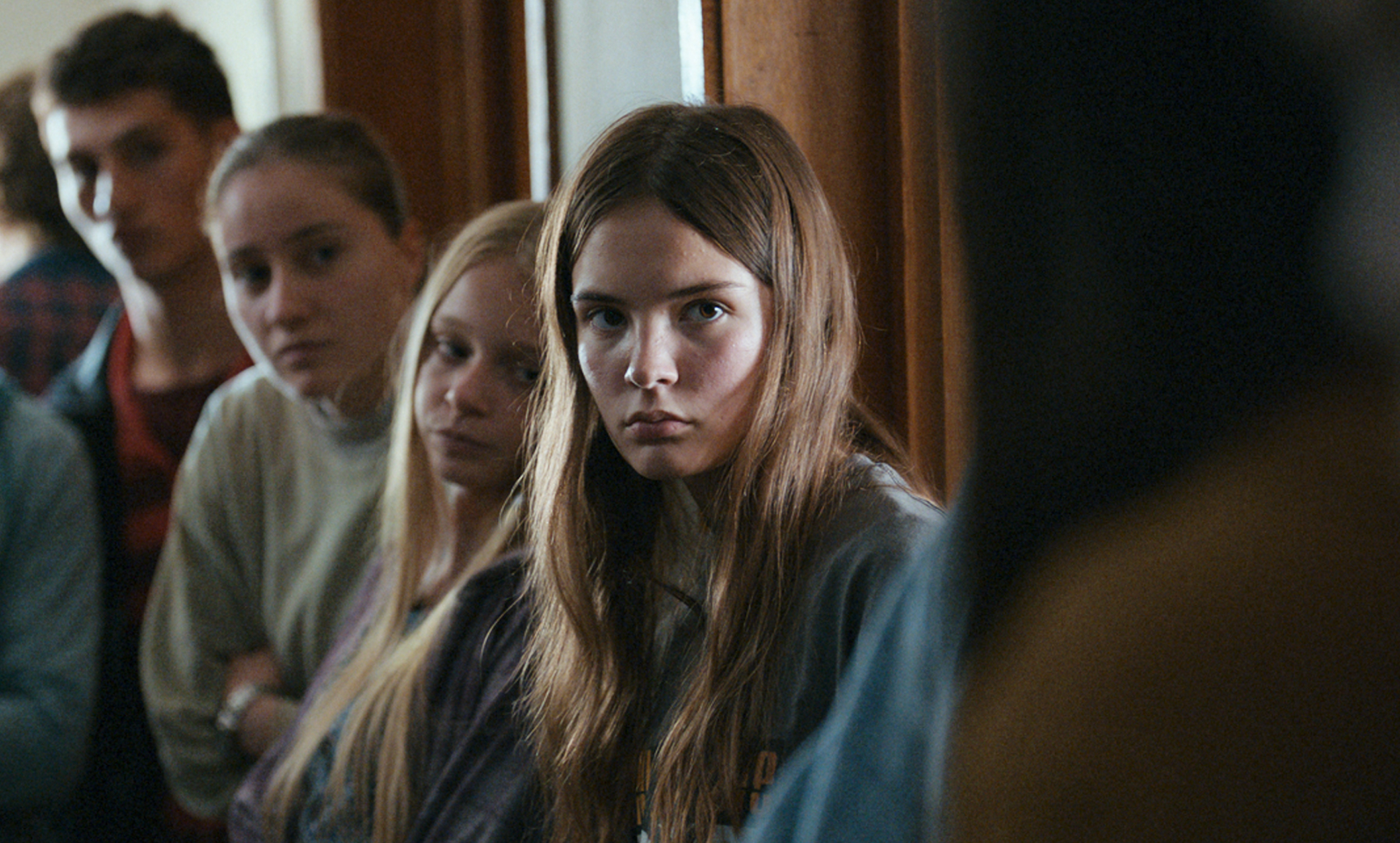
VERDICT: Kosovar director Blerta Basholli’s assured second feature is a taut, ‘90s-set coming-of-ager in which a teen's journey to agency over her body means reckoning with political violence.
An air of danger and hushed vigilance has consumed Prishtina like a noxious cloud in Blerta Basholli’s Dua, eclipsing the excitement its thirteen-year-old namesake and her friends had felt over school dances and first kisses. It’s the ‘90s, and ethnic hatred has exploded in the Balkans. While many Kosovar men are away in the mountains at the front, Serbian paramilitary police are terrorising the city, beating up drivers at checkpoints, and harassing women in the streets.
Basholli’s psychologically astute and assured sophomore feature, which screens in the Narrative Feature Competition at Sarajevo after premiering in Cannes Critics’s Week, comes after her breakout Sundance hit Hive (2021), about a woman who starts a honey and ajvar business after her husband disappears in the Kosovo War (Hive lead Yllka Gashi puts in another strong turn here as Dua’s mother.) Dua cements Basholli’s place as a key figure in Kosovo’s recent, largely woman-helmed wave of acclaimed dramas that process the scars of war, and the battle of citizens to reclaim dignity and agency over memory.
Basholli captures, with sustained, visceral tension, the debilitating stress for citizens of co-existing side by side with those who have dehumanised and persecuted them. It’s a challenge that goes on across the region since the wars that raged as Yugoslavia broke apart, and one that will especially resonate with all nations navigating traumatic histories of division.
“It’s better to develop later,” Dua (Pinea Matoshi) is told by her mother, when the teen expresses impatience for the changes that come with puberty. It is an offhand comment that hits hard, in a city where the sister of a classmate has been violated and left for dead in the street, another suspected victim of the sectarian violence that has the inhabitants of Prishtina in its grip.
An alarming incident of harassment from an older man in the neighbourhood and Dua’s retaliatory smashing of a car window are the catalysts in this taut and political coming-of-ager. It’s an inter-personal conflict we understand to be part of something larger and too boundlessly horrifying to freely discuss in her close-knit family as they try to survive and hold on to shreds of their usual everyday lives. But the illusion of normality is already shattered. As the fighting hots up, the question of whether exile is the only reasonable answer becomes more pressing.
We stay close in with Dua (convincingly portrayed by a subtle yet intense Matoshi), her impulses frozen into sullenness as she, like the rest of her family, tries to keep a lid on emotions too overwhelming to even properly name. This restrained watchfulness soon becomes second nature in a city in which routes to school or work are compared for which is the least frequented by groups of bullies, and no public space feels safe. Dua’s father has welded an iron grid to their apartment’s door for added security, and in the trying, volatile economy, has started to sell more of these.
Dua joins a defiant friend, who insists on walking wherever she likes in the city, in judo class, the adolescent rite of passage toward comfort in one’s own body extending, here, in this climate of intimidation and threat, to learning to have a sense of ownership over a body that has become weaponised as a site of warfare.
A soundtrack of ‘90s hits sets us square in the era, with several scenes of living-room dancefloor abandon, most notably to Skunk Anansie’s Brazen, providing moments of release and rebellious attitude amid the oppressive fear and insecurity. News bulletins on the family’s television set are a simple, effective device to convey the geopolitical context of the Serbian offensive, and the cautious diplomacy of a United States that the family doubt can be relied upon for any help, just as Bosnia was abandoned by the international community in its time of need. Fed up with the global inaction, Dua’s older brother Vegim (Andi Bajgora), though inexperienced as a soldier, is itching to join the Kosovo Liberation Army, to his parents’ dismay.
As Dua’s dilemma of scrabbling together enough Deutschmarks to repay the car window damage so that the Serbian police do not get involved kicks into urgent high gear, protests are met with tear gas, schools close and air strikes pummel the land — a perfect storm of pressures that push the family toward one of war’s most heartrending questions: to stay, or to go?
Director: Blerta Basholli
Writers: Blerta Basholli, Nicole Borgeat
Producers: Valon Bajgora, Yll Uka, Britta Rindelaub, Thomas Reichlin
Cast: Pinea Matoshi, Vlera Bilalli, Kaona Matoshi; Yllka Gashi, Kushtrim Hoxha, Andi Bajgora
Cinematographer: Lucie Baudinaud
Editor: Enis Saraci
Music: Audrey Ismael
Production companies: Ikone Studio (Kosovo), Alva Film (Switzerland), Kazak Productions (France)
Sales: The Party Film Sales
Venue: Sarajevo (Narrative Feature Competition)
In Albanian, Serbian
101 minutes