
Asghar Farhadi in Sarajevo: “Success is very dangerous, it creates a distance”
.
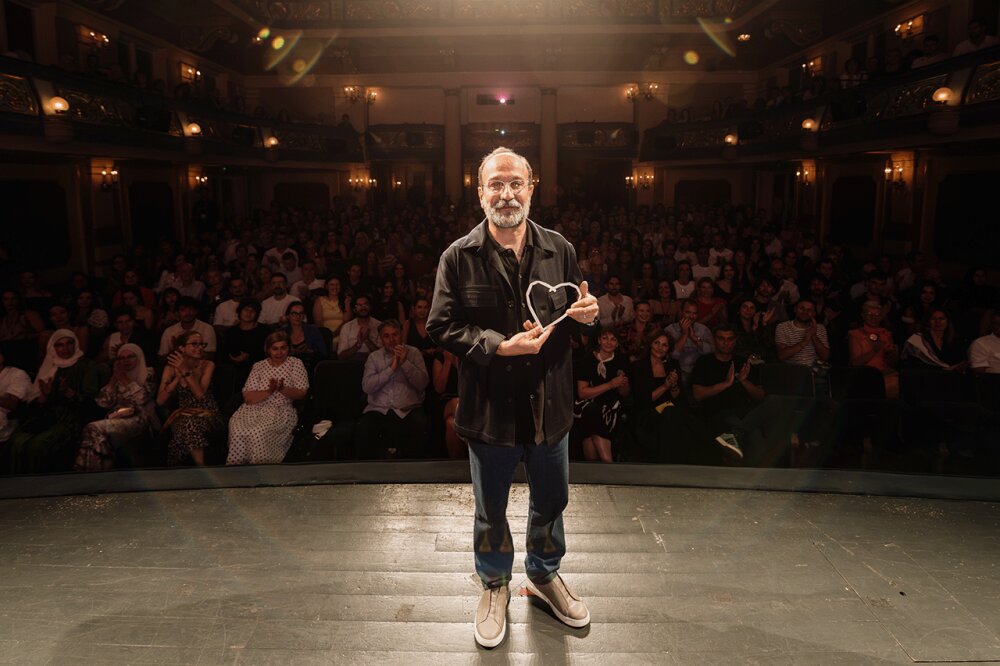
VERDICT: Iranian director Asghar Farhadi spoke about keeping the gift of everyday observation alive, and resisting media’s manipulation of reality, in a masterclass at the Sarajevo Film Festival.
Prominent Iranian director and screenwriter Asghar Farhadi gave a masterclass at the Sarajevo Film Festival, where he is visiting as a guest to collect the Honorary Heart of Sarajevo award for his contribution to the film industry. The globally acclaimed filmmaker, known for tense dramas that explore family conflicts and thorny ethical and societal dilemmas, is also being celebrated this year in Sarajevo with a tribute retrospective of seven selected films from his career, including his latest film Parallel Tales, a French-language production shot in Paris, and his two dramas that netted Academy Awards for Best International Feature Film, A Separation (2011) and The Salesman (2016).
In a conversation with moderator Neil Young that spanned over one and a half hours, the director covered many topics, from the unique challenges of directing children (“every time I work with them, I say it’ll be the last time,” until realising they are the ultimate observers, “watching everything,”), the specificity of curse words in building characters (“I always think about how they will swear,”) and the underrated value of editors (“When they give a prize to an actor, I think they should actually give that prize to his or her editor.”)
Farhadi stressed the importance of staying alert to the details of everyday life as a writer and director, and closely observing reality. “To be a creative person, you need to have eyes and ears like a kid. Even if you’re making a film that’s not realistic, you need life as a source,” he said. He described helping his family in their grocery store in the Isfahan province of Iran as a child, and how it gave him the opportunity to interact with many people, and notice their behaviours, a solid education in life accrued long before he went to theatre school and fell in love with the playwrights Henrik Ibsen, Anton Chekhov, and August Strindberg.
“We have an emotional bank inside us. But you need to find the password,” he said. As adults, all of our actions and attitudes have roots in our childhood experiences, he believes. Direct engagement with people and reality around us is valued less by today’s directors, he contends, as a means to make works that really resonate. “Our source has changed from real life to cinema itself, and it’s a problem.”
Farhadi is among a small, select group of directors, which also includes Ingmar Bergman and Federico Fellini, to have won the Oscar in the category of Best International Feature Film more than once. But he is very wary of letting it go to his head, and suspicious of the seductive nature of public accolades, which can cause a director to lose touch with the people whose stories they purport to tell. “Success is very dangerous, it creates a distance between you and people,” he said.
It can also hamper a director by limiting their freedom to make mistakes. “We need to be able to take a risk, where we don’t know what the result will be,” he said, adding: “Some filmmakers love filmmaking, but some love to be a filmmaker. It’s two different things.”
It is also essential not to lose faith in the shared humanity of local stories, he said. When he made A Separation, his best-known drama, about a marriage breaking apart a middle-class couple in Tehran, and its reverberations through their extended family, in 2011 it became the first Iranian film to win the Oscar for what was then Best Foreign Language Film. The story was so local he assumed it would not work internationally. But he learned that “if you’re an honest filmmaker, more local is more universal,” he said. “We forget it these days, because the media and some politicians highlight our differences, but hate and love are basic emotions that are the same everywhere. If you make a local film based on humanity, everyone will understand.”