
Trick
Scherzetto
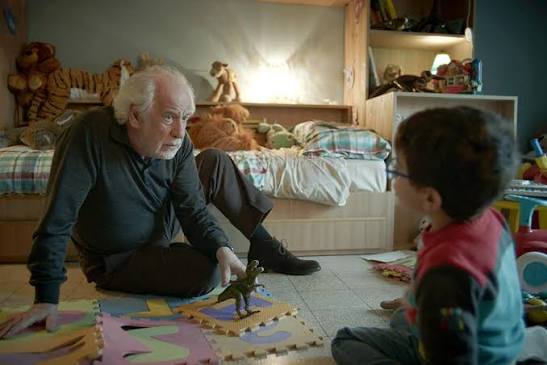
VERDICT: Little Mario and his grouchy granddad (Toni Servillo) spend a ghostly weekend home alone together, one that turns into an existential battle of wills in Mario Martone’s slyly amusing adaptation of Domenico Starnone’s novel 'Trick' (‘Scherzetto’).
Part domestic comedy with a Home Alone vibe, part ghost story headed for a dramatic climax, Trick (in Italian, Scherzetto) lives in a world of its own, a happy outlier on the Italian film scene where so many presumed comedies feel like reruns of their predecessors. An excellent if somewhat theatrical cast is led by Toni Servillo as an aging, self-absorbed grandfather whose failing health and slackening work load make it hard for him to keep up an outer veneer of dignity and self-importance. Though the pace could have been tighter, director Mario Martone (Nostalgia; The King of Laughter) packs a lot of thoughtful reflections into an intelligent script worthy of adult audiences but not too cerebral for younger viewers.
Much of the enjoyment comes from the character of the mischievous, know-it-all little boy Mario, played with controlled appeal by Lorenzo Perrotta. He is a real co-protagonist, the catalyst for a bizarre dual that forces grandpa Daniele to confront his senior egotism, his deepest fears and, naturally, the ghosts of his past. The film is based on a novel by acclaimed novelist and screenwriter Domenico Starnone, and its Neapolitan setting adds a cultural layer that enriches the tale of a famous illustrator who gets roped into looking after his 5-year-old grandson while the boy’s parents are away.
The opening tracking shot, which goes on long after the opening credits, emphasizes the importance of the location: a past-its-prime housing complex, an architectural monstrosity occupying a city block and looming gloomily over a nest of railroad tracks in a run-down part of Naples. The only breaks in the building’s concrete façade are small, open balconies hanging off the walls against the laws of gravity. One of the latter will play a central role in the drama.
When grandpa arrives for a three-day stay, it is as a favor to his daughter (Serena Rossi) rather than the prospect of spending quality time with his grandson, whom he hardly knows. The smart little boy behind comically round glasses is friendly and affectionate, but the 75-year-old Daniele rebuffs his overtures and constant pleas to play. An illustrator, he has brought his sketches for a book he’s working on – it’s Henry James’s The Jolly Corner, a supernatural tale about a man who returns to New York after a long stay in Europe and meets the man he could have become in America. This parallels Daniele’s own life: he finds himself in his childhood home in Naples, after a lifetime of living in Milan. Now that his wife is dead and his daughter physically distant, and his artistic reputation fading, he ruminates over his future and it isn’t pretty. He even has trouble relating to the personable housekeeper (Patricia Pimienta), perhaps because she calls him Gramps. And he simply has no mental space for the demanding Mario.
Meanwhile, the old apartment becomes populated with silent ghosts: his father as a young man (Gianluca Di Gennaro), his brothers. They seem to stimulate more distaste than fear or yearning in Daniele, and Servillo remains crotchety and aloof as he observes these figures, carefully keeping his distance from them.
He is displeased to discover that young Mario has no discernible artistic talent, but takes after his father’s side of the family. They go for a long walk around the grubby and sometimes violent neighborhood, during which grandpa is overcome with nostalgia for his childhood, while he is deaf to Mario’s protests that his feet hurt. But the tide is about to turn on their unequal relationship. As even a six-year-old will be aware, thanks to heavy foreshadowing, Daniele is afraid of the little exposed balcony outside Mario’s room, wind-swept and rising high above the railroad tracks and overpasses where no one can hear you scream. And it has a defective door that locks automatically from the outside…
Over the course of his long career in film and on stage, Martone has become a refined director, which shows not only in his flawless direction of the excellent cast, but in his expert balancing of serious themes and funny moments, harrowing incidents and the warmth of a recomposed family. Two unexpected visits from the neighbors provide hilarious cameos, the first played by Maria Lanza as a furious young mother who doesn’t want her son associating with the better-off Mario. It’s an obscure question of toys and she pours her rage on Servillo non-stop in a thick Neapolitan accent. The second bit is a visit from her husband (Giovanni Ludeno), a passive-aggressive type who won’t meet grandpa’s eyes as he bitterly returns one of Mario’s toys.
Director: Mario Martone
Screenplay: Mario Martone, Ippolita di Majo
Cast: Toni Servillo, Serena Rossi, Lorenzo Perrotta, Leonardo Lidi, Patricia Pimienta, Diego Pleuteri, Luciana Zazzera, Maria Lanza
Producers: Maria Carolina Terzi, Carlo Stella, Lorenza Stella, Luciano Stella, Mauro Luchetti, Francesco Grisi, Giorgia Priolo, Roberto Sessa, Gianluca Di Gennaro, Giovanni Ludeno
Cinematography: Paolo Carnera
Editing: Jacopo Quadri
Production design: Carmine Guarino
Costume design: Daniela Ciancio
Music: Valerio Vigliar
Direct sound: Emanuele Cecere, Francesco Sabez
Sound editing: Silvia Moraes
Production companies: Mad Entertainment in association with RAI Cinema, WSI Wddwrri Digitali Italiani, Picomedia
World Sales: RAI Cinema International Distribution
Venue: Venice Film Festival (Venice Open – Out of Competition – Fiction)
In Italian
105 minutes