
Look Back
.
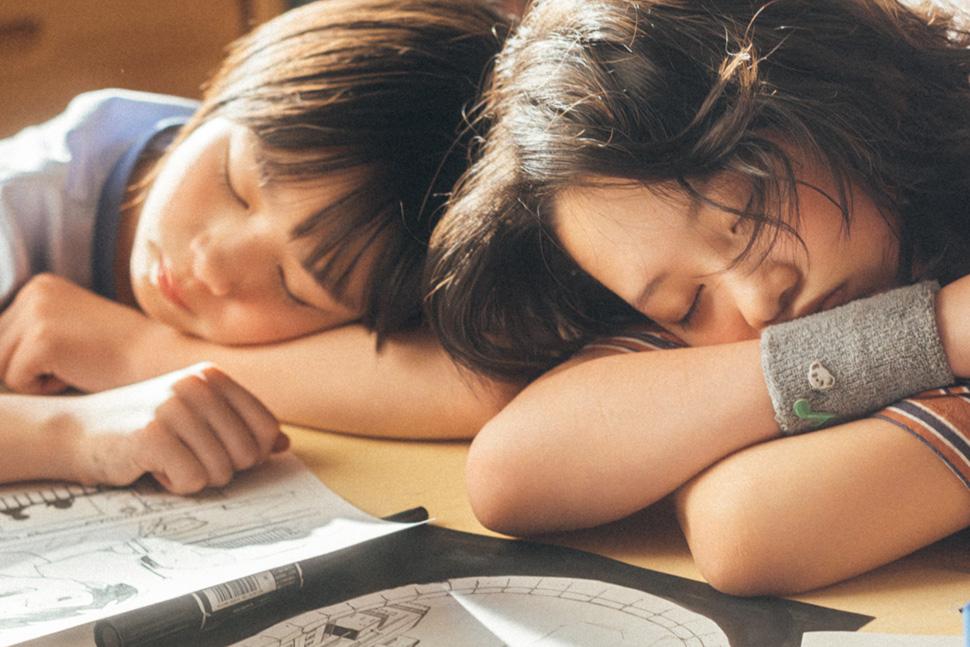
VERDICT: Hirokazu Kore-eda returns to storytelling from a child’s POV in the visually dazzling and narratively charming ‘Look Back’, where two talented schoolgirls break into the magical world of manga comics.
Following on the heels of Hirokazu Kore-eda’s disturbing SF android tale Sheep in the Box which bowed in Cannes this year, Look Back arrives in Venice competition on the more familiar and, to many, welcome register of childhood fantasy and adventure. Though not without tragedy, the story of how two 4th grade girls became best friends and famous drawing mangas together is basically upbeat and satisfying as a success story. But its real charm lies in the way Kore-eda keeps Fujino (who draws the characters) and Kyomoto (who draws the backgrounds) walking the line between their everyday lives and the unlimited world of their imaginations. Apart from a few harmless adults who wander in, the stage belongs to them. It is the kind of film that appeals to virtually all ages and will certainly bring a smile to Kore-eda fans.
This live action movie is actually the second feature film made from Tatsuki Fujimoto’s phenomenally popular one-shot web manga of the same name, published in 2021 by Shueisha. The first adaptation was an all-anime film produced by Studio Durian and released in June 2024. Kore-eda’s choice to use real actors and live action draws the story out a bit more, leaving multiple endings that are somewhat anti-climatic. But it pays off in showcasing four delightful actresses in the two lead roles, growing up from childhood to young adulthood, as they discover their talents drawing manga.
The story is set in the Tohoku region of Japan, an idyllic land of rolling hills and snow-capped mountain ranges. Nature wears the sky blue and spring green colors of a Ghibli Studio background, and in fact the legendary animation studio gets a nod several times in passing.
As the four seasons cycle around from bright leafy trees to deep winter snow, the friendship between the two girls unfolds. Fujino, lively and extroverted, at first feels an angry rivalry with the reclusive Kyomoto, who never leaves her house because interacting with people makes her anxious. But Kyomoto’s admiration for Fujino’s artwork in the school newspaper breaks the ice and gets them started working together.
Up to this point the characters and storyline seem exotic enough, but aimed at children of the heroines’ age. Only gradually does the adult theme of the cost of becoming an artist, a creator, begin to surface, taking the film to a new level. The girls’ initial success in getting published opens up all kinds of economic and artistic possibilities, but there is a rupture coming that sets them on different paths, and one of them will be exposed to tragic violence.
But the story is not over; it is just shifting timelines. Fujino returns in her imagination to an earlier time in her life: what if she had become an athlete instead of an artist? Perhaps she could have changed the future… Kyomoto’s voice haunts her: Then why do you draw?
The technical work is prodigious throughout, mixing D.P. Senzo Ueno’s intense palette of colors with a detailed spectrum of sounds like a pencil moving across paper, and finding creative solutions to blending live action and flat 2D drawings. A shout-out to Shinsuke Kojima’s amusing production design featuring a teenager’s bedroom with the maximum amount of superfluous objects on display.
Director, screenplay, editor: Hirokazu Kore-eda
Screenplay Hirokazu Kore-eda based on a manga by Tatsuki Fujimoto
Cast: Natsuki Deguchi, Aju Makita, Furi Nanase, Rokka Okada, Masaki Suda, Kankuro Kudo, Kayo Noro
Producer: Daiju Koide
Cinematography: Senzo Ueno
Production design: Shinsuke Kojima
Costume design: Sacico Ito
Music: Yuta Bandoh
Sound: Kazuhiko Tomita
Visual effects: Linto Ueda
Production company: K2 Pictures
World Sales: Goodfellas
Venue: Venice Film Festival (Competition)
In Japanese
100 minutes