
Les Misérables
.
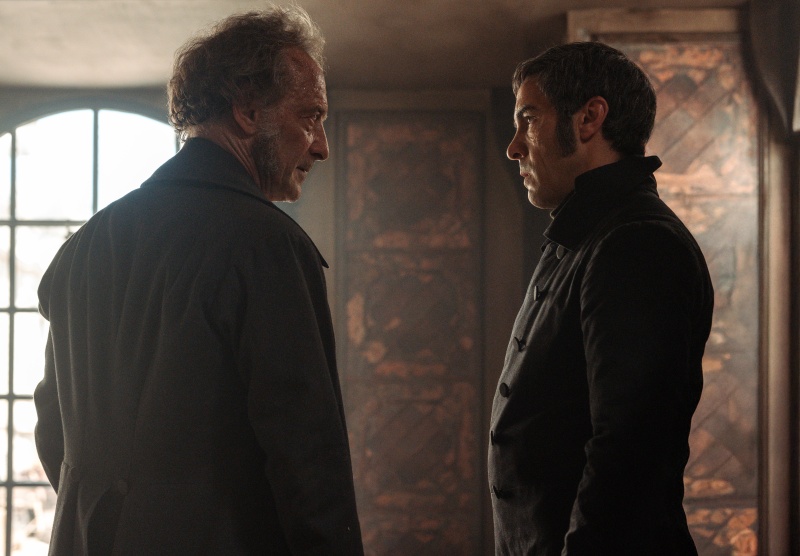
VERDICT: Victor Hugo’s classic novel gets an appropriately epic treatment in Fred Cavayé’s massively grand ‘Les Misérables’, starring Vincent Lindon and Tahar Rahim.
For the past few years, the French film industry has been reclaiming the country’s legacy of classic literary works, with Pathé dominating the box office thanks to Alexandre Dumas (a two-part Three Musketeers – with more to come – in 2023, The Count of Monte Cristo in 2024). StudioCanal is now getting its own share of the action with Les Misérables, which ditches the musical component and goes back to the more pure spirit – but not always the letter – of Victor Hugo’s novel. The brand alone should be enough to warrant wide circulation all over the world, and a starry cast won’t be a disadvantage either.
In fact, so sprawling is the film, the nominal lead actor doesn’t appear until almost an hour in: before we get to Vincent Lindon as Jean Valjean, we see the younger version in prison, with the older actor taking over once the former bagnard (jailbird) reinvents himself as the wealthy Monsieur Madeleine; that early section of Valjean’s life overlaps with the beginnings of the future Inspector Javert (here reimagined as a child criminal sent to an orphanage after being abandoned by his unscrupulous mother) and that of the mendacious Thénardiers (Benjamin Lavernhe and Camille Cottin), partners in crime as early as what will become the male half’s mythologized exploits at Waterloo.
In Fred Cavayé’s hands, Hugo’s work retains its ensemble nature, where a lot of adaptations tend to focus on Valjean, Javert (played in adult form by Tahar Rahim) and Cosette (Megan Northam). Sometimes it gets even narrower: in 2025, Eric Besnard directed Jean Valjean, which adapted only a handful of early chapters of the book (the meeting with the priest who gifts Valjean two silver candlesticks) over the course of 98 minutes – in Cavayé’s version, the corresponding section accounts for about ten minutes of screentime, out of the three hours devoted to the tale of those oppressed by poverty (a voiceover justifies the existence of yet another adaptation by saying, “As long as misery exists, stories like this will never be useless”).
Ironically, one element from the rather drab 2025 film carries over into this one: the composer Christophe Julien, whose score contributes a large chunk of gravitas, particularly when the June Rebellion beckons (interestingly, given this is not an adaptation of the stage musical, that section includes some very evocative choir work). Equally powerful is Denis Rouden’s cinematography, with bravura moments including a sequence that deviates from the book, when Valjean fakes his death and emerges zombie-like from a mass grave instead of swimming to safety.
With his penchant for pained intensity (which recently won him a Best Actor prize at Venice for The Quiet Son), Lindon was born to play Valjean, but as we said earlier, this is no one-man show: Rahim captures the subtleties of Javert’s inner contradictions with the smallest hints of a change in facial expression; Noémie Merlant is heartbreaking in her limited time as Fantine; and Lavernhe and Cottin walk a masterful tightrope between tragedy and buffoonery as the Thénardiers, whose plot strand is streamlined (like in most other adaptations, we don’t get to see all their children) but no less impactful. On the younger front, Northam and Vassili Schneider add sparks to the romance between Cosette and Marius.
Brazenly modern and old-fashioned at the same time in both scope and thematic relevance, the film is a veritable epic that strikes the right balance between fidelity to the source and cinematically dictated artistic license (amusingly, one darkly comic punchline that some might assume to be a contemporary addition is in fact accurate to the source). It may be a bit rushed in a couple of places (the third act gets increasingly impatient), and some Hugo purists might wince at one narrative choice in particular, but all in all this is another shining example of France showing Hollywood what it’s capable of with its own cultural history.
Director, Screenwriter: Fred Cavayé
Cast: Vincent Lindon, Tahar Rahim, Camille Cottin, Benjamin Lavernhe, Noémie Merlant, Vassili Schneider, Megan Northam, Marie Colomb, Louis Peres
Producers: Richard Grandpierre, Olivier Delbosc
Cinematography: Denis Rouden
Production design: Pierre Quefféléan
Costume design: Pierre-Jean Larroque
Music: Christophe Julien
Sound: Pierre Andre, Louis Bart, Nicolas Bouvet-Levrard, Marc Doisne
Production companies: Eskwad, Curiosa Films, StudioCanal, TF1 Films Production
World sales: StudioCanal
Venue: San Sebastián International Film Festival (Official Selection)
In French
178 minutes