
Mike Leigh’s Tender, Loving Career
.
VERDICT: The great English director Mike Leigh might be done with filmmaking after his sixteenth feature ‘Tender Loving Care’, currently playing on the festival circuit.
We do not know for sure that Mike Leigh has delivered his final film, in the shape of Tender Loving Care, his sixteenth feature (fifteenth if one excludes 1983’s Meantime, which did screen theatrically outside of the UK but aired on the BBC domestically). The man himself refuses to be definitive on the matter, but has conceded – most notably in a recent Variety interview – he may have said his final words in cinematic terms, on account of a muscular illness that impacts his ability to walk.
If this is indeed his artistic swan song, it is an oddly fitting one: a filmmaking career bookended by one picture called Bleak Moments and another called Tender Loving Care. Two titles that encapsulate his worlds, where tragedy and tenderness are two recurring elements, sometimes hand in hand, sometimes in direct contrast from one film to the next – per Leigh, what eventually became his (possibly) final movie came from a desire to make something more optimistic after the aptly titled Hard Truths.
It is also fitting that he might say goodbye to his career behind the camera with a work that deals with family and those who become an extended part of it, given he has surrounded himself with a loyal troupe of collaborators over the course of five decades – while they may not be as well-known as some of his more recognizable recurring actors (Timothy Spall, Jim Broadbent, Sally Hawkins), all the main cast members in Tender Loving Care have worked with Leigh at least once before. Marion Bailey, who plays the motherly figure Birdie, first joined the troupe with Meantime, and has since gone on to become the director’s partner off-screen; additionally, her real-life daughter from a previous relationship, Alice Bailey Johnson, plays Rosie, the best friend of Birdie’s daughter.
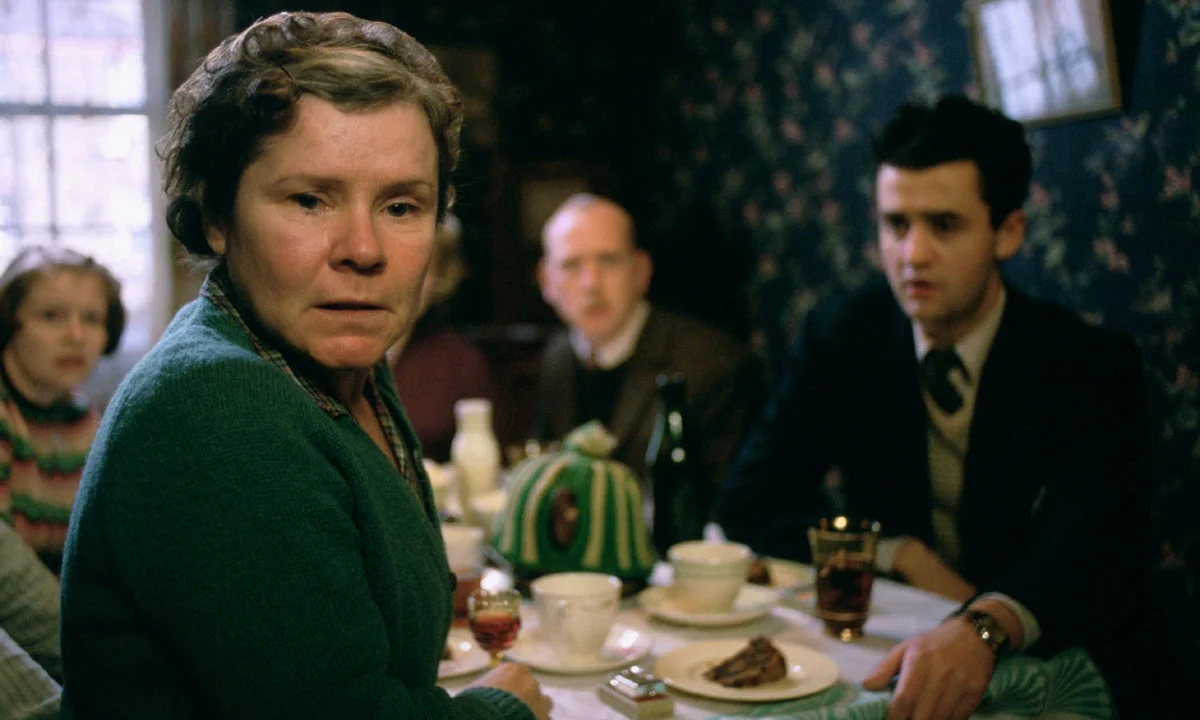
Such a tight and long-running relationship with the people embodying his creations is most likely a result of his creative process, one he first devised when working as an assistant director at the Midlands Arts Centre in Birmingham in the late 1960s. Believing writing and rehearsing could be one and the same, Leigh came up with an approach that has remained unaltered since the start of his career: the story – for which he has ideas, but not a clearly defined structure – is developed organically through rehearsals and improvisations with the cast. This happens over the course of several weeks, during which the actors known only as much as their characters would in the given scenario. On 2004’s Vera Drake, this meant only Imelda Staunton knew ahead of time the film was about an abortionist, and even she had no idea Vera would be arrested until the actors playing police officers showed up.
Only after this lengthy preparation time, which also involves the cast being privy to and/or creating backstories that will merely be hinted at in the finished film, is there a structure in place that will shape the actual filming, with the script proper a byproduct of the rehearsals and a final round of improvisations on set before the scenes are shot. This method, often misunderstood as purely improvisational (Judd Apatow, who encourages his actors to riff during filming, has described his own style as “a half-assed Mike Leigh”), has put the director in a very unusual position: he’s been able to get financing for his projects without having to tell the producers what the films were about. The three exceptions are the period pieces Topsy-Turvy (1999), Turner (2014) and Peterloo (2018), for which he provided a brief explanation of the premise and historical context, as those projects required larger budgets.
As a result of his approach, the performances in his films are uniformly well-rounded and rooted in emotional truth, something that multiple film festival juries have noticed: David Thewlis (Naked), Brenda Blethyn (Secrets and Lies, 1996) and Timothy Spall (Turner) have all won acting prizes in Cannes; Jim Broadbent (Topsy-Turvy) and Imelda Staunton (Vera Drake) in Venice; and Sally Hawkins (Happy-Go-Lucky, 2008) in Berlin. Through those performances, carefully nurtured before they ever went before a camera, Leigh has crafted a rich, compelling tapestry of British lives across multiple centuries, from the 1800s to the present day. One can hope it’s not over yet. But in the event we have seen the last feature film directed by him, it’s a very appropriate note to go out on: a picture about empathy, solidarity and, on a meta level, the affection he has for his actors.