
Magic Atlas
Magic Atlas
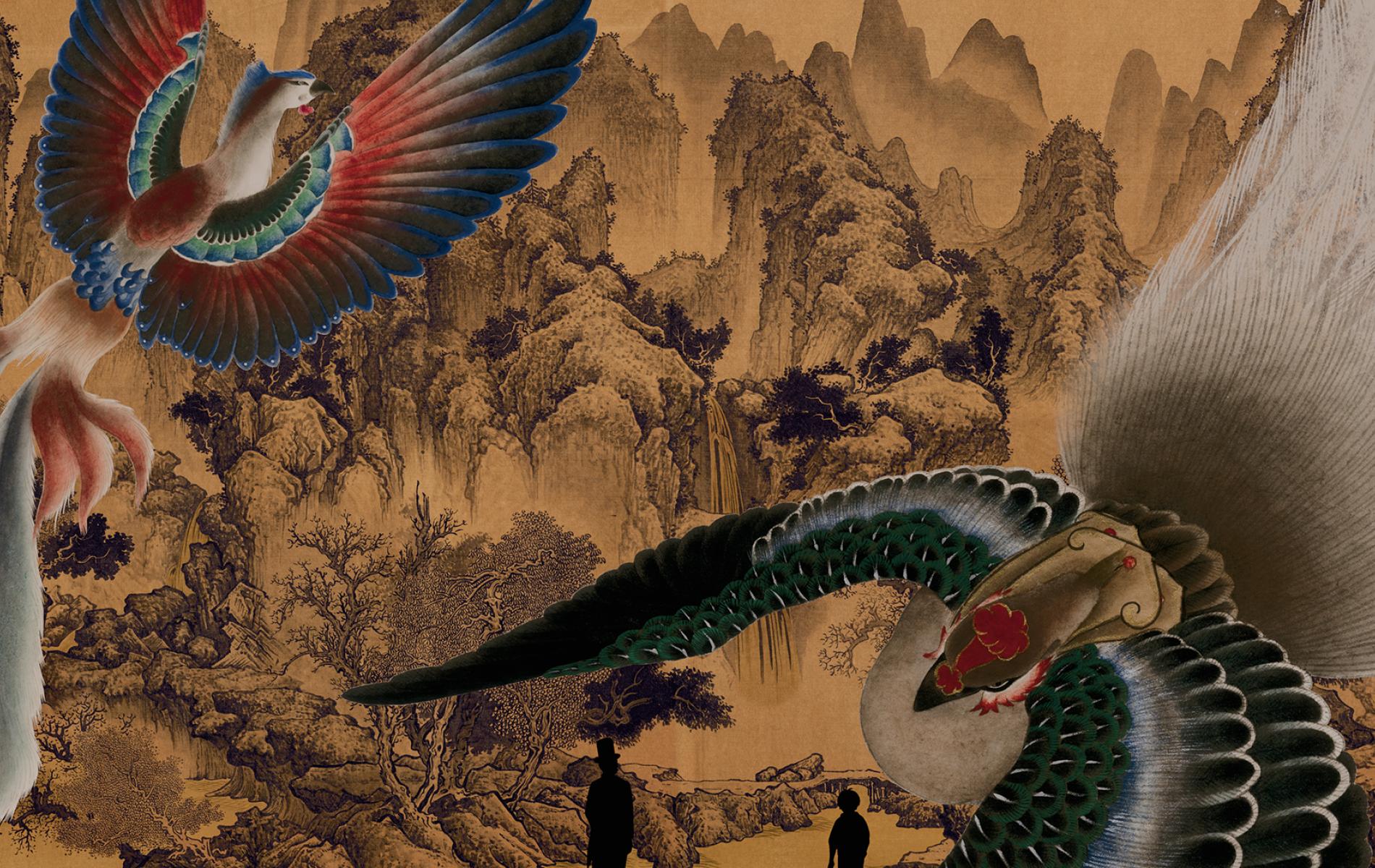
VERDICT: Sun Xun’s feature animation debut is a visually ravishing, steampunk-infused maximalist allegory about authoritarianism and the transformative power of art.
Acclaimed Chinese multimedia artist Sun Xun’s feature animation debut about a magician captured by tyrants is an exquisitely crafted vision of art and its possibilities for radical freedom from political repression, that embraces the power of fantastical allegory to transcend censorship. Oblique but visually sublime and transfixing, Magic Atlas was ten years in the making, and screens at DOK Leipzig in the international animation competition.
Sun Xun enlisted a large team of animators to collaborate on the labour-intensive production of this hand-made work, a monument of sorts to committed human artistry in an era of AI, that incorporates woodblock printing, traditional Chinese ink, charcoal drawings and other methods rooted in the analogue. Buddhist cosmology, Borges and steampunk are all channeled to conjure a world of retro-futuristic contraptions, map-making and hybrid beings, in which the imagination’s unbound magic offers the luminous possibility of escape from dictatorial control and the erasure of memory.
Sun Xun hails from Fuxin, a once-thriving coal-mining centre in the rust-belt of China’s north, and his affinity for themes of industrialisation has featured prominently in his prior work as a visual artist. A title during the credits sets out a newer motivation for Magic Atlas: the panic and despair of the Covid pandemic, in which China was especially hard hit. The film is a memorial to that time, it notes, and a set of co-ordinates for the future, to help us to be vigilant against the kind of memories that may lie to us. As a contribution to a current trend for films tackling today’s resurgence of authoritarianism, Magic Atlas is not only timely, but a splendid feat of intricate and endlessly dynamic and generative handcraft that renews an appreciation for what artistic dedication means, and the entire universes it can bring into being.
The film’s embrace of contradiction is set out by a narrator at the beginning, who claims to come from mountains deep in the sea, a meteor within a bubble, headed toward antiquity. In other words, here, nothing is ruled out. Luocha’s cinema projector creates a meta-narrative layering that underscores this tribute to animation film as a space of radical political freedom, that can transcend all physical confines to regenerate the world with its dreams of limitless possibility.
The narrative’s digressions operate according to a surrealistic dream logic that favours a wild, free flow of ideas and images over a single, clear interpretation. The story, as much as there is one, turns on the capture and imprisonment of a magician in a top hat when his airship enters the skies above Luocha. The empire he’s strayed into is ruled by an iron-fisted regime in which flying has been outlawed, and security is causing jitters on the eve of the first magic dream festival in sixty years. A slated prisoner amnesty may see him almost immediately released, but the authorities are wary that their mosquito-borne surveillance cameras and the amnesia powder set to be dropped in the public square may not be enough to wipe out memory and non-conformism from the realm once and for all.
It’s rumoured in Luocha that all magicians are artists — just in case we missed that this is an allegory about the stamping out of creative expression and its ability to seed alternate possibilities in the minds of citizens. Luocha’s rulers have decreed that anything not useful or profitable be banished from their industrialised land of coal-mining and labour exploitation. When the magician gives a map to an orphan boy on the run who still remembers yesterday, new co-ordinates and dimensions open.
Against a background pulsating with subtle textures and other sublime details from German newspapers, Egyptian pyramids and more, hybrid creatures blending animals and machines go about their business, and vehicles with Victorian-style propellers to traverse land and sea. Fine-lined white tigers with Pegasus-style appendages cross a sepia, snow-flecked landscape; a clacking, winged typewriter sits on a rock beside Molotov cocktails as owls and bats soar above; ominous guards and authorities with the sometimes flaming heads of dogs, goats, and horses parade in masses, or sit scheming. Melting, Dali-style watches, and live snake skeletons hang coiled from bare trees, in frames that defy the real-world laws of death, place and time.
These images, which can be as alarming as they can be delicate and beautiful, lack strict cohesion, but all have in common a boundaryless ability for transmutation. Black-and-white predominates, but colour bursts through not infrequently, another quality that cannot be suppressed for long with even one magician around who is buoyant and assured — an alchemy-championing representative, of course, for artists, like Sun Xun, whose brushes are devoted to encompassing and reflecting back everything with love rather than fear.
Director: Xun Sun
Writers: Xun Sun, Mingchun Gong, Yuehao Kuai
Cinematographers: Chong Xu, Liang Zhao, Tianwei Dai
Editors: Xun Sun, Xingye Chen, Chong Xu
Producers: Xun Sun, Xiaobo Zhang
Sound: Yang Yicheng
Music: Feng Jiangzhou, Lao Dan, Xue Daran, Mamer, Kan Mikami, Shen Gun
Animators: Yanping Yu, Fengli Lai, Jing Deng, Xingye Chen, Jing Cui, Tianwei Dai, Xun Sun
Production companies: Trail Mix Media (Singapore), Pi Animation Studio (China)
Sales: Xun Sun
Venue: DOK Leipzig (International Competition Animated Film)
84 minutes