Heat
.
VERDICT: Jacqueline Zünd returns to documentary filmmaking with the (literally) scorching ‘Heat’, a hit on the festival circuit.
When Jacqueline Zünd premiered her fiction debut Don’t Let the Sun in Locarno in 2025, it was mentioned that it came about while she was doing research for a separate, documentary project. That project had its first screening eight months later, as part of Visions du Réel’s International Feature Film Competition in the form of Heat, which has since enjoyed a rich journey on the festival circuit (Reykjavik, Vancouver, La Roche-sur-Yon and DOK Leipzig, among others). And that journey is bound to continue, owing to a topicality that borders on the extreme.
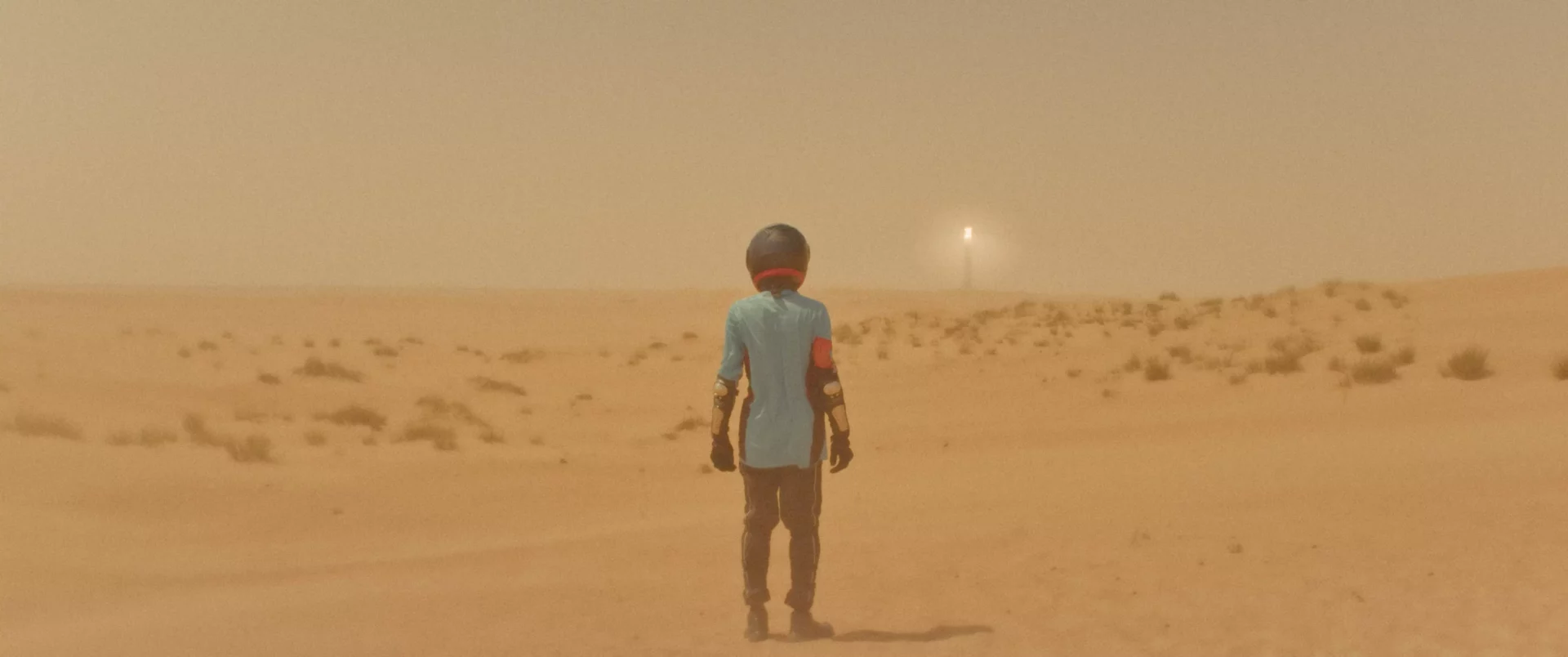
Described as “a possible glimpse into the future for all of us”, the film takes us on a trek across the Persian Gulf area, regarded as one of the hottest regions on the planet. Over the course of an hour and a half, Zünd observes everyday life in a part of the world where temperatures can and do soar past 50 degrees Celsius (122 Fahrenheit). As the privileged carry on without any major impediments, others – mainly migrant workers with limited or non-existent alternative options – have to cope with this inhumane status quo and come up with survival strategies.
Even without the aforementioned production backstory, Heat is for all intents and purposes a companion piece to Don’t Let the Sun. The two films are in a dialogue with each other, especially on a formal level, as they both come across as hybrid works where reality informs fiction and vice versa: Don’t Let the Sun took place in a dystopian near future where rising temperatures have made it virtually impossible to go outside during daylight hours, and was shot in Liguria, in Northern Italy, at a time when such a scenario was not as far-fetched as one might think. That it debuted in Locarno, which has become increasingly notorious for the extreme summer heat (in 2024, this writer went home after a late evening screening and it was still above 30 Celsius/86 Fahrenheit), added to the different layers of reality being juxtaposed.
Heat is the real deal, captured in an area of the world where the dystopia is a daily occurrence, but the desert vistas look like something out of a science fiction film, like Dune without the sandworms or the Tatooine sequences in Star Wars without the speeders and lightsabers. There’s a visual continuity between the two projects, owing to Nikolai von Graevenitz serving as the cinematographer on both pictures, which makes them two halves of a single entity where a nightmarish reality bleeds into the fictional structure and the real world looks so much like a genre picture that the distinction between “documentary” and “narrative feature” becomes tragically obsolete.
It is a somewhat gloomy prospect, but amidst all this, Zünd still manages to find kernels of something more uplifting, for at its core, via the variety of lives depicted in Heat, it is a story of human resilience in the face of the most unbeatable adversary of all: nature, and its sometimes unrelenting, uncompromising metamorphoses. The future may not look particularly bright, except for the sun shining brutally in the sky, but this film’s empathetic look at the people for whom it is already the present comes with the notion that, if some common ground can still be reached before it’s too late, it might still be a future worth adapting to.
Director, Screenwriter: Jacqueline Zünd
Producers: Louis Mataré, Magdalena Welter
Cinematography: Nikolai von Graevenitz
Music: Marcel Vaid
Sound: Oscar van Hoogevest
Production companies: Lomotion, real Film GmbH, SRF Schweizer Radio und Fernsehen, ARTE G.E.I.E.
World sales: Taskovski Films
Venue: DOK Leipzig (Audience Competition)
In English, Arabic, Swahili
87 minutes