
The Blind Ferryman
Al Baseer
VERDICT: Lyrical and slow-moving, ‘The Blind Ferryman’ is a timeless folk tale set in Iraq’s wild marshlands, where it explores elemental human drives with delicacy and a touch of mystery.
A sightless young man sings happy songs as he ferries residents around the wetlands in his small boat, until one day he meets a supernatural woman who nobody else can see. Director Ali Al-Fatlawi’s simple, slow-burning tale The Blind Ferryman tests the boundary between sight and insight, outer and inner vision, the real and the imagined, making the viewer decide what to believe. Though its leisurely pace and folk tale-like repetitions may not beguile audiences in a hurry, it is a deep film that lingers in the memory.
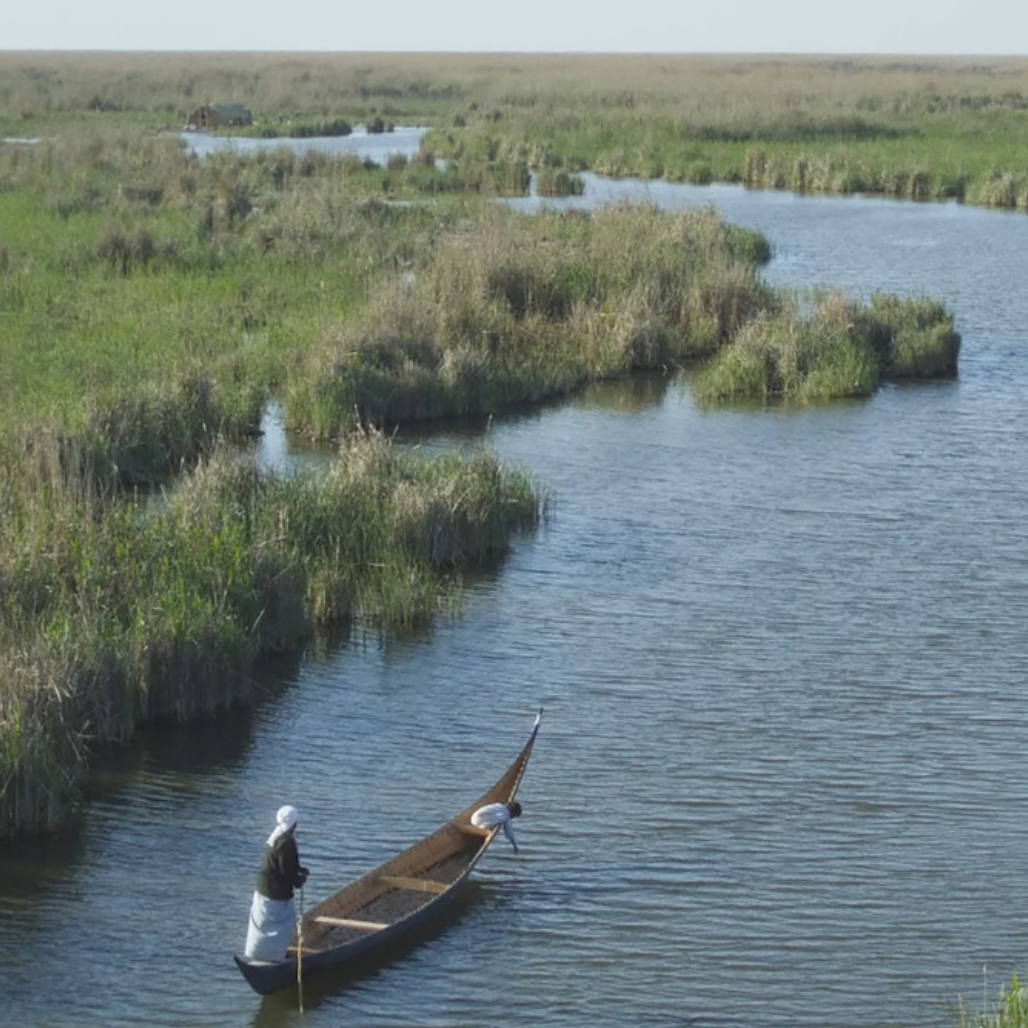
Its visual originality lies in the stunning natural setting of seemingly infinite marshes, where tall grass whipped by the wind grows out of shallow water as far as the eye can see. There is barely any break separating the indoors/outdoors, as local dwellings appear to be open-weave semi-circular structures made out of reeds and marsh grass.
There is only one way to travel between them, and that is in long, graceful, fat-bellied boats moved by long poles. Though blind, Ayoub (Ahmed Moneka) has no hesitation navigating the familiar waterways and we watch in awe as he slips around other boats as if by a sixth sense. In the morning he takes children to school, where Jasen the schoolteacher entertains his class with traditional stories and myths about Gilgamesh and Endiku, and how love is the strongest human emotion.
The only blemish in this paradise is the arrival of Sheikh Fadel, a hard-liner who upsets the village Hajj’s moderate preaching with an extremist brand of “religion is the only salvation”. Recruiting Ayoub’s violent brother (Kihel Khalid), the two stage a sneak fire-bombing attack on Ayoub and his friends while they are out drinking late one night. In the resulting conflagration, Ayoub gets separated. As he wanders lost among the reeds, he finds himself rescued by a strange woman he calls Mirror (a supernaturally poised Sam Rahmani), who he falls madly in love with in a series of meetings. When he asks where she lives, she says she lives in his heart.
Unfortunately, no one else has ever seen her and the villagers – even his own mother – make fun of Ayoub and his imaginary lover. The outcome is heart-breaking, very much in keeping with the cruelty of fairytales and the psychological complications of human love affairs.
The scenes do tend to get a bit repetitive towards the end, sometimes only distinguishable by the different animals associated with Mirror. Water buffaloes are rife; there is a dog and a sheep, and something that sounds like wild boar; birds soaring over the marshes and even a turtle, all on the fence between natural and supernatural creatures.
The cast, led by Moneka as the charismatic simpleton in the title role, each embody a vivid figure in the drama: the strong, protective mother; the self-centered brother who is easily led astray; the idealistic, slightly unworldly teacher. These archetypes further underscore the mythic dimension of the screenplay, written by Al-Fatlawi and Joel Jent.
The Swiss-Iraqi-Qatar coproduction makes use of some top tech work to create its basic stripped-down look. DP Yunus Roy Imer uses the natural lighting with great skill, creating fantastic effects in the open-air huts.
Director: Ali Al-Fatlawi
Screenwriters: Ali Al-Fatlawi, Joel Jent
Producer: Samir
Cast: Ahmed Moneka, Sam Rahmani, Kihel Khalid, Awatef Naeem, Zahraa Ghandour, Aziz Khyoun
Cinematography: Yunus Roy Imer
Costume design: Tamara Nouri
Editing: Ali Al-Fatlawi, Paul Avondet
Music: Marcel Vaid
Production companies: Dschoint Ventschr Filmproduktion
Venue: Cairo Intl. Film Festival (Horizons of Arab Cinema Competition)
In Arabic
120 minutes