
Abderrahmane Sissako’s Immersive Journey
.
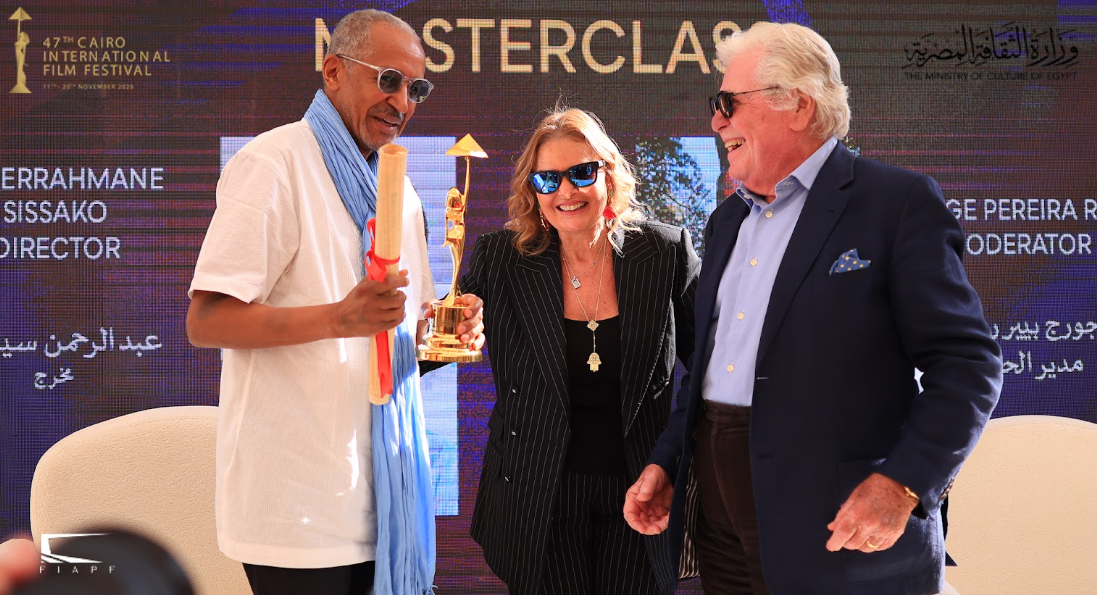
VERDICT: The acclaimed Mauritanian filmmaker Abderrahmane Sissako received the Golden Pyramid Honorary Award for Lifetime Achievement at the Cairo International Film Festival.
Abderrahmane Sissako is quite busy during his stay at the 47th Cairo International Film Festival, where he’s giving a Masterclass and receiving the Golden Pyramid Honorary Award for Lifetime Achievement. Nevertheless, he finds the time to talk to a small group of journalists. He apologizes upfront for his English, and at least one remark leads to the need for clarification later on: when he refers to Artou, presented in the XR program, as his “last film”, he does not mean he’s retiring, it’s just his most recent work.
Other times, he resorts directly to French words or phrases, since some of us made it clear beforehand we understand the language and can translate for the others. For example, when the question of AI arises, Sissako says he’s not entirely against it, provided he has a full understanding of how it works. He then mentions a specific incident during the making of Artou: “My cinematographer, who is very much into all that stuff, showed me the city he had created with AI for the opening shot. I looked at it for one minute and threw it à la poubelle.” In the trash. In the final version of the film, that first bit is a completely black screen.
That Sissako would be open to new technologies is perhaps not a surprise when one considers his life and career, both marked by major changes: born in Mauritania, he grew up in Mali before moving back to his home country to be with his mother. He then studied filmmaking in Moscow, at the tail end of the Soviet era, and spent years living in Paris (“I’ve had a privileged relationship with ARTE”, he says about working with French producing partners) before returning to Mauritania. Fittingly, displacement is a recurring image and theme in his work, including Artou, which is a largely dialogue-free depiction of a family fulfilling a man’s dying wish and taking his body from France to his boyhood village in Africa, so he can be buried in his native land.
But how did the idea for an immersive film come about? The seed, it turns out, was planted a couple of years ago: in 2024, he served on the Competition jury in Venice, and while walking around with his wife, he ran into an old acquaintance: Michel Reilhac, formerly at ARTE, now co-head of Venice Immersive. “He invited me to come take a look at what they were doing. Now, Venice is very intense, sometimes we see three movies in one day, but my wife pointed out a moment when we’d have two hours to ourselves, and we went and looked at the VR.” At that point, he felt inspired to make something with immersive storytelling tools, if he found the right material. A subsequent conversation with a friend who had lost their father provided the impetus for a 360-degree trek across African landscapes that allows us to see things from every angle, although we are naturally drawn to the coffin or the body, and the people carrying them. “We are not free”, Sissako explains about his approach to a technology that, in theory, grants the user a certain freedom in where to aim their gaze.
Beyond the artistic drive, Sissako was also drawn to what eventually became Artou for practical reasons: “I wanted to bring this technology to Africa.” Eager to share with others, he hopes this will bring about something new in the region where he grew up. And on the basis of his own work, and the kudos it has received on the festival circuit, it would seem like his effort will play a key role in making immersive media more palatable across the continent.