
At Night
At Night
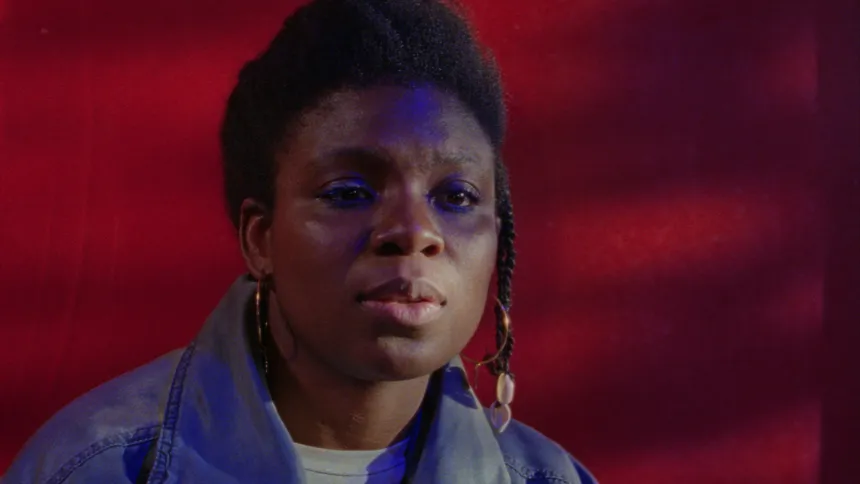
VERDICT: Beatrice Gibson flips expectations in this autofiction odyssey through a nocturnal Paris created a dreamlike and intersectional exploration of contemporary womanhood.
At its core, Beatrice Gibson’s feature debut is an epic journey happening at night.
The British artist known for excellent shorts like I Hope I’m Loud When I’m Dead (2018) and Two Sisters Who Are Not Sisters (2019) transitions into the longer form with predictable aplomb. The result is an experimental derive through Paris after dark based primarily on two works by female writers: Alice Notely’s book-length poem that challenges the maleness of epic poetry traditions, The Descent of Alette (1992), and Kathy Acker’s gender-swapped retelling of a familiar tale, Don Quixote: Which Was a Dream (1986). Taking these wanderings as their basis, Gibson’s film is a collaboratively written piece that follows several women through the Paris night, reflecting on the interplay and dissonances of their experiences of womanhood. Gibson took home the Best Emerging Director Award at Locarno, where the film premiered, before going to play at various festivals and now screening at IDFA.
The film’s genesis in the tradition of autofiction is, of course, key to its playing at an international documentary festival, where it has been programmed in the endlessly fascinating Paradocs strand. Gibson’s cast of women are all non-professional actors who are, more or less, playing themselves though in meticulously planned and pre-written conversations and scenarios. The centre figure around which they seem to gravitate is B (played by Gibson herself), a filmmaker who is in Paris location-scouting for a movie and wrangling with the guilt of being absent the family home. She is also attempting to reconnect with her friend, Didi (Diocouda Diaoune), a single-mother who lives in Paris and who has worked for B and been in her films in the past but with whom there has been some unexplained falling out.
The conversations are embellishments, refractions or simply reflections upon the real history that exists between these women. There is an archness and an artiness to the film’s overall feel, but it is grounded wonderfully by the very genuine authenticity that all of the performers show as their conversations range across various facets of their experiences and. In particular, conversations discuss how their experiences have shifted as they have grown older – whether that is something more familiar to the big screen, like the nature of becoming a mother, or less typically articulated such as the way that their relationships to sex have changed as they have aged. Gibson searches for no consensus or singular view, she gives time for these characters to express themselves and in doing so creates moments of almost startling intimacy and empathy.
Two sequences in particular standout in this regard – though there are many. One is a quiet and deeply personal conversation between B and Didi, and the other a larger group conversation in a bustling cafe including the likes of filmmakers Laida Lertxundi and Amy Gwatkin, artist Pauline Curnier Jardin and poet Sophie Robinson amongst others. In both of these instances the conversations feel utterly real, whether it is a group discussion in which various views about sex or motherhood are shared openly, or the one-on-one personal discussion in which two people even more nakedly discuss the starkness of their different experiences and the ways in which these differences cannot help but affect their perspectives and their relationship.
These conversations can feel loose and spontaneous, helping the sense of verisimilitude, but the film around them is artfully composed. The Paris metro acts as some kind of hypnogogic transport – as trains so often act in cinema as a vehicle across metaphysical as well as geographic thresholds – often being seen conveying B around the city, moving the viewer from one vignette to the next. All of this is shot on sumptuous 16mm celluloid by Gibson’s former collaborator on Two Sisters Who Are Not Sisters and celebrated experimental filmmaker in his own right, Ben Rivers. Accompanying the images is Elvin Brandhi’s soundtrack that weaves field recordings from the metro into its rhythmic, ambient tones.
Rhythms play a central role in the feel of At Night. Editor Liyo Gong and Gibson have crafted a film that seems to breathe to the beat of the urban environment at night. Gibson has spoken about the multitudes that the darkness can offer – its danger, its comfort, its limitless potential to disappear, or to be transformed. Here she moves through these various modes and more, crafting something infused with both dreamy unreality and a striking credibility and truthfulness. It’s a beautiful film to drift along with and to reflect on at length, and should continue to enrapture festival audiences as it continues its travels.
Director, screenplay: Beatrice Gibson
Cast: Katia Belo Cardoso, Denna Cartamkhoob, Adam Christensen, Pauline Curnier-Jardin, Diocouda Diaoune, Amy Gwatkin, Beatrice Gibson
Producer(s): Denna Cartamkhoob, Beatrice Gibson, Scott O’Donnell
Cinematography: Ben Rivers
Editing: Liyo Gong
Music: Elvin Brandhi
Sound: Beth Grainger, Andy Neil
Production design: Lucie Beauvert
Production companies: Somesuch, BBC Film (United Kingdom), Norte Productions (France)
Venue: International Documentary Festival Amsterdam (IDFA) (Paradocs)
In English, French, Tibetan, Bambara
88 minutes
Read more of our coverage of International Documentary Festival Amsterdam (IDFA).