
DAU
DAU
VERDICT: A mammoth 4-hour extravaganza of brilliant, cutting-edge cinema that has been in the making for the last 20 years, Ilya Khrzhanovsky’s wildly imaginative critique of Soviet society DAU found an appreciative showcase in Venice competition
DAU is the kind of film that film-lovers go to festivals for. First of all, because it is not likely to play at your neighborhood cinema anytime soon – more likely at a big-city cinematheque – and secondly, because its extreme esthetics offer audiences a mental reset after too many lookalike movies have dulled the knife. Its futuristic production design and cinematography are game-changers that will carry their influence forward, and leave viewers with a truly memorable experience.
The film is the culmination of a decades-long film and multimedia “DAU. project” describing the evils of Soviet communism and how good people found themselves manipulated into becoming a part of it. An emotionally intense, provocatively long immersion into cinema pyrotechnics, the film spins off forty years of violence and Communist ideology in the fictionalized biopic of a real Soviet physicist who, broken by State Security torture and his own moral shortcomings, becomes part of the system. The inspiration is Lev Davidovich Landau, known as Dau, who was awarded the 1962 Nobel Prize in Physics and, more germane to the film, who led a team of theoretical mathematicians who developed the first Soviet atomic and hydrogen bombs.
Stated most generally, Dau’s theme is the moral responsibility of scientists for the effects their work has on humanity. As an American physicist puts it to his Soviet peers, are we forces of light, or powers of darkness? The film doesn’t pull any punches about the unethical and inhumane way the Soviet police and bureaucrats forced their military goals on the initially innocent scientific community, from human experimentation of radiation effects to the suppression of empathy in the brains of soldiers. And then nuclear weapons of mass destruction.
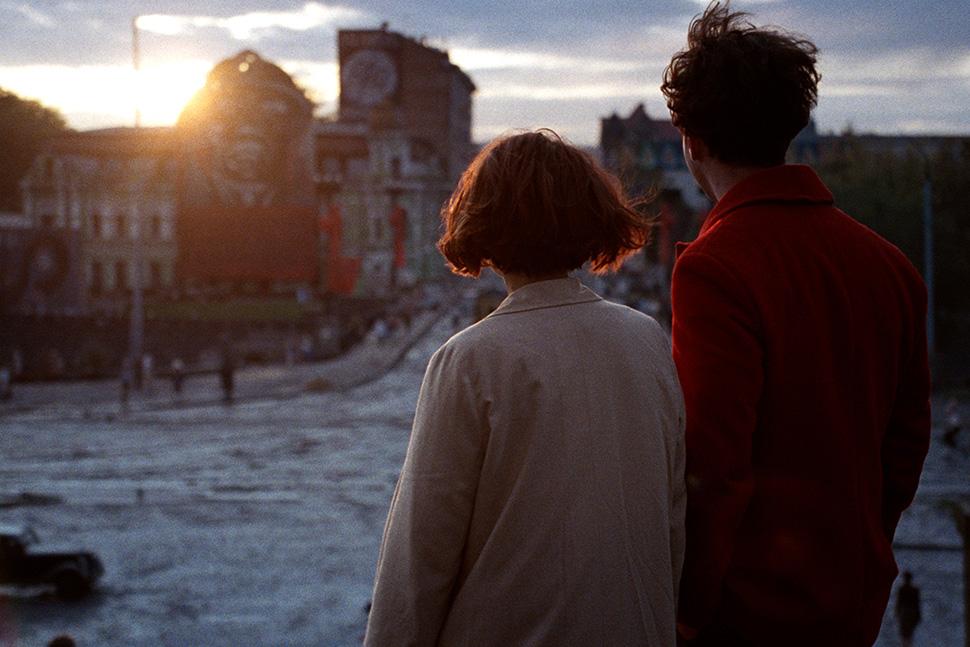
The story begins in Leningrad in 1928. In the aftermath of the Bolshevik revolution that brought Lenin to power (presumably represented by a rapid-fire machine-gun sequence of exploding lights and sublininal images), the broad, littered streets are filled with jubilant citizens in fashionable, bright-colored clothes, like the young Dau in his red wool coat topped by an asymmetric bush of hair. Everything seems to be moving at breakneck speed – the trams, the pedestrians – and the scene abruptly shifts to Khakiv in Ukraine.
It is 1933-37 and people are beginning to come down from their revolutionary illusions. Still wearing his red coat, Dau (Teodor Currentzis) arrives on a futuristic propeller plane with his colleagues and lands in a field of mud and noise. They are taken to a spanking new research complex, one of the film’s largest and most impressive sets, to practice theoretical physics. No one is sure how this will happen, though: their students haven’t a clue and the rough military people who try to boss them around keep suggesting they build radar detectors.
The bright light in this period of Dau’s life is his encounter with Nora (Radmila Shchogolieva), a fiery redheaded worker who he chats up at a fantastic masked ball of Dadaist inspiration. She is Dau’s equal in bed and is stubbornly possessive of this posh gent who has rescued her from a collective apartment pervaded by the smell of cooking cabbage. He, on the other hand, insists they both should feel free to sleep around, raising the bone of contention that will poison their relationship as the years go by.
But there is danger in the scientific institute, which appears ever more like a dystopian Disneyland whose soundtrack is a heroic song sung by an opera tenor. Dau gets beat up on the street and the contemptuous attitude of his friends Koretz, Shubnikov and Demyan gets the young scientists put on trial.
Dau moves to Moscow in 1938 and gets a job in the new Institute for Physical Problems (in the film it is referred to as a secret scientific institute) directed by the brilliant Pyotr Kapitsa, another Nobel laureate. The laboratories and marble residential quarters filled with artworks are again futuristic, massive sets built to impress. Nora comes with him but she cramps his playboy aspirations. Not even the birth of their baby son can make him chill, and he cruelly sets about seducing the other physicists’ wives under Nora’s nose.
If in the early scenes Dau’s “extraordinary uniqueness” bought his questionable morals some audience indulgence, it gets much worse and more outrageous as time goes on. At one point he hires two girls, both blonde and nubile, as his “assistants” – in reality as his domestic harem. A bedroom scene in which one of the girls breaks down into hysterical sobbing is close to unbearable to watch. It should be said that all the sex scenes do look simulated, given the accusations of on-set abuse of actors that has dogged Khrzhanovsky during work on the project, specifically ahead of the premieres of the first two DAU installments at the 2010 Berlin Film Festival.
But at the same time as Dau is going off the deep end of lust, he is capitulating to the growing demands on the part of the Soviet authorities, particularly his friend and protector Kapitsa, that he work on the Bomb. Their discussions about scientific ethics and the thirst for knowledge notwithstanding, Dau is in serious trouble with the State Security people who opened a case file against him in Ukraine and tortured him in a particularly repellent way. In Moscow, everyone is spying on everyone and his irregular sexual habits are well-known to the KGB. The final scenes show him as an old man disabled by an accident, and shown off like a trophy by Nora and his son, who are not innocent, either.
The technical work on the film is an emotional experience in itself, capturing an expressionistic spirit of the times reminiscent of the grotesque, monumental figures in Alexei German’s films, along with many other Soviet and Russian influences. Due to the extended period over which the film was shot, with at least three distinct periods and crews, it is impossible to give credit to the many fine directors of photography, editors, production designers, costume designers and others who contributed to its exhilarating and inspiring overall look. Their collective work shines onscreen.
Director: Ilya Khrzhanovsky
Screenplay: Ilya Khrzhanovsky, with Susanne Marian, Vladimir Sorokin, Ilia Permyakov
Cast: Teodor Currentzis, Radmila Shchogolieva, Anatoly Vasiliev, Maria Nafpliotou, Vladimir Azhippo, Dmitri Tcherniakov, Dmitry Cheglakov, Demian Kudryavtsev, Ekaterina Andreeva, Victoriia Skytska, Konstantin Leshan
With: Carsten Höller, Marina Abramovi?, Romeo Castellucci
Producers: Ilya Khrzhanovsky, Svetlana Dragayeva, Philippe Bober, Solal Coutard, Susanne Marian, Erik Hemmendorff, Leonid Lebedev
Cinematography: Jürgen Jürges, Manuel Alberto Claro, Lol Crawley
Editing: Ilya Permyakov, Rob Myers
Production design: Denis Shibanov, Olga Gurevich, Boris Shapovalov
Costume design: Lyubov Mingazitinova, Irina Tsvetkova, Alexandra Timofeeva, Alexandra Smolina-Rozanova, Stefania Graurogkayte, Elena Bekritskaya, Olga Bekritskaya
Sound: Kirill Vasilenko, Guillaume Bouchateau, Maksym Demydenko, Elena Gurvich, Rob Myers
Production companies: Phenomen Berlin, Essential Films & Parisienne de Production, Plattform Produktion in association with Arte France Cinéma, Westdeutscher Rundfunk
World Sales:
Venue: Venice Film Festival (Competition)
In Russian, English, Greek
195 minutes