
Dentro
.
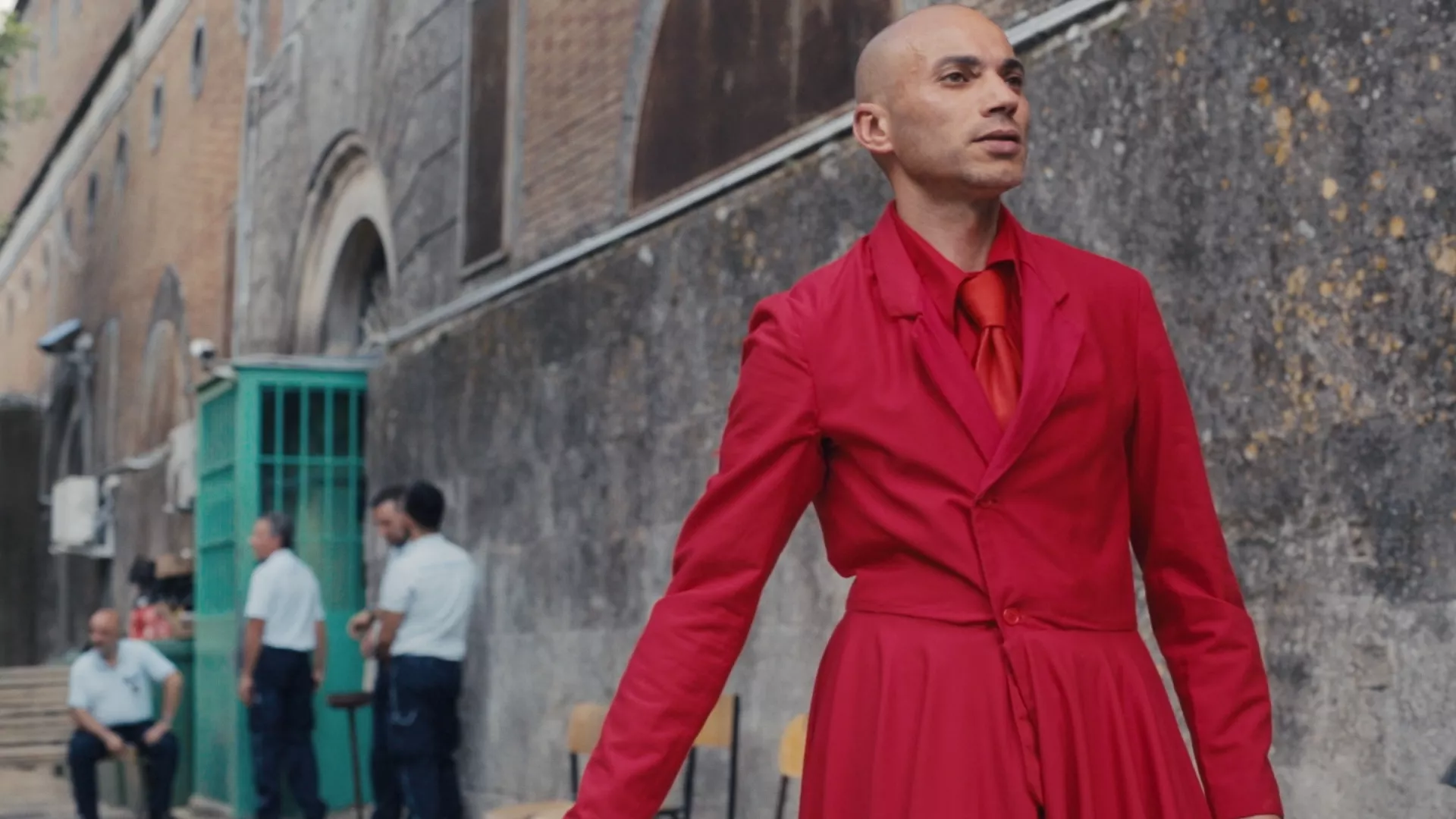
VERDICT: Captivity and the arts mix in a riveting fashion in Elsa Amiel’s documentary ‘Dentro’, screened in Visions du Réel’s International Feature Film Competition.
In 2012, the Taviani brothers won the Golden Bear in Berlin for Caesar Must Die, a blend of documentary and fiction set inside a prison where the inmates starred in a production of Shakespeare’s Julius Caesar. An ostensibly similar vibe is the spark that ignites Elsa Amiel’s documentary Dentro, whose successful debut at Visions du Réel – where it received the Interreligious Award for a film highlighting the subject of human solidarity – is hopefully the first of many landing sites on the festival circuit and beyond.
Due to its Italian setting, comparisons are perhaps inevitable not only with the aforementioned Taviani film, but also with Mario Martone’s Fuori, released in 2025 and based on Goliarda Sapienza’s autobiographical novel L’Università di Rebibbia, about the time she spent inside a famous prison in Rome and what happened to her fellow inmates after they were released. The contrast between the two titles, Fuori (outside) and Dentro (inside), is amusing but coincidental, as Amiel began developing her project shortly after the premiere of her fiction debut Pearl (2018), upon coming across the work of Armando Punzo.
An acclaimed stage director, Punzo has spent the last few decades inside a prison, located in Volterra, Tuscany. He’s there by choice, driven by artistic hunger to create work with the inmates, all of whom are serving long sentences. Within the confines of the penitentiary and its walls, he pushes the convicted men to express themselves in as free a manner as possible, turning their life behind bars into an unexpected vessel for liberty, at least on a creative level. There are occasional treks to other locations (such as when Punzo receives a lifetime achievement award from the Venice Biennale in 2023), but for the most part, the work done by the Compagnia della Fortezza (the Company of the Fortress) is situated in that building which sets the men free while keeping them locked up.
Whereas Caesar Must Die dramatized the process leading to a single performance, Dentro is more about the creative flow in general, the relationship between the director, the cast and the texts, as seen through the prism of a logistical context that gives a new meaning to the Bard’s famous line “All the world’s a stage”. Or perhaps in this case it should be worlds, plural, as the only form of escape these men – far more than “merely players” – have at their disposal, and the means to achieve limited interaction with other locales. And this applies not only to the convicts, but to Punzo himself who, in the film’s most poignant piece of voiceover, explains he’s not trying to “save” anyone: “I’m actually the problem. I’m the one with unresolved issues with reality, with the world. I need to work with people to explore these questions further.”
Such a perspective on theater and the importance of a communal creative experience is probably part of why Elsa Amiel, herself the child of a stage performer (the celebrated Swiss mime Jean-Pierre Amiel, who notably collaborated with Jim Henson) and already interested in how bodies are depicted on the screen, was drawn to this closed space that imagination can open up, this time with a little help from cinematic vision. As such, the title refers not only to the literal condition of the inmates, but also – and maybe more so – to the endless ideas and energy they have within and cannot wait to unleash.
Director, screenwriter: Elsa Amiel
Producers: Eugénie Michel-Villette, Lionel Baier, Agnieszka Ramu
Cinematography: Paulina Pisarek, Elsa Amiel
Music: Fred Avril
Sound: Antoine-Basile Mercier, Marc Thill, Xavier Lavorel, Rémi Chanaud, Louis-Julien Pannetier, Théo Viroton
Production companies: Les Films du Bilboquet, Bande à part Films, RTS Radio Télévision Suisse
World sales: Bande à part Films
Venue: Visions du Réel (International Feature Film Competition)
In Italian
95 minutes