
Heysel 85
Heysel 85
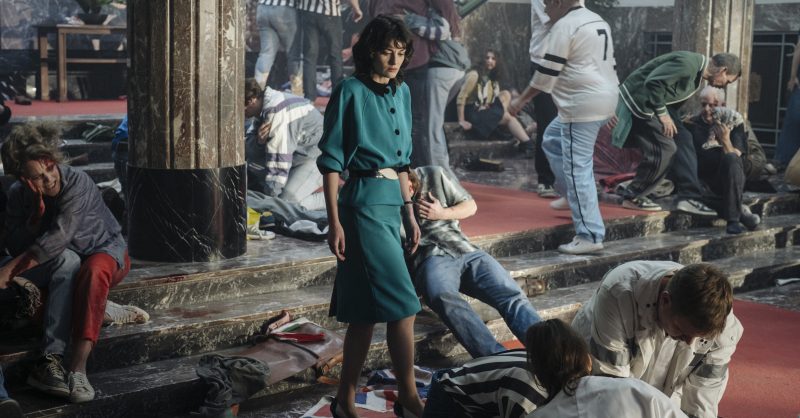
VERDICT: Teodora Ana Mihai returns to one of football’s darkest nights in a tense, sometimes frustrating drama about the officials who failed to prevent a catastrophe.
Thirty-nine people died in Belgium’s Heysel Stadium on 29 May 1985, shortly before Liverpool and Juventus were due to play the European Cup final, as fans of the two teams clashed and a concrete retaining wall collapsed on them. Despite the tragedy, the match went ahead. That decision, and the people who made it, are at the centre of Romanian-Belgian director Teodora Ana Mihai’s Heysel 85, which premiered in Berlin and is now competing at the Cairo International Film Festival.
Mihai is less interested in the football than in the decision-making and the official side of the story. She spends most of the film beneath the stands, following police officers, football officials and politicians as they try to work out how to contain the disaster and, more importantly, who will eventually take the blame.
The film opens in an atmosphere of joy and celebration, not unusual for big European matches, especially in a capital like Brussels. The city’s mayor, Marc Dumont (Josse De Pauw), is enjoying the attention surrounding the final and is still proud of having hosted Pope John Paul II. His daughter Marie (Violet Braeckman), who also works as his press attaché, follows him around, dealing with journalists and organising his media appearances. There are already early warning signs about security, the condition of the stadium and the fans gathering outside, but none of them is given much attention.
Once the violence begins, Marie spends the rest of the evening running between offices, corridors and emergency rooms. Officials argue, contradict each other and pass responsibility around. Her father keeps drinking. At one point, he even sends her to fetch more whiskey, an almost absurd moment considering what is taking place a short distance away.
Another storyline follows Luca (Matteo Simoni), a Belgian-Italian journalist reporting on the match while searching for his brother and other relatives who might be among the victims. His story could have offered something different, particularly about what happens when a journalist becomes personally involved in the events he is covering. Mihai doesn’t really develop this conflict, however, and Luca eventually feels like a missed opportunity, secondary to Marie’s continuous movement around the building.
Some of that movement is brilliantly filmed. Cinematographer Marius Panduru shot on 16mm, and the grainy images resemble the television footage that Mihai skilfully inserts throughout the film. After all, those images are what remains of the tragedy in the memories of thousands of football fans. The camera follows Marie down narrow passages, through doors and into rooms where the injured are arriving. We rarely see what is happening in the stands, but we hear plenty of it: screaming spectators, the noise of the crowd, and police radios with no idea how many people are dying nearby. The effect is chilling, and it builds a real sense of hopelessness.
One of the film’s strengths is how Mihai builds tension around an event whose outcome is already known. The audience knows that dozens will die, yet watching the officials gradually lose control remains unsettling. Keeping the camera away from the stands works particularly well here, as the panic is conveyed through the injured arriving in the corridors. There is also something frightening about how ordinary the officials’ conversations remain despite the scale of the disaster. Mihai makes the audience experience the catastrophe from inside a failing institution rather than simply watching it unfold.
One particularly moving scene involves an Italian radio presenter reading out messages from survivors to their families. Just a few words, sometimes only names, tell us more about the tragedy than many of the scenes involving the officials.
The trouble begins when the screenplay tries too hard to explain its politics. Dumont is a drunk, arrogant politician who seems incapable of taking anything seriously. Marie, meanwhile, is repeatedly interrupted by men who refuse to listen to her. Both points are established early, but Mihai returns to them so often that the characters’ reactions and words become predictable. The mayor’s behaviour is so exaggerated that the film risks simplifying the institutional failure it wants to expose.
The film will be particularly relatable for Egyptian viewers. In February of 2012, 72 Al Ahly supporters were killed in the Port Said Stadium disaster, with the overall death toll commonly reported as 74. Although the circumstances were different, the questions surrounding security failures, official responsibility, and the treatment and militarisation of football supporters are painfully familiar. Egyptian football has also seen years of restrictions on organised fan groups, while the game itself has become more and more commercialised.
The contradiction between celebrating football as a public spectacle and treating its supporters as a security problem is hardly unique to Belgium and Egypt. Heysel 85 could have pushed further into this contradiction, particularly when officials debate whether to continue a match after dozens have already died. Mihai is very good at recreating the panic and sheer terror of that night, but she misses the chance to examine the complicated history behind it.
Director: Teodora Ana Mihai
Screenplay: Lode Desmet, Isabelle Darras, Teodora Ana Mihai
Cast: Violet Braeckman, Matteo Simoni, Josse De Pauw, Fabrizio Rongione, Paolo Calabresi, Bobby Schofield, Ben Segers
Cinematography: Marius Panduru
Editing: Bert Jacobs
Music: Anna Katharina Bauer
Sound design: Senjan Jansen
Production design: Hendrik Van Kets
Costume design: Linda Maria Bogers
Producer: Hans Everaert
Production companies: Menuetto (Belgium), Topkapi Films (Netherlands), Leitwolf Film (Germany), Les Films du Fleuve (Belgium)
World sales: Salaud Morisset
Venue: Cairo International Film Festival (International Competition)
In Dutch, French, English and Italian
91 minutes