
Love Is the Monster
Amor es el monstruo
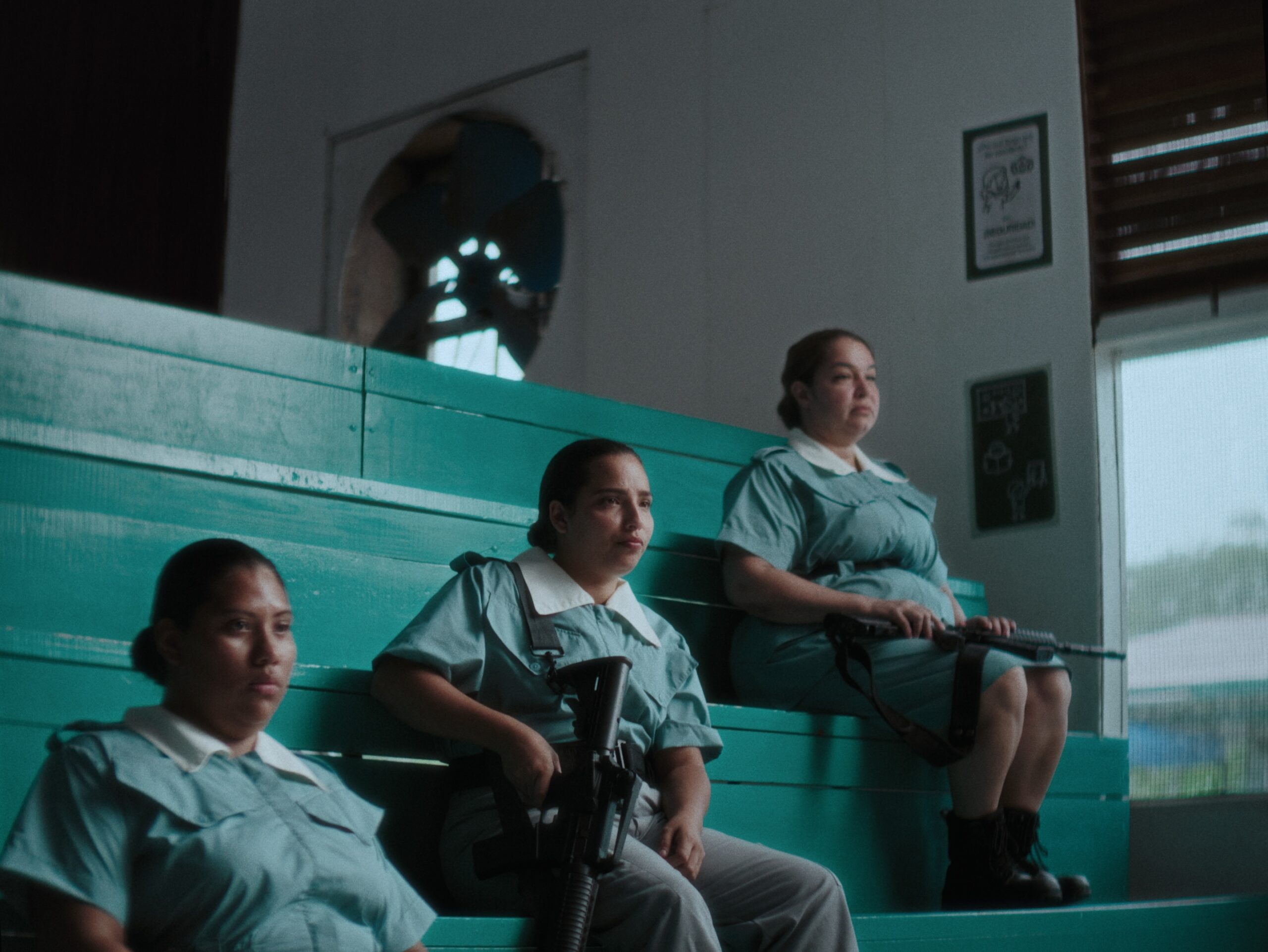
VERDICT: .Costarican filmmaker Neto Villalobos Brenes's third feature is an intelligent, efficient mix of drama and thriller, in which a grandmother tests the boundaries of love and violence in a dystopian near future.
In the recent avalanche of dystopian films, Costa Rican director Neto Villalobos Brenes offers his vision of a tropical future in Love Is the Monster.
Some things just look worse than our present: the rich live in well-guarded, gated communities, the middle income class is almost nonexistent, ageism is common and condoned, workers are rampantly exploited, and people get sick from pollution.
Love Is the Monster is intentionally located in limbo. It could be either a near-future or the present under extreme conditions. No country, people, or year is ever mentioned. We are in a story in which The Grandmother is the protagonist and everybody’s role refers to her: the Daughter, the Grandaughter, the Nanny. Place names refer to economic status: The Perimeter is a gated community with all the services, including disinfection of arriving automobiles, where the elite live, while Villa Miseria (Misery Village), well, just imagine.
The film opens on a lovely scene of lush palm trees. But soon workers appear in protective gear to fumigate them with a dangerous-looking orange gas. The Grandmother (Paulina García), a woman in her late sixties, tries to pick up her 8-year-old Grandaughter (Gloriana Vargas) from school inside the Perimeter. However, she is prevented from doing so by new instructions from the girl’s mother, her Daughter (Natalia Regidor), enforced by the strict, almost robotized personnel. The Grandmother is a very sane, intelligent person, but her extroverted, somewhat eccentric personality puts her at odds with her Daughter. Even though the Grandmother is a capable person, prejudices about her age infect even her own Daughter.
Beyond the frictions common in any relationship, this is also a power struggle. The Daughter wants the Grandaughter to stay inside the Perimeter at all times — for safety, she says. We see another reason: to keep the girl from having contact with people of a different status. She hires a Nanny (Erika Reinkendorf), who resembles an armed bodyguard in a nurse’s uniform more than a Mary Poppins, to watch both the Granddaughter and the Grandmother. The fight escalates when the Grandmother locks the Nanny up and takes the Grandaughter to get a pet on the black market. The consequences are a tense relationship all round from then on, until a crisis tests the Grandmother’s limits of love, strength and sanity.
Paulina Garcia, a well-respected Chilean actress who won a Silver Bear in Berlin in 2013, crafts her character very carefully, avoiding any melodramatic undertones. She is compelling both as a doting granny and also as a decisive, mature woman; protective or menacing according to the moment.
This is an all-woman universe, because all the able-bodied men have been conscripted in a remote war. In this man-less world, hierarchy is determined by a person’s economical means. On the low end stand the female factory workers who go months without pay. On the top is the Daughter, who as the General Manager is the most powerful person inside the Perimeter. In a archaic remnant of patriarchy, only the male children are taught to shoot. The males in the film are a young man with a mental illness and two 10-year-old boys. These blond, blue-eyed twins in their brown shirt uniforms are the very image of Nazi youth, which may be a portent of their future.
Futuristic films are rather scarse in Latin America, and Love Is the Monster is a welcome rarity: a dystopia in Spanish. A future, even if bleak, that includes Latin Americans. Another example was last year’s The Blue Trail (directed by Gabriel Mascaró) which had several things is common with Love is the Monster, but in Portuguese. The quality of Villalobos’s film has already found it a warm reception in a festivals as diverse as Valdivia, Chile; Toronto and now Cairo, but the Spanish-speaking public is its natural market.
Director: Neto Villalobos Brenes
Screenplay: Neto Villalobos Brenes, Diego van der Laat
Producers: Ana Lucía Arias, Felipe Zúñiga Sánchez, Jimena Hospina, Neto Villalobos Brenes
Cast: Paulina García, Natalia Regidor, Gloriana Vargas, Erika Reinkendorf
Cinematography: Nicolás Wong Díaz
Production Designer: Mauricio Esquivel Fallas
Costume Design: Patricia Alvarado Hurtado
Edition: Yibrán Asuad and Neto Villalobos Brenes
Sound: José Rommel Tuñón
Music: Pablo Rojas Carballo
Production Companies: La Sucia Centroamericana (Costa Rica) in coproduction with Cine Infinito, Expansiva Cine, Clara Films, Avalancha Studio, Liminal Estudio
International Sales: Bendita Films
Reviewed in Cairo International Film Festival (Competition)
In Spanish
Running time: 95 min