Musk
Musk
VERDICT: Director Alex Gibney's marathon documentary portrait of controversial billionaire businessman Elon Musk is rich in gossipy detail but short on surprises.
Spanning almost four hours, director Alex Gibney’s mammoth documentary about Elon Musk is a monumental masterclass in the banality of evil. Densely detailed and playfully packaged, with a tone that swings restlessly between tragedy and farce, scathing polemic and gossipy soap opera, Musk world premiered in Venice this week ahead of further festival slots in Toronto, Zurich and London. US theatrical release is scheduled for October 16.
A prolific Emmy and Oscar winner whose credits include Taxi to the Dark Side (2007) and The Armstrong Lie (2013), Gibney pulls together a vast collage of juicy material in Musk. This must be the most comprehensive screen portrait yet of the South African tech tycoon behind Tesla Motors, the SpaceX aerospace company, the X social media platform, Starlink satellites, the Grok AI chatbot and more. And yet, much like Musk’s self-driving cars and exploding rockets, this sprawling documentary zooms all over the place without ever quite hitting the target.
One crucial design flaw is that Musk is already an endlessly scrutinised public figure who clearly relishes his profile-boosting notoriety as a hugely divisive cartoon supervillain on the world stage. His highly impressive engineering achievements, staggering wealth, impulsive egotism and clickbait statements are always in the news, promoting both his personal brand and the global corporate empire he commands. Like Donald Trump, Musk knows controversy is good for business in an outrage-driven attention economy.
In his Venice press material, Gibney insists he has delved beyond the official narrative to unearth more colourful, unfiltered side angles. All the same, Musk is low on fresh twists, shock revelations or psychological insights not already covered in previous documentaries and media profiles. A dearth of willing interviewees from Musk’s inner circle is part of the problem. Gibney blames a “tremendous sense of fear” among the people he approached, and there are moments here where he seems legally over-cautious too.
That said, Gibney does persuade a handful of key fringe players to speak on camera, mostly estranged friends, former partners and family members. He wrings a few telling details from Musk’s overbearing gargoyle of a father, Errol, touching gingerly on claims that he was an abusive husband and bullying dad. Musk’s first “starter wife” Justine Musk (nee Wilson) shares a few scathing horror stories too, as does conservative social media influencer Ashley St. Clair, mother to one of Musk’s army of children, who claims her controlling ex cut her child support allowance for “disobedience”. All unreliable narrators with their own agendas, of course, but enjoyably bitchy stuff all the same.
Naturally, as Gibney explains in his opening voice-over, he also requested an interview from Musk himself, but the billionaire businessman declined, dismissing the project as a “hit piece.” Paranoid persecution complex? Maybe, but his gut instinct was not entirely wrong. This was never going to be a flattering portrait. No matter, because the resourceful Gibney finds a playful way to fill the Musk-sized hole at the heart of his documentary, partly by using a wealth of archive material, but also by creating a highly realistic AI-generated avatar of his subject to deliver a collage of Musk’s audio quotes to camera throughout the film.
Gibney pitches this stylistic conceit as a mischievous spin on Musk’s oft-aired belief in “simulation theory”, which essentially claims humankind may be trapped inside The Matrix, an immersive fake reality generated by a supercomputer. This unsettling Uncanny Valley doppelganger is amusingly strange at first, but comes to feel like a superfluous distraction over the long haul. Riffing on Musk’s love of computer games, comic books and science fiction, the film-makers also comment on real events using vintage game-play graphics, plus clips from classic sci-fi drama including the Terminator and Iron Man movies, Star Trek and The Hitch-hiker’s Guide to the Galaxy.
Musk sketches out its slippery protagonist’s colourful journey from South Africa to Silicon Valley to Texas to Washington DC, starting his career as a balding computer geek before gradually re-engineering himself into a boorish billionaire playboy with a harem of baby-mothers and a miraculous new mop of hair. He comes across throughout as clearly intelligent but socially awkward and emotionally blank, oddly devoid of charisma or charm. A background chorus of tech experts, NASA scientists, lawyers and media commentators add extra critical heft to this story, mostly by trashing Musk’s history of dubious boasts and brazen lies, from exaggerated claims about Tesla battery life to impossible dreams about colonising Mars.
But in terms of rigorous journalism, the film hits hardest when Gibney pauses this scattershot deluge to forensically focus on a single aspect of Musk’s legacy. A detailed investigation into Tesla’s self-driving cars, for example, shows this much-hyped feature has proved dangerously unreliable, with over 50 deaths, dozens of injuries and multiple lawsuits to date. Dashcam footage of a fatal Tesla accident is particularly gut-wrenching.
Another strong section retraces the costly carnage and mass lay-offs that Musk unleashed when he bought Twitter, now X, in 2022. Likewise when he applied similar slash-and-burn tactics to government spending as head of Trump’s infamous efficiency unit DOGE three years later, a financial chainsaw massacre which actually ended up costing billions. Some media reports and medical experts have since blamed Musk’s hugely contentious cuts to the USAID budget for almost 800,000 deaths worldwide, two thirds of them children.
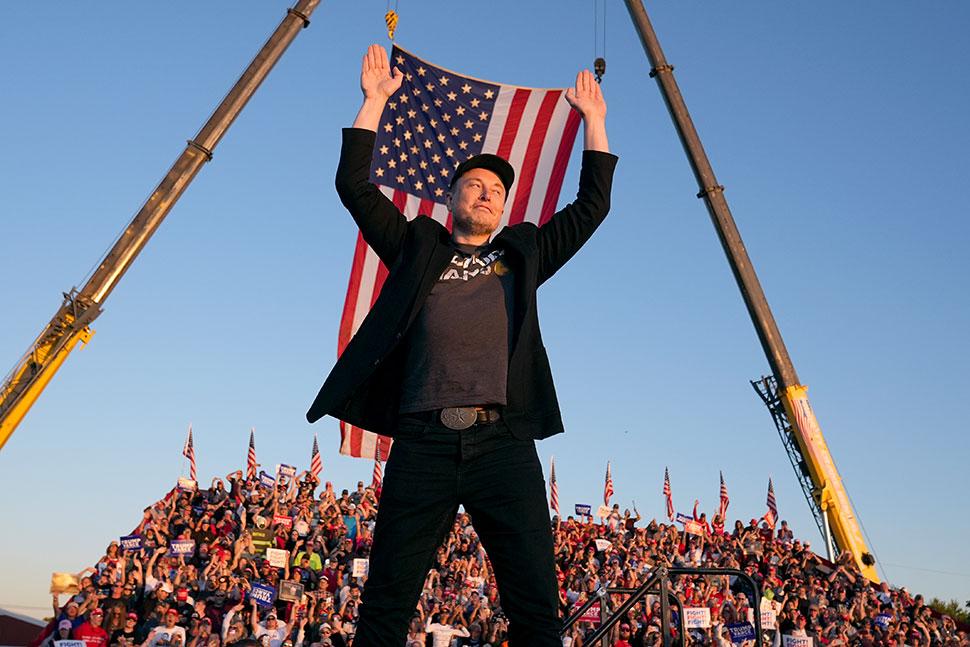
The film’s second half concentrates on Musk’s mid-career pivot to the political right, including his volatile billionaire bromance with Donald Trump. Gibney traces this shift back to the Covid-19 pandemic, when the Tesla boss became incensed by lockdowns forcing him to pause production. Since then he has become an obsessive opponent of the “woke mind virus”, funnelling $30 million dollars into Trump’s second US presidential run while endorsing far-right nationalist parties and spreading racist conspiracy theories globally. Indeed, shortly before this film’s Venice premiere, Musk publicly congratulated Germany’s anti-immigration AfD party, widely deemed an extremist organisation with neo-Nazi links, following their high-polling win in the Saxony-Anhalt state election.
And yet the film-makers find scant evidence that Musk has any firm political philosophy at all. He emerges more as an opportunistic crony capitalist who follows the money, cynically using his Trump connections to secure lucrative government contracts and quietly sideline ongoing investigations into his companies that began under Joe Biden’s administration. It is a disappointingly banal take-home message for a film about a power-crazed sociopath with intergalactic ambitions, but Gibney leaves viewers with the distinct impression that the only cause, the only ideal, the only brand Musk truly believes in is himself.
Director, screenwriter: Alex Gibney
Cast: Elon Musk, Justine Musk, Ashley St. Clair, Sam Harris, Kara Swisher, Martin Eberhard, Zoë Schiffer, Geoffrey Hinton
Cinematography: Benjamin Bloodwell
Editing: Michael J. Palmer
Music: Daniel Pemberton
Visual effects: MakeMake, Kaleida Studio, Mighty Oak
Production: A Bleecker Street (US), HBO Documentary Films (US), Ronan Production Group (US), Jigsaw Productions (US), Anonymous Content (US), Closer Media (US), Double Agent (US)
Producers: Zhang Xin, Joey Marra, Nick Shumaker, Jessica Grimshaw, Dana O’Keefe, Ronan Farrow, Lawrence Wright, Jessie Deeter, Erin Edeiken, Alex Gibney.
World sales: Black Bear, Santa Monica
Venue: Venice film festival (out of competition)
In English
225 minutes