
Nothing Has Happened Yet
Ajik amu ildo ireonaji aneun
VERDICT: Korean director Shin Sun crafts a quietly inquisitive meditation on chance and uncertainty in 'Nothing Has Happened Yet', although its romantic preoccupations and later pacing narrow its horizons.
by Nemo Kim
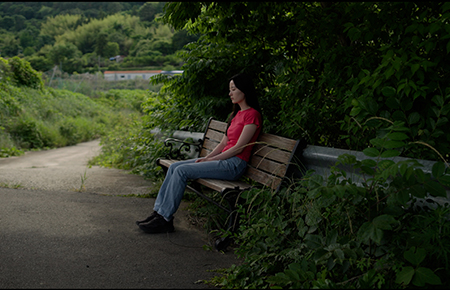
A park bench promises a glimpse of the future in Nothing Has Happened Yet, but the more revealing moments arrive when its protagonist gets up and walks away.
In his third feature, writer-dirctor Shin Sun explores the uneasy coexistence of a desire for certainty and the unpredictable encounters through which life acquires meaning. Anchored by Park Hanbitnara’s thoroughly convincing central performance and Shin’s measured approach, the film finds considerable warmth in this tension, even as its philosophical reach occasionally exceeds its dramatic scope.
Premiering in Busan’s Vision Korea section, Nothing Has Happened Yet follows Eun Yul (Park), who returns to her home island of Geoje after a breakup. With her comes a copy of Swiss author Robert Walser’s 1917 novella The Walk, a gift from an ex and a companion to her proposed thesis on doing nothing. Her hometown, where “nothing happens”, would seem an appropriate place to begin. Yet the possibility of withdrawing from the world soon proves as elusive as the future she believes she can foresee.
The very ordinariness of park benches makes the significance Eun Yul attaches to one particular roadside bench all the more intriguing. Here, she believes, closing her eyes and clasping her hands allows her to see scenes from her future. She cannot say when they will occur, only that she will eventually recognise them.
But the bench thus offers more than a supernatural possibility. For someone nursing emotional wounds from childhood and apprehensive about what may come next, it provides a place where uncertainty might just briefly become bearable. Shin leaves room for doubt about Eun Yul’s supposed psychic gift, directing attention instead towards her need to believe in it.
Having resolved to avoid meeting anyone, she nevertheless ends up drinking and dancing with her childhood friend and neighbour Min Jung (Kang Soyi) and her partner Ji Geun (in a nuanced performance by Ha Seong-guk). When Eun Yul tells them about her ability, his fascination contrasts with Min Jung’s sharp questioning. Whether unsettled by this scepticism or by her own changing circumstances, Eun Yul finds the future increasingly harder to bring into focus.
These encounters expose the contradiction at the heart of her project of doing nothing. A life organised around anticipating what will happen remains subject to interruptions that cannot be predicted. Familiar faces reappear unexpectedly, strangers briefly become intimate companions and attempts to explain herself risk having her dismissed as mentally unstable.
Walser’s book provides a fitting point of reference for this going back and forth between reflection and encounter. Walking gives Eun Yul time to think, while continually exposing her to people and situations beyond her control. She searches for answers in Walser and the summoned images, yet she is unable to entirely retreat into the security of her predictions.
Shin weaves textual echoes from Walser, recurring encounters and moments of recognition into an intricate whole. There is pleasure in tracing the connections without finding every one resolved, and the film’s title gradually acquires a double meaning. That nothing has happened yet can express anxiety about the future, but also relief that a feared outcome has not materialised. It leaves room, too, for possibilities that Eun Yul has not imagined.
Park’s performance supplies the continuity that keeps these strands together. She makes Eun Yul’s faith in the bench, her vulnerability to doubt and her continued curiosity about others feel not only convincing but compelling throughout. Her performance carries the film through its more abstract passages, giving emotional substance to ideas that might otherwise remain merely suggestive. Shin’s controlled direction allows that presence to register without forcing its implications.
Kim Tae San’s choice of Schumann’s piano music lends an impassioned poignancy to Eun Yul’s contemplation against Geoje’s rural landscape when dialogue falls away.
The film’s insistence on returning to Eun Yul’s relationships with men, however, limits the film’s scope. Her former boyfriend, a possible romantic connection and her position within another couple’s relationship occupy so much of the narrative that the film’s broader philosophical inquiry repeatedly contracts into a question of how to negotiate her love life. These entanglements give her uncertainty an immediate emotional basis, but their accumulation proves to be somewhat restrictive. An early vision of a man and woman dancing and kissing further complicates matters. The dim lighting and their fleeting presentation in profile make it difficult to establish whether the woman is Eun Yul. Viewers who assume it is her may anticipate a development considerably more consequential than the mundane circumstances that subsequently emerge. The ambiguity creates an expectation the film does little to reward, making the eventual clarification feel frustrating rather than revealing.
The setting is also less fully realised. Although Geoje is repeatedly invoked as a quiet rural retreat where little happens, the countryside appears curiously sanitised. With no visible farming or animals to give it a stronger sense of everyday rural life other than cats, it functions more convincingly as a space for contemplation than as a lived environment. The distinction matters in a film so attentive to the unexpected things a walker might encounter.
The dialogue further weakens the sense of place. Despite Geoje’s distinctive dialect, characters who supposedly grew up there and left as adults speak in standard Seoul accents. Local speech is largely confined to elderly extras. This raises a broader question about films set in Gyeongsang Province. Why is its dialect so often muted in central characters, yet confined to extras serving as local texture and background? This choice distances the protagonists from the place meant to have shaped them.
Towards the end, the editing also loosens its grip. An extended passage interspersing scenes and photographs from Eun Yul’s childhood interrupts the film’s previously measured movement, and its accumulating associations begin to feel less purposeful. The backward glance has an evident place in a story concerned with memory and recognition, but its length dissipates momentum and leaves the narrative briefly adrift.
Shin recovers his bearings by returning to the mysterious bench and, more movingly, through Eun Yul’s encounter with a crying high-school student whom she consoles. Here, the film finds a moving expression of solidarity, whether Eunyul is comforting a stranger or, more poignantly, reaching back towards her own teenage self. After so much searching for signs, it is this simple act of attention that gives Nothing Has Happened Yet its most persuasive sense of possibility.
Director, screenplay, editing: Shin Sun
Cast: Park Hanbitnara, Ha Seong Guk, Kang Soyi, Park Bong Jun
Producers: Shin Sun, Park Hanbitnara, Kim Min Seong
Cinematography: Ahn Kyoung Hoon
Costume design: Park Hanbitnara, Kim Sung Ha
Music: Kim Tae San
Sound: Kim Ju Hyun
Production company: Pauline
World Sales: TBC
Venue: Busan Intl. Film Festival (Vision Korea)
98 minutes