
Sister Brother Manhole Cover
Sister Brother Manhole Cover
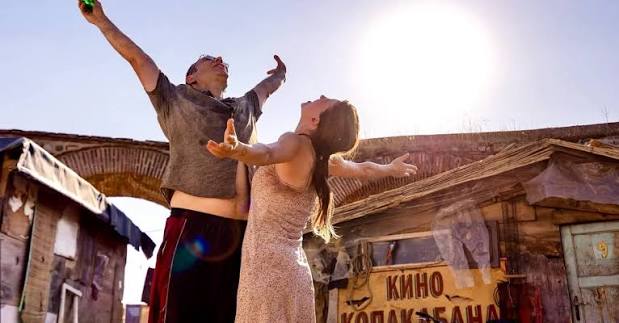
VERDICT: The fresh recipient of the Grand Prix in Tokyo, Milcho Manchevski’s funny-sad ode to sibling bonding ‘Sister Brother Manhole Cover’ champions human compassion in a chaotic world split between abject poverty and obscene wealth.
Down and out in Northern Macedonia, a spirited young woman and her cognitively impaired brother eek out a living stealing public property, until an accident on the job threatens their future. If the film’s title sounds hermetic at first glance, rest assured that it is fully meaningful in the context of this kinky character study filled with surreal objects, along with frequent tonal shifts and the kind of crazy local comedy that may not grab every viewer; but it is the kind of experiment audiences won’t regret trying. Sister Brother Manhole Cover won the best film prize at the Tokyo Film Festival two weeks ago, before playing to a welcoming full house in Cairo.
Offbeat, self-assured and ultimately quite moving, it is beautifully crafted with a playful, outrageous touch that will open doors to festivals and should find some business beyond that. It is the latest venture written and directed by indie filmmaker Milcho Manchevski, who won the Golden Lion in Venice in 1994 with his first film Before the Rain, and whose last film, a chillingly austere documentary interviewing survivors of a deadly nightclub fire in the town of Kocani, Good People, just bowed in Sarajevo.
Sardonic Balkan gallows humor introduces the wild couple of outsiders Malina (Manchevski regular Sara Klimoska) and her towering brother Viktor (Filip Trajkovic). They clatter through a summer night on a custom-made vehicle that combines a motorbike with several shopping carts, and stop in the middle of a deserted Skopje street where Viktor uses his muscle to pry a 40-kilogram manhole cover off its base. Considering the going price for cast iron on the black market is 30 euros a kilo, the risks they take begin to make sense.
They are also expert thieves of public statuary, particularly the ubiquitous busts of national heroes that stud the city parks. But when Viktor drops one of the heavy things on his foot, the excruciating pain knocks him out. He urgently needs to go to the hospital – but without insurance, it’s out of the question. Malina has to take matters into her own hands in a wild rush to raise cash and save Viktor’s foot.
Only now does it become apparent that Viktor is missing a few marbles and his younger sister is his caretaker. Her unwavering devotion to him is touching and limitless. The only thing she has to barter is her body, whose vulnerability screams from a flimsy black dress she wears in every scene of the film. On a visit to a lecherous doctor they know, “Mile Rabbit” (Dejan Lilic), she goes from asking for a loan to offering oral sex then and there in his office. He agrees to the latter, in exchange for medicine and bandages and a professional opinion of Viktor’s injury. His prognosis is not good. In an outré scene back at the siblings’ rural squat, Mile jumps on Malina, who has a weak heart, and ignoring her pleas nearly kills her – until Viktor surprisingly gets out of bed and drops a manhole cover on his head.
The absurdities pile up from this point on. Mile is dead and has to be disposed of, along with his expensive SUV which is parked in front of their hovel for all to see. They leave the body in a garbage dump and go joy-riding in his fancy car, in one of the many scenes that express the love between the brother and sister and their sheer happiness in each other’s company. The sordid life of poverty they lead, far beyond the reach of any social services or safety net, is heavily contrasted to the way they look after one another.
Their backstory emerges when Malina drags Viktor – on foot – to a remote house in the country where their father lives. He wants nothing to do with his offspring, as he is still nursing a grudge against his daughter, who it is implied should be in prison for what she did to his mistress, except his wife took the rap for her. The situation is complicated and Manchevski pulls it off with a light touch of desperate absurdity, aided by very physical, on-point performances from Klimoska and Trajkovic, who work together as a near-perfect comic-tragic duo. Klimovska has a physical exuberance that makes her a force of nature, but her dreams reveal her inner fear of suffocating under the weight of a manhole cover. Trajkovic gives Viktor a spacy wistfulness that makes Viktor’s mental disability both convincing and unthreatening at the same time.
Malina comes into her own in a long sequence where they break into Dr. Mile Rabbit’s modern mansion and become the forced guests of his blind mother, Todora (Sonja Mihajlova). Though sightless, the witchlike old lady with her sharp nose and long white hair seems to know everything about the siblings, and the fact she calls them Hansel and Gretel does not bode well. Veteran actress Mihajlova assumes an ambiguous control over their fate, and although she too is a doctor, Viktor’s foot remains in the balance.
The family’s great wealth and social status (they even have the bust of a national hero in the living room) opens up the theme of extreme poverty and riches that plague modern societies. However helpful Todora can be to them, Malina and Viktor remain the moral center of Manchevski’s very complex fictional world, where the very rich are evil and lonely, and the values of love and compassion seem all but lost.
Director, screenwriter: Milcho Manchevski
Producer: Jane Kortoshev
Cast: Sara Klimoska, Filip Trajkovic, Sonja Mihajlova, Dejan Lilic, Petar Mircevski, Stefan Nikolovski, Jordan Simonov, Jasmine Vasileva, Ana Kostovska, Ivan Gosevski
Cinematography: Stefano Falivene
Production design: David Munns
Editing: Blagoja Nedelkovski
Music: Igor Vasilev Novogradska
Sound: Igor Popovski, Herman Pieete
Production companies: Banana Film DOOEL, Gala Film, Sense Production, Tirana Film Institute, Berkeley Media Group, Amarcord Production, Augustus Color
World sales: Banana Film
Venue: Cairo Intl. Film Festival (Out of Competition)
In Macedonian
106 minutes