
The Cord
Kindik
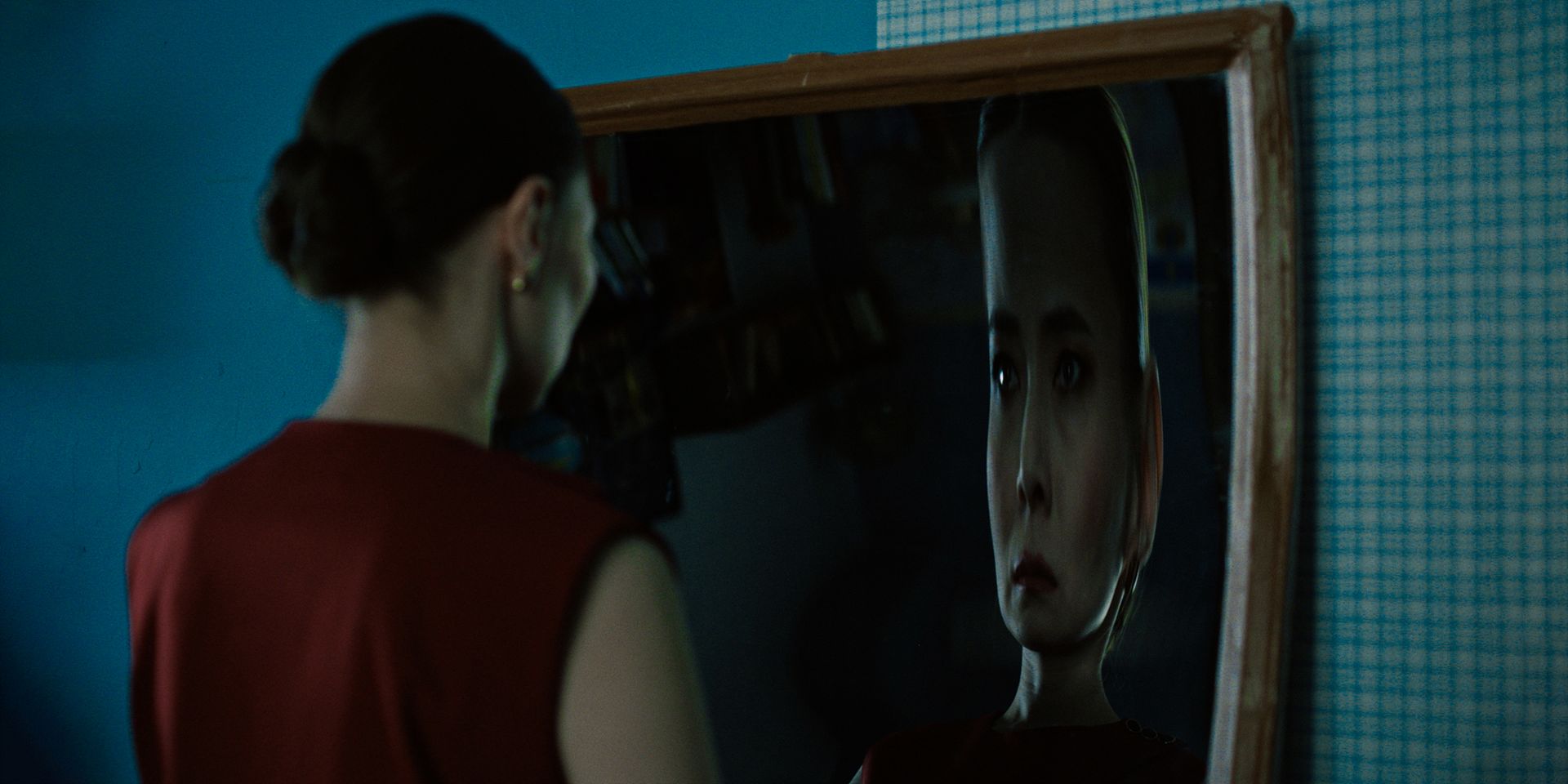
VERDICT: A mother's world unravels when her only son is charged with a violent crime in this dark, chilly and pointed Kazakh drama.
Sometimes it is not see easy for a mother to cut the cord.
In the case of Dinara (Aigerim Mustafa) she has been a doting mother to her only child, Kuanysh since the moment he was born. Long divorced from the boy’s father, Dinara and her son have been each others’ worlds for 17 years, living in claustrophobic close quarters until one day a brutal assault charge is levelled at Kuanysh and his friends. Dinara soon finds herself desperately trying to get Kuanysh released from prison – a battle against police but also the other mothers whose money affords them more power over the situation. In The Cord, which premieres in Busan this week, Darkhan Tulegenov tells the story of a mother struggling with her grip on reality and sanity as she fights for her son’s future. It’s a dark drama with pointed social critique that primarily lives or dies by Mustafa’s full-throated and increasingly unhinged central performance.
The unsettling direction that The Cord travels is evident from its opening moments. A pre-title sequence gives the year as 2009 and features Dinara beaming with love at the babe in her arms, however a second short scene, set in 2014, shows the child Kuanysh rushing to the kitchen drawers as his mother and father fight – physically by the sounds of it – in another room. He reaches into the drawer and pulls out a kitchen knife, at which point the title appears and the action shifts to the present. Given the time elapsed, this is not so much a case of Chekhov’s kitchen knife, but the threat of violence seems palpable and Tulegenov does little to dispel this in atmosphere. As we meet Dinara and Kuanysh (Ansar Bolatbekuly) at this stage of life, they have a strange relationship – too close – with Kuanysh smothered and infantalised.
As the story begins, Kuanysh is accepted into an American university, an achievement that fills his mother with unbridled pride but a night out partying with his best friends Sanzhar (Damir Amengeldin) and Leila (Dana Amirkul) leads to a violent altercation with two men who end up in hospital with grievous injuries, one of whom subsequently succumbs to his. This all happens off screen, with no real clue as to the exact order of events. All three of the teenagers are arrested in conjunction with the offence and Dinara and the other two mothers find themselves battling to prove their children’s innocence or, at the very least, have them released.
It is in this mode that most of The Cord resides, striking an unusual balance between being about a devastated mother fighting for her son’s freedom, begin about the petty grievances and rivalries in the Kazakh middle classes, and being about this unnervingly intimate mother-son relationship and its psychological impact on both Dinara and Kuanysh. The screenplay by Anel Sartayeva, Perizat Myrzakhmet and Luiza Zaripova tries to weaves all of these elements throughout the proceedings with mixed results, but it is a compelling mix of themes and narrative threads that continually wrong-foot the audience and keep them wondering what actually happened on the night in question and how the case will conclude.
From early on, it is clear that Dinara and Kuanysh are outsiders when compared to the affluence of the other two families. Asel (Assel Akbarova) and Sara (Tolkyn Nurbekova) – Sanzhar and Leila’s mothers, respectively – make snide comments at a parents meeting that belittle and undermine Dinara’s attempts to make attending the forthcoming prom cheaper for her son. When the three women meet at Sara’s house after the arrests, the chic and cavernous living space sits in stark contrast to Dinara’s home with barely a few small cluttered rooms and one single bed that mother and son still share. When things go south, this existing line of distinction makes it easier for Asel and Sara to raise funds to bribe a judge, to hire expensive lawyers, and to pin the crime solely on Kuanysh.
Through all of this, Mustafa’s Dinara cuts an anguished figure. Even before the arrests she seems seems drawn and flinty, her angular features and sharp eyes suggesting someone who has had to fight her way to where she is. There are moments of warmth – with Kuanysh and in a relationship with the handsome doctor Tair (Zhanat Ospanov) that she has hidden from her son – but as events unfold those ebb away and something more manic emerges. In the prison, Bolatbekuly does a sterling job of conveying Kuanysh’s own bewilderment at what has happened. He is tight-lipped and refuses to give away anything without ever allowing Kuanysh to lose the audience’s empathy.
All of this is shot in cool tones that only emphasise the callous nature of the world that these people inhabit and the cruel decision that they have made – and may still have to make – to retain their status and get what they want for their children. In Dinara’s case, that distress leads to recklessness and an increasingly disassociated demeanour even as – or, perhaps, because – tragic truths are exposed. There are some sequences in which this works incredibly well, not least the most chilling scene of the film, near the end. At other times it lands a little less well, and there are certain scenes whose drawn out nature fails to maintain their tension. On the whole, though Tulegenov does a good job of sustaining the disconcerting atmosphere that keeps The Cord highly watchable.
Director: Darkhan Tulegenov
Screenplay: Anel Sartayeva, Perizat Myrzakhmet, Luiza Zaripova
Cast: Aigerim Mustafa, Ansar Bolatbekuly, Assel Akbarova, Tolkyn Nurbekova, Damir Amangeldin, Dana Amirkul
Producer(s): Kuat Sadykov, Igor Tsay, Rustem Omarov, Timur Smagulov, Orynbasar Kudaibergenov, Anel Sartayeva
Cinematography: Satbek Bakyt
Editing: Yerkin Sagindynkov, Almatbek Amangeldy
Music: Abai Akbaev
Sound: Andrey Kiryukhin, Aleksandr Proskuryakov
Production design: Kazybek Tabylganov
Production company: Salem Entertainment (Kazakhstan)
Venue: Busan International Film Festival (Vision: Asia)
In Kazakh, Russian, English
120 minutes
Read more of our coverage of Busan International Film Festival.