
The History of Concrete
The History of Concrete
VERDICT: Following his cult TV show, John Wilson's first feature smuggles reflections on endurance, transition and mortality into a film ostensibly about a ubiquitous building material.
Anyone familiar with his previous work, would know John Wilson’s new feature documentary was bound to be about far more than The History of Concrete.
In the same format as viewers came to and love from his adored HBO television show How To with John Wilson, the filmmaker takes an apparently mundane topic and spins it out into a freewheeling and free-associating riff on deeper human questions. The show included episodes called things like How To Put up Scaffolding, How To Appreciate Wine and How To Clean Your Eyes, in which Wilson would take these simple questions that many fellow New Yorkers might wonder about the answers to, and take viewers on a rambling and often rather profound 30-minute journey towards answers to those questions and more. Made up of an ever-moving montage of clips from Wilson’s own enormous archive of street footage, the episodes were wry, inventive and very funny. The History of Concrete is basically a 1 hour and 41 minute episode of the show.
The premise of the film, in fact, is born of the show’s ending (it ran for three seasons from 2020-23). Wilson finds himself somewhat adrift. He has acquired a certain level of fame – he gets invitations to work with known brands, his voice is being approximated by AI to sell guttering, and he is the subject of a question under the ‘celebrity’ category on Jeaopardy – which the contestants don’t get right. Floundering for what to do next, he attends a WGA workshop on how to write and sell a Hallmark movie and finds comfort in the idea of a formula that can guarantee viewership and attract funding. Inspired by a Hallmark film about a property developer falling in love, wonders if he can use the hints and tips he’s learned, to sell his own film about concrete – a subject he admits to know embarrassingly little about.
Wilson approaches his subject using the same stylistic devices that became familiar to viewers of How To… The film is made up of visuals shot by Wilson himself, documenting everyday life and the odd and humorous things that he comes across in New York as he goes about his week. It is accompanied by his own voiceover narration, delivered in his nasal and slightly stilted, awkward manner that describes events in the second person, so all the things happening in his life and the decisions he takes are attributed to ‘you’ – the viewer. This compilation of images often throws up incongruities and ways to undercut any import in his pondering – he delights in subverting the meaning of his words with comical shots.
At one point early in The History of Concrete he pairs the voiceover line “you always wanted to take the road less travelled,” with a shot of a little girl riding a tricycle down a suburban street, before panning up to the sign identifying it as ‘Buttzville Rd.’ Elsewhere, as employs the visuals as wordplay like when he he describes having signed a contract agreeing not to portray concrete in a negative light. “You’re not loving it,” he says as the film cuts to an image of the shape of the McDonald’s arches, silhouetted against a wall. This playfulness exists throughout the film as the narration and edit dovetail into perfect little pirouettes and the sheer volume of footage Wilson has to call upon allows him to make cheeky or clever connections to any topic he’s centred in on.
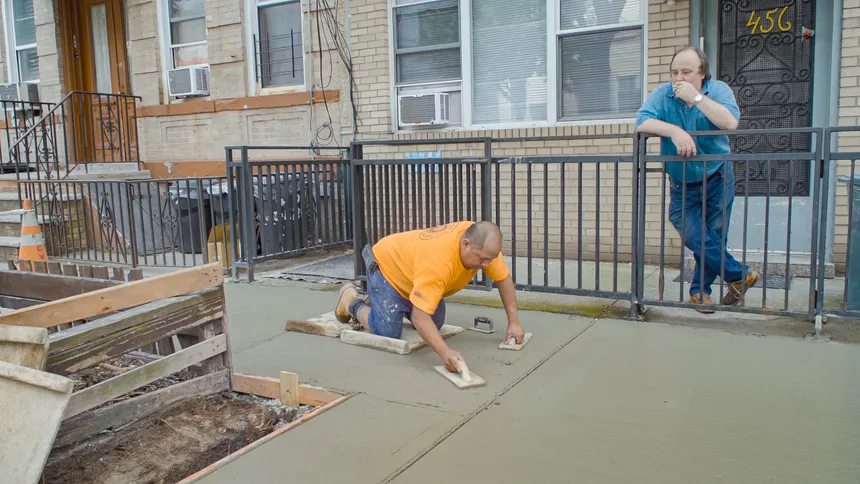
The topics themselves range wildly, though. From the maintenance of New York sidewalks, he ends up spending time with the city’s premiere chewing gum cleaner, the Gum Busters, via curious observations of the places that most people tend to spit their gum onto the pavement. From a visit to a Hallmark movie studio in Canada where an employee describes the cyclical nature of making the same movie on repeat, Wilson finds himself depicting a 3,100 mile race that takes place around a single block in Queens which competitors circle all day, every day, for 52 days straight. From taking a ride down the oldest concrete street in America, in Ohio, he ends up speaking to the people who run a company preserving the tattoos of deceased loved ones.
These may all seem like bizarre and idiosyncratic cul-de-sacs that Wilson finds himself travelling, but the gift that he has – exhibited in How To… and once again with The History of Concrete, is coalescing this oddball cast of characters and subjects into a cohesive whole. Whether or not the film quite warrants the full extent of its runtime, he shows that the format absolutely supports the longer feature film. Through taking in the subject of this ever-present building material – by his own claim the second most-used material on the planet after water – he explores human nature, our need to preserve, to endure. He might go to Rome and see the majesty of the Pantheon standing for the depth of human ingenuity, but he sees the same thing in the injured ankle of a runner who’s attempted to run around a single city block for more than 5,000 laps. For John Wilson, the magnificent and mundane exist in the same instant.
Director, screenplay, cinematography: John Wilson
Producer(s): Clark Filio, Shirel Kozak, Allie Viti, John Wilson
Editing: Cori Wapnowska
Production companies: Bronxburgh, Central Pictures, Peanut World Pictures (USA)
Venue: International Documentary Festival Amsterdam (IDFA) (Best of Fests)
In English, Italian, Mandarin
101 minutes
Read more of our coverage of International Documentary Festival Amsterdam (IDFA).