
The Lookalike
El Shabih
VERDICT: Three Egyptian men turn their looks into a living in Nehal Elkoussi's funny, quietly political, warm documentry about fame and class in contemporary Egypt.
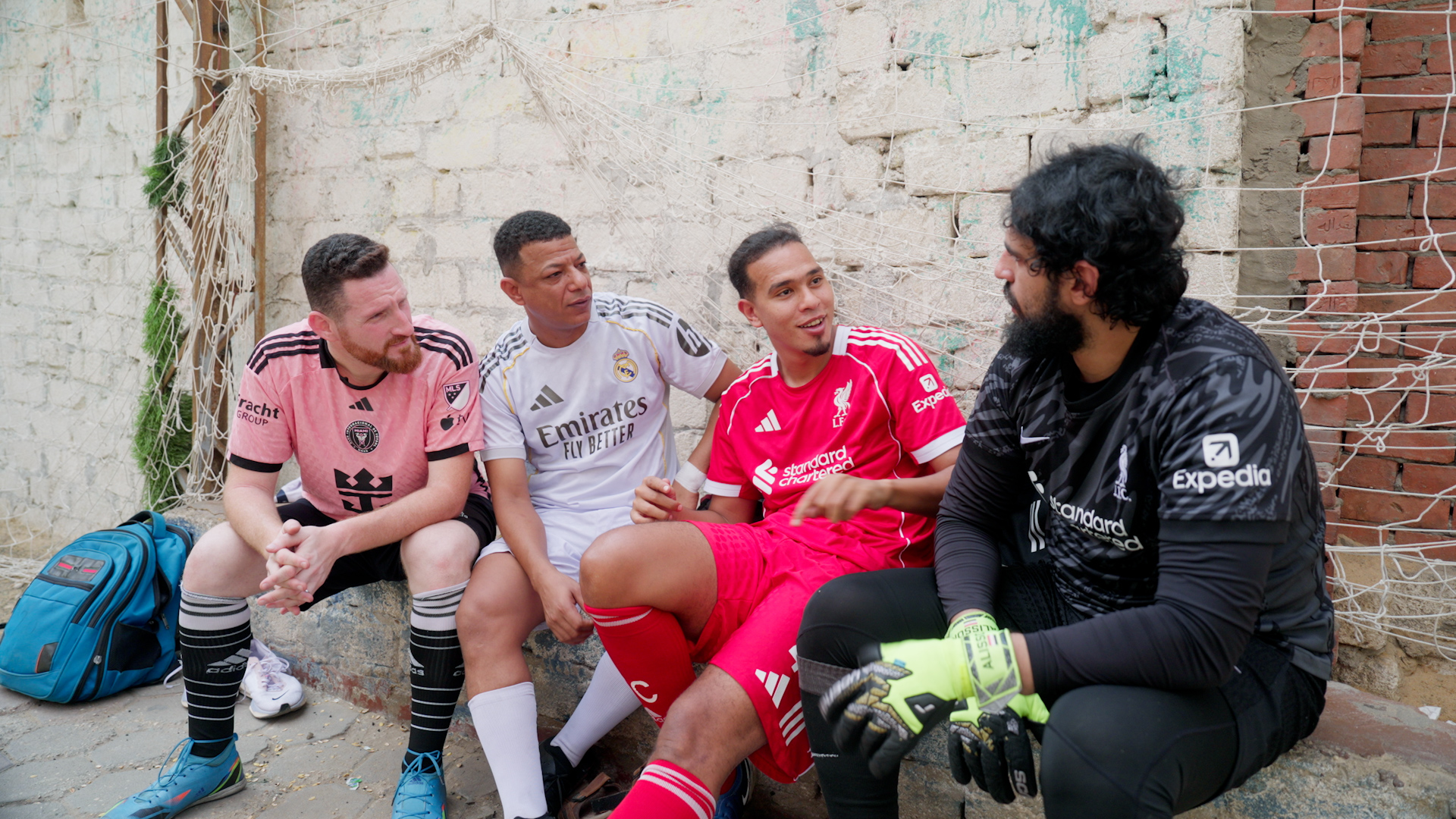
A small boy runs up to three men in football shirts and starts pulling at their faces. “Take off those masks,” he shouts. He thinks faces so close to Kylian Mbappe, Virgil van Dijk, and Alisson Becker must be rubber. They aren’t. They belong to Egyptian men who turned looking like someone famous into a way of making money.
Nehald Elkoussi’s documentary, The Lookalike (El Shabih), which premiered at Cairo Film Festival’s special screenings section, follows three of them. Khalid Munir has the moves, curls and lip syncing skill of singer Muhammad Munir. Alaa El Bedawi is the Egyptian Mbappe, leader of the football doubles. El Hajj Abdel Nabi, a former construction worker, carries the face of Sheikh Mohammed Metwalli Sha’rawi, Egypt’s popular TV preacher.
Khalid gives the film its main idea. Once he went to a Mohamed Munir concert which cost 20 Egyptian pounds. Now tickets reach 2,000 or 4,000 pounds, money he could use to buy his son college clothes. He charges two tickets’ price and brings the Mohamed Munir double to orphans’ parties, graduations and weddings. Alaa makes the same point. The real Mbappe travels like the president, so a shop hires the double. When stars are out of reach, the masses settle for what they can touch and whoever they can relate to.
In Egypt, doubles have a nickname, the Ghalaba version, a.k.a. the poor man’s Mbappe. Ghalaba means people who get by on little. Mbappe al Ghalaba is the Mbappe you can afford. The film takes this joke seriously.
After 2011, social media consumption and production boomed in Egypt. Internet access and pirated programmes allowed young people from working-class neighbourhoods to make their own content, and helped genres such as Mahraganat, a working class sub-genre of RnB and Pop, flourish. Later, TikTok offered another path for working-class people to become stars, producing videos for audiences who recognised their jokes, accents and daily lives. The doubles belong to this world too.
Elkoussi’s documentary is also funny, mostly thanks to the football squad. Their Syrian Messi boasts of eight Ballon d’Ors. Alisson is an engineer. Trolls call Alaa Kylian “Ambuba”, which is Egyptian Arabic for gas cylinder. He is delighted, because arguments in the comments push up his views and get him more gigs. Before playing, they have no referee. Alaa says the YouTube comments will decide. When a skinny teenager declares himself Mbappe 3, Alaa walks off in mock despair. “If they call me the gas cylinder, what will they call you?”
Under these jokes, there is real hardship. Alaa and his videographer friend lived on bread and nearly quit, until a client offered 500 Egyptian pounds for a birthday video.
Abdel Nabi’s strand is the quietest. He recalls a dream of handing out dates that led him to his mosque job, and buys skull caps from the sheikh’s tailor. At a Moulid, a fair to celebrate the birthday of a holy person, crowds kiss his hand and ask for blessings. He draws a line: he will not give religious opinions or quote a hadith or Quranic verse he doesn’t know. He is just an image of the sheikh, whose pictures hang everywhere from juice stands to microbuses.
Elkoussi cuts between the three, rather than giving each a chapter. Khalid is in a dressing room lit by ring lights, showing two faces in the frame. The squad looks tiny on a green pitch under brick tower blocks. A double recalls a TV psychologist warning they could lose themselves in their characters. “Don’t worry, we are the pharaohs,” he replies. Alaa’s daughter points to an old photo: “That’s not Mbappe, that’s Alaa.”
The film raises hard questions, but does not give them much space. The filmmakers tell Khalid that he only lip syncs and Munir’s fans have a right to be angry, as they are on his socials. The conversation ends quickly. There is little room for the families.
For all its jokes, Elkoussi’s film is quietly approaching politics. There is no mention of inflation or the government, yet Khalid’s ticket prices says more about Egypt’s cost of living crisis than a statistic. Alaa’s joke that Mbappe travels like the president carries an edge. Abdel Nabi’s caution about fatwas raises a question: who gets to speak for religion? Why are crowds ready to treat a former worker as a holy man? So when Khalid, in his bold closing speech, explains that people love the lookalikes because they are humble, approachable and come from the same world as their audiences, unlike the stars who have become distant and arrogant, his words take on a political edge. After all, it was the poor who made these stars famous. And when he declares that their time is over and the poor will rise, his speech about pop stars starts to sound like something bigger.
The film ends with a Mahraganat video song, “I am Mbappe’s lookalike,” the squad dancing before street graffiti. This cheeky ending closes a warm and generous film that should travel beyond Cairo. But the line that stays with you is Alaa’s: “Maybe if you call me Mbappe, I will answer.” The real Mbappe won’t.
Director, screenplay: Nehal Elkoussi
Producers: Nehal Elkoussi, Ahmed Nader
With: Khaled Mounir, Aladdin Ahmed, Abdel Nabi Kaabou
Cinematography: Ahmed Nader, Mohamed Abdelatef
Editing: Ahmed Nader
Sound: Mohamed Ezz, Ramzy Zakka Yossef
Production company: Render Films
In collaboration with: Al Jazeera Documentary
Venue: Cairo International Film Festival (Special Screenings) – World Premiere
In Arabic
67 minutes