The Spiral
L'estranea
VERDICT: A dark family secret is at the core of Paolo Strippoli’s horror-tinged drama ‘The Spiral’, which injects some genre flavor into Venice’s main competition.
A year after premiering The Holy Boy at the Venice Film Festival, Paolo Strippoli – one of the more intriguing names in the realm of Italian genre cinema – is already back behind the camera, and on the Lido, with The Spiral. And while some may think it was uncalled for to upgrade him to the main competition, it’s the kind of push that is bound to get even more eyeballs on a filmmaker whose confidence with the cinematic tools at his disposal is a marvel to behold, especially when he goes more directly for the jugular as he does in this case.
The story begins in Rome, in 2026. It’s raining heavily, and a woman, Anna (Jasmine Trinca), pays a visit to her daughter Alice (Romana Maggiora Vergano). The two don’t have an easy relationship (as the film goes on, it becomes clear there’s some sort of estrangement), but Anna is driven by the need to share a dark secret that concerns the entire family. In fact, it’s what has been driving everything that’s happened to them for the past (nearly) three decades.
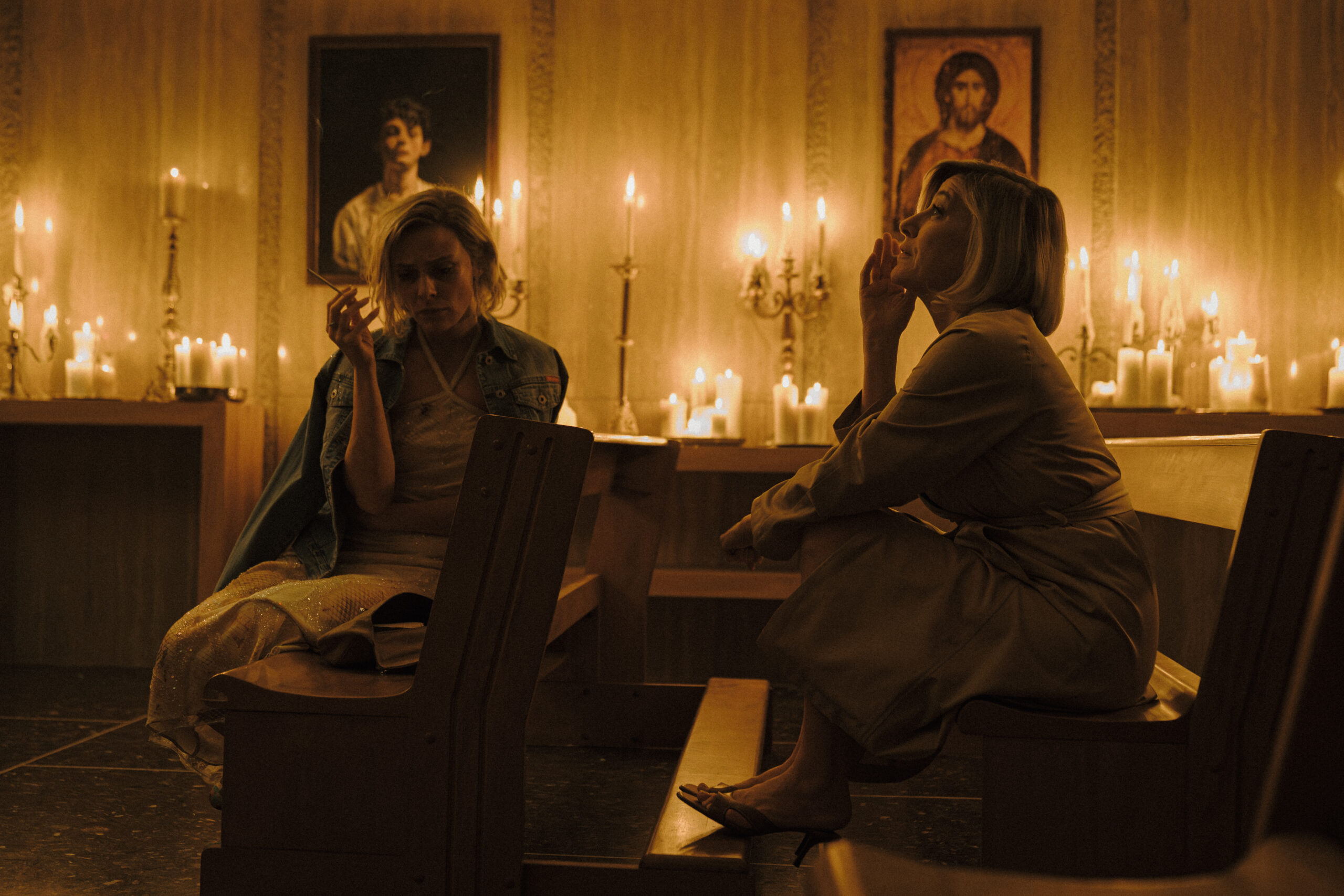
At this point, the film flashes back to various time periods, beginning with 1999. It’s summer, and the wealthy family – Anna, her husband Walter (Adriano Giannini) and their two children Alice and Tobia – are having the time of their lives inside their mansion in Bari. Then, one day, an unfortunate incident puts Anna in contact with the Stranger (per the movie’s Italian title): a mysterious individual who appears in the shape of an eccentric woman (Valeria Bruni Tedeschi) and proposes a deal akin to those made by George Elvid in Stephen King’s novella Fair Extension – she can solve the problem, but someone else will have to deal with a different kind of hardship. The Stranger will go on to resurface periodically, every time Anna realizes her original choice has consequences far beyond her imagination.
The international title refers to a visual motif that reoccurs throughout the film, sometimes in delightfully unexplained ways. The most amusing instance is a character wearing a T-shirt with the image of Billy, the puppet from the Saw franchise (whose ninth installment was titled Spiral). And while Strippoli’s world is markedly different from James Wan’s, there is a bit of a spiritual kinship that becomes literal in a few choice sequences, to the extent that one almost imagines what it would be like to hear Bruni Tedeschi’s take on Tobin Bell’s famous line “Live or die, the choice is yours.”
The Italian-French actress (whose dual citizenship makes her most memorable line even funnier than it already is) is perfectly cast as the enigmatic dealmaker: her acting style has always been an acquired taste, and is magnificently suited for a character who immediately feels a bit out of this world. It’s the opposite approach of Ursula Meier, whose movie The Line grounded her eccentricities in a tangible reality: here, she’s an external force, with the vocal and physical stylings to match.
Then again, the way Strippoli uses her is a bit playful in that regard, as the film operates on a somewhat heightened level even before the Stranger makes her entrance: the early Bari scenes are drenched in an almost unreal light, with a choreography set to Liquido’s Narcotic adding to the bizarre atmosphere. Only when the stage is set for Anna’s first encounter with the malevolent entity is everyone brought down to a more recognizable plane of existence.
One may even wonder if the Stranger is just a figment of the protagonist’s imagination (there’s plenty of room for ambiguity), but that is ultimately secondary to the sheer sense of fun Bruni Tedeschi and Trinca inject into every single one of their darkly comic interactions. Some might miss the more slow-burn approach of The Holy Boy, but what The Spiral may lack in meticulous build-up it makes up for in successive pay-offs, particularly in a segment set in the summer of 2006 that reframes one of Italy’s defining triumphs as a great tragedy. It’s propulsive and exhilarating, a ray of sunshine despite the gloomy clouds that bookend the framing device.
Director: Paolo Strippoli
Screenwriters: Paolo Strippoli, Salvatore De Chirico
Cast: Jasmine Trinca, Romana Maggiora Vergano, Adriano Giannini, Valeria Bruni Tedeschi
Producers: Marina Marzotto, Mattia Oddone, Ivan D’Ambrosio, Lello Petrone, Jean-Christophe Reymond, Joseph Rouschop, Eva Curia
Cinematography: Cristiano Di Nicola
Production design: Marcello Di Carlo
Costume design: Susanna Mastroianni
Music: Rob
Sound: Quentin Collette, Marc Bastien, Franco Piscopo
Production companies: Propaganda Italia, Rai Cinema, Kazak Productions, Tarantula, Dinamo Film
World sales: Le Pacte
Venue: Venice Film Festival (Competition)
In Italian
115 minutes