
Camouflage
.
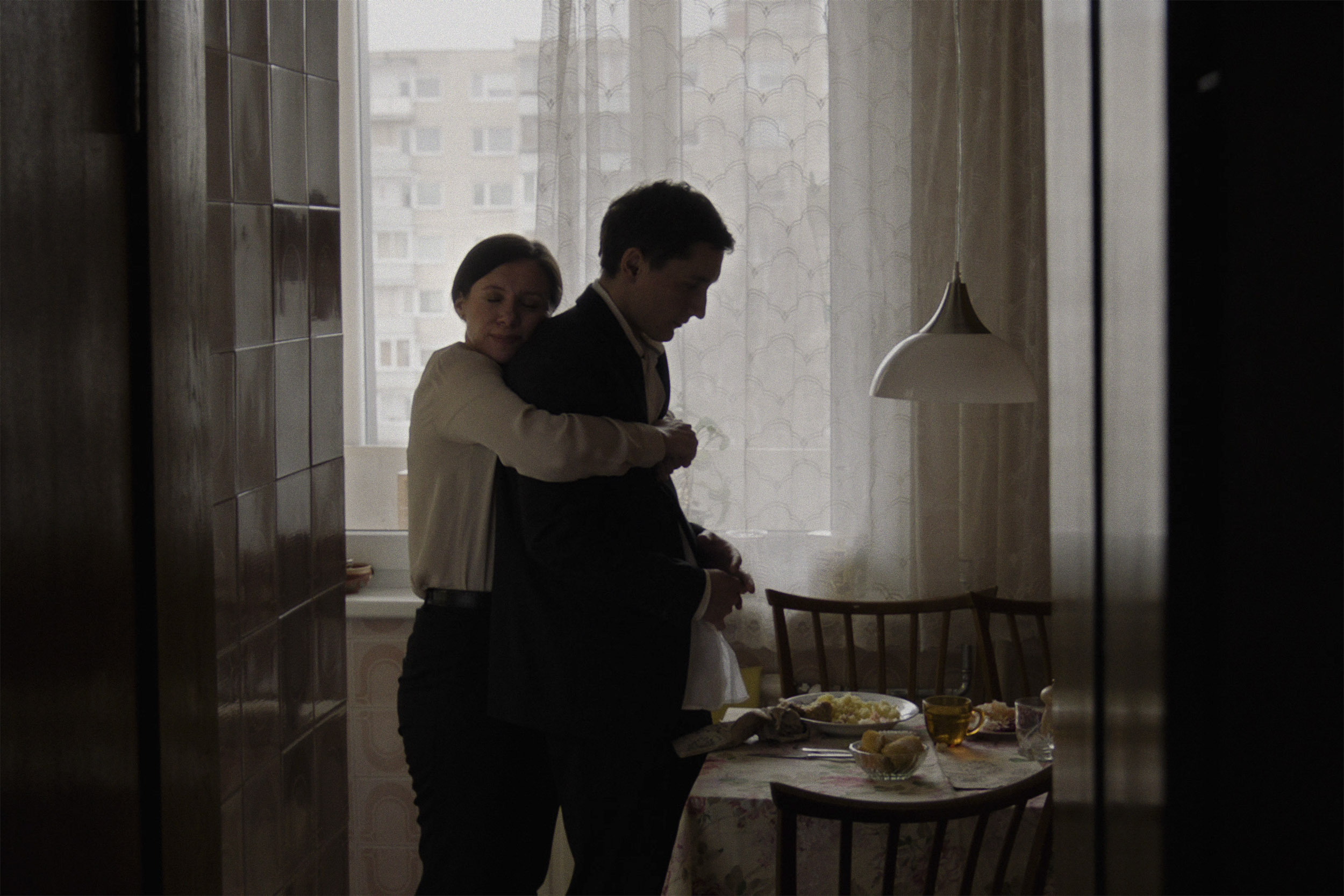
VERDICT: The Russian invasion of Ukraine gets a very personal cinematic treatment in Mykyta Gibalenko’s first feature ‘Camouflage’, inspired by his own experiences.
In 2013, the then 20-year old Mykyta Gibalenko left his native Ukraine for Germany, where he discovered the local art scene while working an engineer. In 2016, he completed his first film, the documentary Sinnspagat, and made cinema his primary interest starting in 2019, with a specific focus on the lives of Ukrainians living abroad. That concern is also part of his fiction feature debut Camouflage, whose topical premise is likely to gain attention on a wider scale after the film’s premiere in Venice’s independent section Giornate degli Autori.
Much like the filmmaker himself, the protagonist Vitaly (Arthur Aliiev) chooses to relocate to Munich for reasons unrelated to the events of the last four years: the story begins in 2021, and the young man is simply dreaming of a different life, which he eventually achieves – after initially struggling with adjusting to the German city – by joining a student theater troupe. Then, the war erupts and things change drastically, not just for Vitaly but also for Fiona (Klara Lange), who has been putting a roof over his head: instead of one guest, she has to look after three, as the duo is joined by Vitaly’s mother (Anna Yaremchuk-Bobalo) and sister (Yelyzaveta Tsilyk).
Having previously made a major change willingly, Vitaly now finds himself with his life upended for reasons beyond his control, having to deal with a dual conflict: the one in the motherland, which affects him from afar, and the one inside his Munich lodgings, where his family members become an emotional burden. The domestic walls turn into a spiritual battleground, which Gibalenko and cinematographer Mirko Hans use to convey the turmoil at play with the same intensity of what other filmmakers would frame as an outdoors scene in a war-torn city.
The devastation is primarily within, and Gibalenko uses this fictional set-up with loosely autobiographical elements to vent his anger at the current geopolitical situation, via the lives of people from two different generations who do not have the same response to what is happening around them (Vitaly’s mother, who grew up in the Soviet era, is in denial about the war until it actively forces her to leave the country). As they wander in a strange city, alienated in every sense of the word, the director conjures an image of his adopted home that is at once a safe haven and a source of existential angst, the symbol of a displacement none of the four main characters – including Fiona, who is literally at home – are fully equipped to deal with adequately.
Only through the performing arts can Vitaly find some relief, and the scenes depicting the theatrical space are among the most moving in the entire film: while the milieu has a bit of an experimental aesthetic, being very bare and not a tangible representation of our world, it’s in those constructs that the protagonist manages to make sense of his existence, and that microcosm feels more real than the nightmare scenario the family is going through. It is often said that art and culture can’t change the world. But at least in this case, they provide a valuable escape, for the people in the film and, to a degree, to those watching it, while we’re all still keenly aware of the atrocities of the outside world.
Director: Mykyta Gibalenko
Screenwriters: Mykyta Gibalenko, Sharyhan Osman
Cast: Arthur Aliiev, Yelyzaveta Tsilyk, Anna Yaremchuk-Bobalo, Klara Lange, Alina Danko, Andrii Kudin
Producers: Katharina Kolleczek, Lea Neu, Jennifer Drake
Cinematography: Mirko Hans
Production design: Olga Yurasova
Costume design: Miriam Waldenspuhl
Music: Mykyta Moiseiev
Sound: Xavier Fleming
Production companies: kalekone film, ZDF Das Kleine Fernsehspiel
World sales: MMM Film Sales
Venue: Venice Film Festival (Giornate degli Autori)
In Ukrainian, German, Russian, English
102 minutes