
Happiness Is So Close!
Ah que le bonheur est proche!
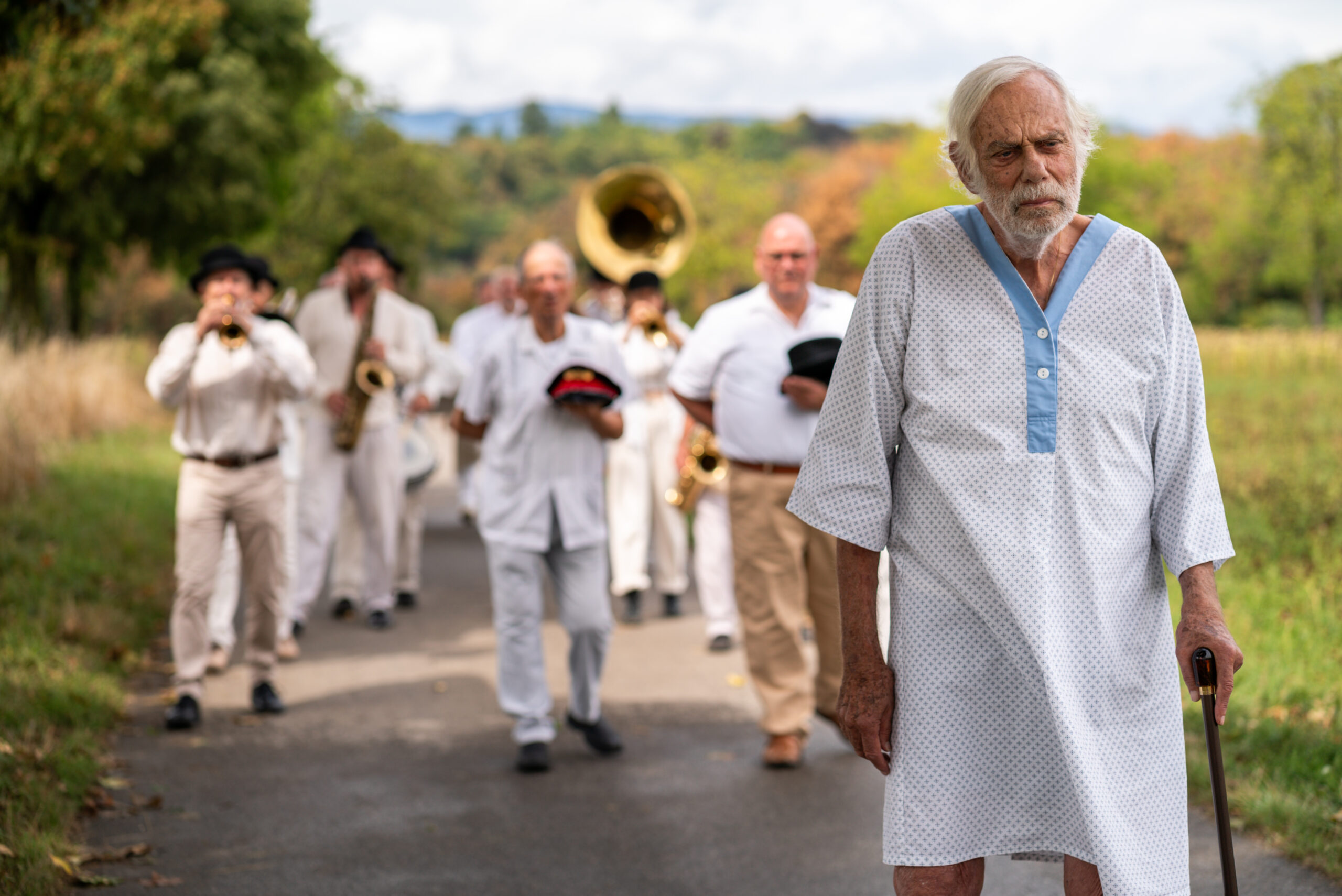
VERDICT: Geneva-born actor Jean-Luc Bideau is in amusingly self-effacing mode in the comedy ‘Happiness Is So Close!’, about an aging thespian.
A living legend in the French-speaking acting community, both on stage and screen, Jean-Luc Bideau has been entertaining audiences since the early 1960s, with no signs of wanting to stop in his mid-80s. He wittily pokes fun at this in the comedy Happiness Is So Close!, which premiered in Locarno and is undoubtedly going to attract viewers in the French-language realm, with possible crossover appeal in the German and Italian-speaking parts of Switzerland as well due to Bideau’s cultural stature.
Based on an idea by the actor’s wife Marcela Salivarova, the film is largely set within the confines of a theater in Geneva, where an elderly thespian named Jean-Luc is about to play Don Quixote, the ideal role to mark his farewell to the stage. Unfortunately, he is no longer all there, physically or mentally, as the very first rehearsal we’re shown goes pear-shaped on account of Jean-Luc struggling with his lines and also getting distracted by various elements.
As is customary, the company appoints an understudy, one Gilles Favre (Gilles Privat), which doesn’t sit well with Jean-Luc since, unlike everyone else, he has no doubt whatsoever he will make it to opening night with the role perfectly nailed down. And as time passes, his existing issues begin to make way for a hefty dose of paranoia, as he believes Gilles’ presence will effectively erase him.
Of course, off-screen is a whole other matter, as Bideau has surrounded himself with trusted friends and collaborators, including director and co-writer François-Christophe Marzal who previously worked with him on 2019’s Roll the Drum!, which partially served as a throwback to the illustrious actor’s career via archive footage. Happiness Is So Close! has a similar approach, in that the fictional Jean-Luc’s filmography overlaps with Bideau’s, with the title itself being taken from one of his defining screen moments, a memorable scene in Alain Tanner’s La Salamandre (shown in the closing credits).
It is a career retrospective, albeit a very self-effacing one given that, by all accounts, Bideau is still very sharp when it comes to memorizing lines and has no intention of retiring. In fact, the endearing vulnerability he showcases here, by actively using his craft to meditate on what happens when the artistic tools begin to fade away, is a nice complement to the energetic and at the same time curmudgeonly persona he has developed over the years. It’s also a very generous performance, for while the other Jean-Luc is mainly concerned about himself, Bideau is in a constant mutually beneficial exchange with the ensemble cast.
Walking a tightrope that goes back and forth between funny and melancholy, Marzal devises a world that is fairly recognizable (particularly if one is familiar with the Geneva culture scene), but also entertainingly heightened in a way that matches his star’s iconic status and occasionally larger-than-life demeanor. As a comedy about the arts, it’s charming despite never really thinking outside the box. As a monument to one of the great European actors, it’s a thoughtful and often very touching piece of work.
Director: François-Christophe Marzal
Screenwriters: François-Christophe Marzal, Nicolas Frey
Cast: Jean-Luc Bideau, Gilles Privat, Aurore Clément, Isabelle Caillat, Pierre Mifsud, Romain Daroles, Roland Vouilloz
Producer: François-Christophe Marzal, Jean-Marc Fröhle
Cinematography: Séverine Barde
Costume design: Geneviève Maulini
Music: Alain Frey
Sound: François Wolf
Production companies: Light Night Production SA, Point Prod, RTS Radio Télévision suisse
World sales: Light Night Production SA, Point Prod
Venue: Locarno Film Festival (Fuori Concorso)
In French
70 minutes