Making Marie Antoinette
.
VERDICT: The mutual love and admiration between mother and daughter is central to the quietly enthralling ‘Making Marie Antoinette’, Eleanor Coppola’s posthumous swansong.
In 1991, Eleanor Coppola’s documentary footage from the shoot of her husband Francis’ film Apocalypse Now served as the basis for Hearts of Darkness: A Filmmaker’s Apocalypse, a mesmerizing portrait of a production that nearly drove everyone involved to insanity. Then 35 years later, she posthumously delivers a very different on-set experience in the shape of Making Marie Antoinette, which was completed at the behest of her daughter Sofia. Available on MUBI, and also screened at various festivals, it will appeal primarily to fans of the original Marie Antoinette, as well as admirers of the Coppola family as a whole.
The footage was originally captured in 2005, and remained unwatched for fifteen years, until the pandemic brought the Coppolas together and Eleanor and Sofia began looking through it. The film opens, in fact, with an extract of Eleanor’s journal, dated June 2020, which ends like this: “I always thought I’d get back to the material one day and assemble it into my look behind-the-scenes at the exquisite beauty created to realize the movie. Now that Sofia is here in our lockdown bubble, we decided to get started.” The next title card is a statement by Sofia, written in 2026: “After my mother passed in 2024, we did our best to finish this for her. Including her journals from the time, this is her footage 20 years later, seeing her eye on what we were making.”
What we see is therefore a dual labor of love: from mother to daughter, as depicted in the material filmed on the Marie Antoinette set in 2005, and from daughter to mother, through the editing of the footage and the selection of journal entries serving as a voiceover, with the narration coming from Diane Lane, a member of the extended family since she appeared in four of Francis Ford Coppola’s films and then starred in Eleanor’s feature fiction debut Paris Can Wait (2016). Naturally, Francis, who dedicated his passion project Megalopolis to his wife, also appears.
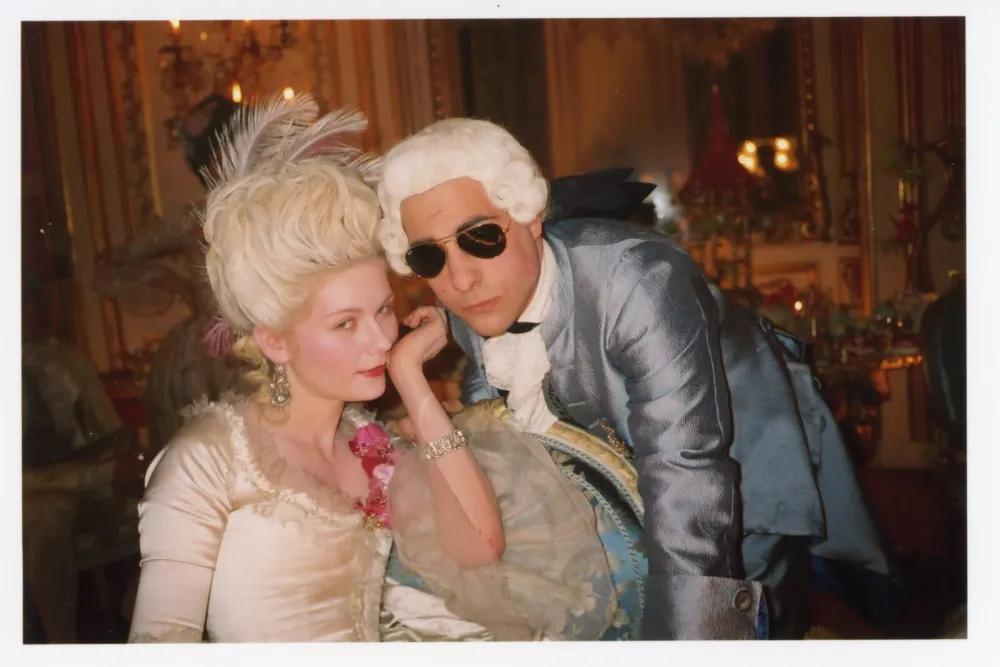
Of course, that Marie Antoinette was a personal project to Sofia Coppola, and a family affair of sorts, was already clear in 2006: in addition to Francis serving as an executive producer, her cousin Jason Schwartzman co-starred as Louis XVI, and her older brother Roman worked as the second unit director, as he had already done on The Virgin Suicides and several of their father’s pictures. Eleanor’s look at what happened on the set adds another layer to the warmth and richness that was part of the finished film. And while her presence is acknowledged (with both Kirsten Dunst and Sofia admitting they feel a bit self-conscious talking while Eleanor is filming them), she gradually disappears into the background and just takes it all in, striking a balance of grace and frivolity that sort of mirrors the movie itself (in one the documentary’s sillier moments, Asia Argento and Schwartzman compare their mastery of Italian gestures).
By virtue of the production it shadowed, Making Marie Antoinette is, inevitably, less chaotic than Hearts of Darkness, which some have famously described as being arguably a better representation of Joseph Conrad’s source material than Apocalypse Now itself turned out to be. But while the stakes may be comparatively lower (Sofia does still marvel at the fact she was able to finish her film on time and on budget, on account of the larger scope compared to her previous two movies), this behind-the-scenes journey is no less interesting, as both documentaries share the core quality of being about family and thus reflecting their director’s very personal sensibility, namely an admiration for what her husband and daughter were able to accomplish in the pursuit of their vision. And it’s fitting that her directorial career was bookended by these two projects: the Coppola family saga, ideally summed up in a total of 182 minutes.
Director, Screenwriter: Eleanor Coppola
Cast: Eleanor Coppola, Diane Lane, Sofia Coppola, Kirsten Dunst, Jason Schwartzman, Milena Canonero, Asia Argento, Francis Ford Coppola
Producers: Lorenzo Mieli, Mario Gianani, Rachel Dengiz, Youree Henley, Sofia Coppola, Liz Bird
Music: Aaron Maine
Sound: Stephen Barden, Ryan Joe Allam
Production companies: Our Films, Entourage Pictures, Important Flowers, American Zoetrope
Venue: Cairo International Film Festival (Special Screenings)
In English, French
86 minutes