Letters from the Silenced Country
Listy
VERDICT: Andrei Kutsila’s haunting doc weaves testimony, video footage and animation into an unflinching, politically urgent portrait of life for Belarusian activists hunted by the regime.
In Letters from the Silenced Country, director Andrei Kutsila takes us close inside the relentless fear governing everyday life in Belarus since the 2020 mass protests against the authoritarian regime of Aleksandr Lukashenko, who has been in power for more than three decades, and the brutal crackdown on anyone reluctant to conform, making for an exceptionally chilling, emotionally charged, and insightful documentary portrait of the impact of state terror on citizens.
Screening at DOK Leipzig in the International Competition Documentary Film after its world premiere out of competition at the Venice International Film Festival, where it won the Impact Golden Globes Prize for Documentary, the film offers deep insight into the intense psychological pressure of an opposition under siege in a country in which independent reporting is actively blocked from reaching the outside world.
Kutsila, who previously made a documentary on the 2020 protest wave, When Flowers are Not Silent (2021), is now living in exile from his native Belarus in Poland, and draws on close personal knowledge of the dangers of speaking out. Letters, which focuses mainly on the aftermath of the mass demonstrations, gathers testimony, letters, drawings, photographs, video footage and animated sequences that present different scenarios faced by those opposing the regime, through the personal stories of individuals who have been imprisoned, killed, or have fled. Their experiences echo those of activists grappling with a resurgence of political repression by totalitarian governments elsewhere in a destabilised Europe, giving the film wide, of-the-minute resonance.
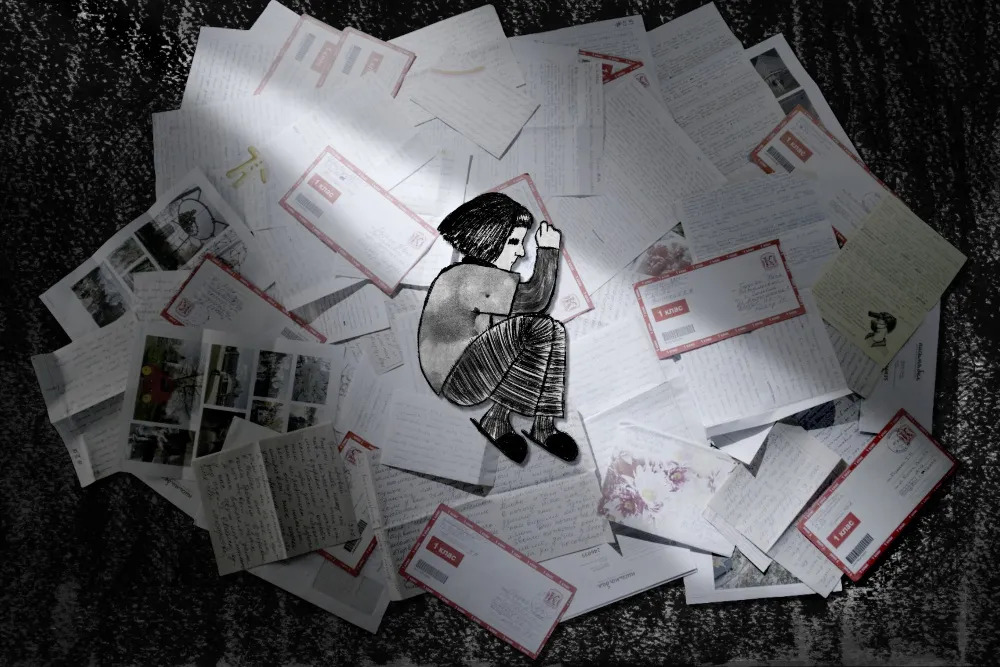
Dark, evocative drawings of a huddled, isolated figure, peepholes, and ever-watching eyes that were made in prison by Kasia Budzko, who was sentenced to two and a half years in a penal colony for protesting when she was just nineteen, are incorporated into the film, forming the basis of animation sequences. These are effective in creating a sense of the troubled interior worlds of political prisoners, who are made to wear yellow tags on their uniforms to single them out from other inmates for particularly harsh treatment. There is scant colour in these animations, or in the cityscapes of Belarus that appear in photographs, in which grey tower blocks dwarf humans, and the statue of Lenin in a square draws an unmistakable parallel to the repressions of a Soviet era threatening to return.
While this dramatic animation provides the soul of the film, the most shocking and nerve-shredding moments come from video-camera, which brings us unsettlingly close to outrageous violence at the hands of the system and its thug-like enforcers. In one, CCTV penal colony cell footage shows prisoner Vitold Ashurak, who would die just after in suspicious circumstances, falling twice, mysteriously unable to stand. Letters home reassure family of his comfort; witness accounts of inmates tell differently, of a campaign of persecution against him. In other footage, recorded by Belarusian KGB, a resident with a hunting rifle faces off against the band of armed officers sawing through his door. Beyond these gut-churning snatches of moments at death’s door, the horror that seeps across most memorably is the unremitting fear before being caught for citizens of conscience in a country in which facial recognition cameras operate as public surveillance against protesters, and arrests, of which there are several a day, happen even in the dead of night. One anonymous man has rejected exile to stay close to his daughter, and he goes about his routine with guarded vigilance.
Extended testimony comes from Andrei Ostapovich, a former police investigator of violent crime sentenced in absentia to eleven years, who resigned due to shock at the sadism of colleagues beating protesters, and is living in exile in Poland after fleeing Belarus. He details his disillusionment, his vulnerable subconscious world of dreams, time on the run, and his subsequent activism breaking into official databases to collect evidence of regime crimes — activity he has now halted due to the frustrating lack of an avenue to act on the findings.
Kutsila achieves access to regime targets whose profiles are varied, and their trust in him is considerable. The voices he amplifies defy the regime’s efforts to dehumanise its victims into faceless, expendable ciphers, as its politically motivated arrests (more than 765,000 have been recorded since 2000 in Belarus) continue. This is not a film that registers great optimism for imminent change, but its humanity, and the dignity of considered attention that it affords its subjects, is undeniable and bracing.
Director, writer: Andrei Kutsila
Editor: Piotr Oginski
Producers: Miroslaw Dembinski, Giedre Zickyte, Gregor Streiber, Friedemann Hottenbacher
Cinematographer: Wojciech Weglarz, Anonymous
Music: Vygintas Kisevi?ius, Paulius Kilbauskas
Sound: Saulius Urbanavi?ius
Animation: Natalia Spychala
Production companies: DocEdu Foundation (Poland), Moonmakers (Lithuania), Inselfilm Produktion (Germany)
Sales: Filmotor
Venue: DOK Leipzig (International Competition Documentary Film)
In Belarusian, Russian, Polish
75 minutes