
Lovers Sleep Alone
.
VERDICT: Massih Parsaei soulfully deals with life far from home in his feature debut ‘Lovers Sleep Alone’, screened in San Sebastián’s New Directors competition.
Young German cinema is on a roll when it comes to foreign-born first-time directors adapting their migrant experiences, or something similar to them, for the big screen (Hijamat, for instance). One such example is Massih Parsaei, an Iranian filmmaker who’s been residing in Europe since 2009, first in Hungary, where he studied animation, and then in Germany, where he attended the Babelsberg Konrad Wolf Film University to study directing. The school is among the institutions that supported his feature debut Lovers Sleep Alone, whose topicality should make it a palatable proposition on the festival circuit and in arthouse milieus.
Set in Berlin, whose train stations and subway stops show up in shots establishing the everyday routine in the German capital, the film follows Iman (Pooyesh Frozandeh), a young man who left Iran a bases his life around a somewhat anonymous existence. He’s disconnected from his home country and his family, works as a caregiver for an elderly man and at a truck wash, and doesn’t have that many meaningful connections in the city, aside from a man he meets at night for sexual encounters in the park (as the title suggests, they keep it quite casual). Then, when a cousin he barely knows comes from Tehran for a visit, what he left behind starts bubbling back to the surface…
As Iman wanders through the streets of Berlin, Parsaei and cinematographer Jakob Reinhardt follow his drifting existence with an aloof closeness, standing next to him but allowing the character to keep his guard up as he embraces a solitude that is at odds with such a large, cosmopolitan city (five languages are spoken on screen, including those of all three countries tied to the director’s personal and artistic growth). Frozandeh skillfully journeys through the layers of a carefully constructed anti-personality that slowly starts exposing what was hidden underneath. A couple of supporting performers have worked with Angela Schanelec, but this is not the heightened reality we’re used to seeing in her films: as the story evolves, so does the emotional vulnerability and availability the protagonist has tried to shove aside.
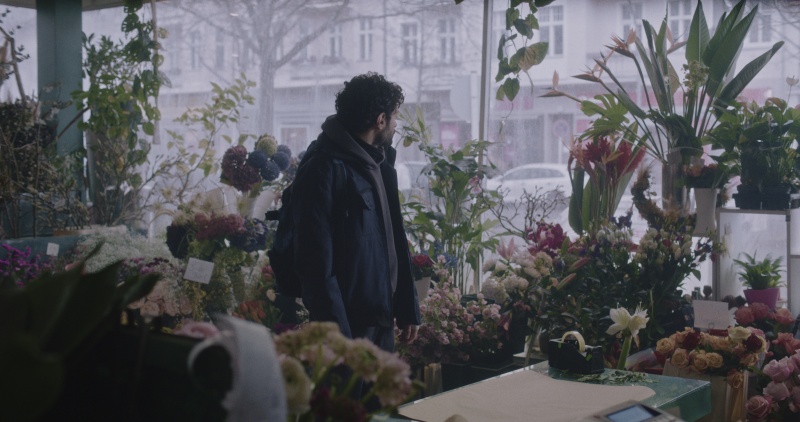
Alongside Iman’s daily tribulations, Berlin behaves like a character in its own right, opting for a less scenic version of itself to convey an image that matches the characters’ less than romanticized relationship with the city (here, the stereotypically spellbinding shots of Alexanderplatz are replaced by views of Kottbusser Tor). There’s a grayness to it that goes hand in hand with Iman’s commitment to absence, albeit with room for something to start blooming again visually when the status quo is challenged.
And as the characters come out of their shells, so does Parsaei with a confident debut that, while certainly not aiming to reinvent the wheel (as mentioned earlier, the bare bones of the premise have become a bit of a trope among emerging filmmakers with a migrant background), has more than enough personality to signal the arrival of an intriguing voice on the younger European filmmaking scene, assisted by a team of collaborators that ultimately underlines the importance of kinship in these uncertain terms.
Director: Massih Parsaei
Screenwriters: Massih Parsaei, Hanna Thomschke
Cast: Pooyesh Frozandeh, Ava Darvishi, Marcel Kohler, Wolfgang Wobéto
Producers: Carla Buchal, Florian Schewe
Cinematography: Jakob Reinhardt
Production design: Fanny Welz
Costume design: Alma Sinai
Music: Mona Matbou Riahi
Sound: Jonas Schüler
Production company: Film Five GmbH
World sales: Film Five GmbH
Venue: San Sebastián International Film Festival (New Directors)
In Arabic, German, Hungarian, Persian, Polish
87 minutes