
Sarajevo 2026: The Verdict
.
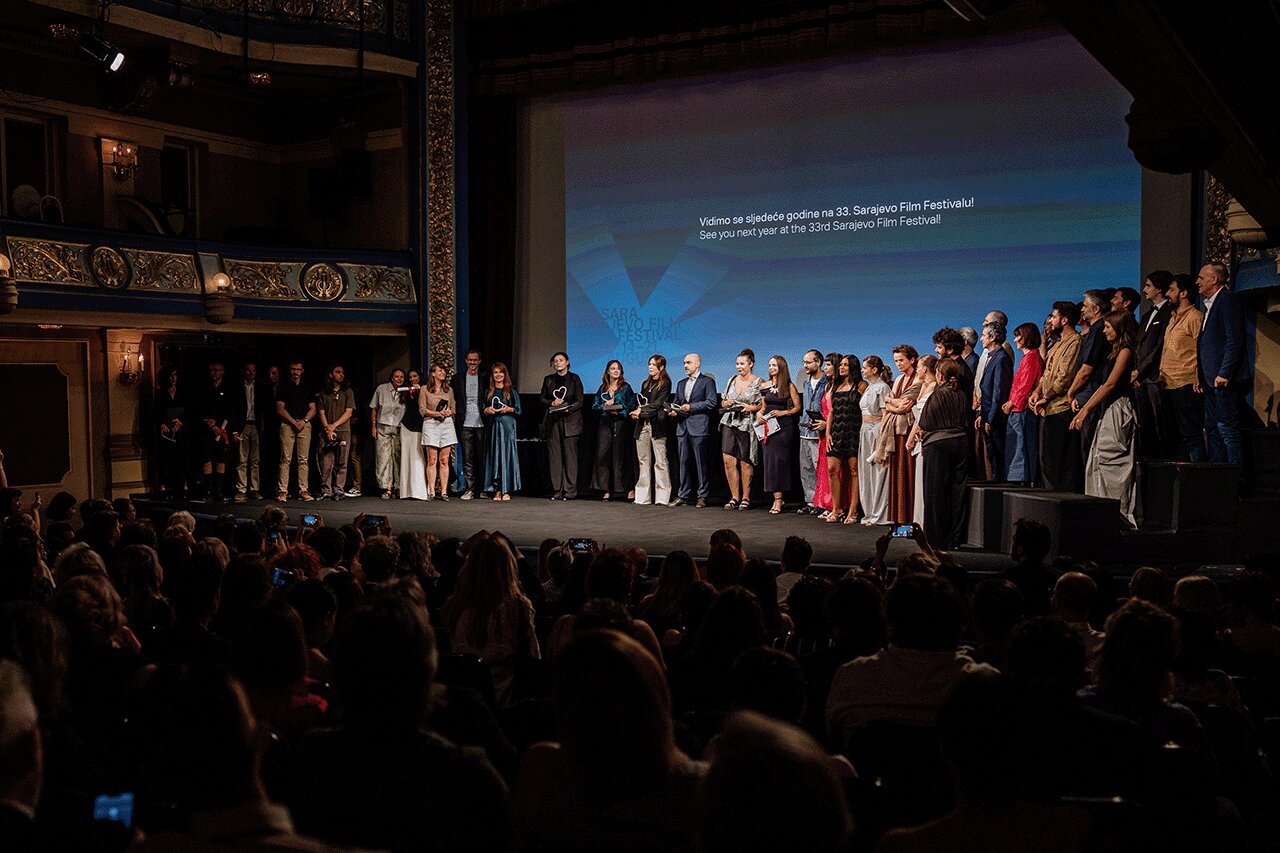
VERDICT: Sandra Wollner’s Everytime won the Heart of Sarajevo for Best Feature Film at Sarajevo Film Festival’s star-studded and politically engaged 32nd edition.
Polish director Pawel Pawlikowski led a starry roster of guests at the Sarajevo Film Festival’s 2026 edition, with his latest film Fatherland chosen to open the week-long event at which American star Woody Harrelson, directors Asghar Farhadi and Celine Sciamma, Mexican actor Diego Luna were also in attendance. Both Harrelson and Luna were Honorary Heart of Sarajevo recipients, in recognition of their careers and contributions to cinema.
A luminous black-and-white film that grapples with exile, return and the rehabilitation of cultural figures after Germany’s darkest wartime era, when artists made very different choices to prop up, resist or escape the regime, Fatherland is just the kind of thorny political cinema that Bosnia’s flagship event has never shied away from, embracing its program as a means to navigate its own turbulent past at the heart of Europe, and its long years under siege in the ‘90s. Pawlikowski told the local audience that he feels at home in Sarajevo, a “city that smells of history.”
The jury, comprised of British actress Emily Watson as president, directors Athina Rachel Tsangari and Igor Bezinovic, actress Sara Klimoska and CEO of the European Film Academy Matthijy Wouter Knol, awarded Best Film to Austrian director Sandra Wollner’s Everytime, a mesmeric and unusual meditation on memory and grief, and Best Director to Georgia’s Ana Urushadze for Supporting Role. Eva Kostic was named Best Actress for her role in 17, and Best Actor went to Adrian Vancica for his performance in Florin Serban’s You Don’t Belong Here.
A concern with power and resistance, and navigating the past in the present, echoed through the Narrative Feature competition, which was notably strong this year. It was threaded through with urgent, politically resonant themes such as cycles of violence (Kosara Mitic’s 17 and Blerta Basholli’s Dua), economic pressures (Visar Morina’s Shame and Money and Zvonimir Juric’s Small Things), and self-important men reckoning with a decline in machismo and influence (Urushadze’s Supporting Role, and Florin Serban’s You Don’t Belong Here.)
In the Documentary section, the top prize went to Montenegro-set To Hold a Mountain, a portrait of women in a shepherd family in territory now being used as a NATO training ground, by Biljana Tutorov and Petar Glomazic. It was awarded by a jury made up of director Kamal Ajafari, Crossing Europe festival director Sabine Gebetsroither, and editor Ollie Huddleston. Salient issues from the region were particularly foregrounded in the selection, from healing ethnic divisions in Damir Markovina’s reflection on family and his hometown of Mostar, We Shall Live Together, to bearing witness to Macedonia’s recent deadly nightclub blaze, in Milcho Manchevski’s Good People.
The Best Narrative Short Film went to Nobody Said Anything, by Tamara Todorovic, and Holy Defiance by Karla Jelic was named the Best Documentary Short Film.
The festival’s specially curated, annual Dealing with the Past section added to a sense that the festival takes its role seriously as a public space for processing history and belonging, with films such as Abdallah Alkhatib’s Chronicles from the Siege, Ivan Ramljak’s Peacemaker and Lana Daher’s Do You Love Me among powerful works negotiating memory and identity.
This year, in addition to receiving an Honorary Heart of Sarajevo, Asghar Farhadi was also honoured with a tribute retrospective of seven selected films from his body of work to date, including his latest film Parallel Tales, and the two dramas which won the Academy Award for Best International Feature Film, A Separation (2011) and The Salesman (2016). In a masterclass, he emphasised the role of cinema in reminding us of the universality of shared human emotion, in a world in which the media and politicians increasingly want to divide us.