
Woman Unknown
Kvinde Ukendt
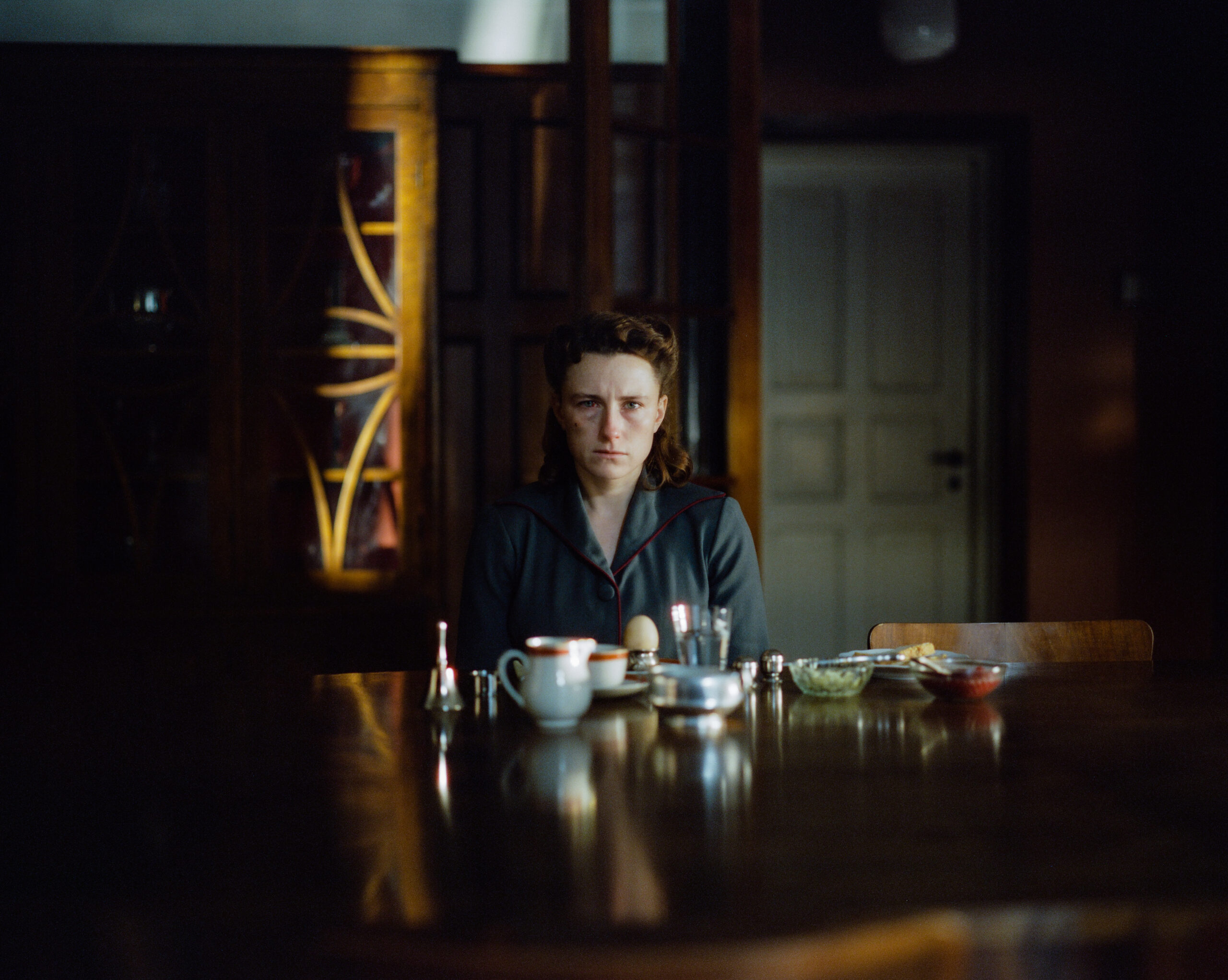
VERDICT: A dark secret could upend an upcoming marriage in May el-Thouky’s vibrant and resonant period piece ‘Woman Unknown’, set at the tail end of World War II in Denmark.
To some degree, May el-Thouky’s third feature film Woman Unknown will be remembered primarily for the same reason as Jennifer Kent’s The Nightingale – namely for being the lone woman-directed entry in the main competition at the Venice Film Festival the year it participated (with the caveat that NAZA, co-directed by Rachel Szor, was added to the 2026 lineup closer to the festival’s start date). Beyond that, though, it is a confident, rich work that is bound to increase the international profile of its director, who already made waves on the festival circuit in 2019 with Queen of Hearts (remade in French by Catherine Breillat in 2023 as Last Summer).
The story is set in 1945, as Denmark is undergoing liberation after being occupied by the Nazis. The protagonist is Marie (Mathilde Arcel), a nanny and housemaid who is about to marry Christian (Carsten Bjørnlund), the wealthy widower she has been working for. On the surface, everything is fine: they live comfortably, Marie gets on swimmingly with Christian’s young daughter Leonora, and the entire household loves her. Unbeknownst to her fiancé, however, Marie needs to take medication to get through sexual intercourse, due to internal scar tissue as a result of a complicated birth she has kept quiet about (not least because her child didn’t survive).
As preparations for the wedding are underway, a chance encounter with a former schoolmate (Thorbjørn Hedegaard) causes Marie to realize her reputation might be at risk: a few years back, she had a sexual relationship with a German soldier (with her classmate suggesting there may have been multiple lovers), and the Danish Resistance is now targeting those who cooperated with the Nazis. Women, referred to as “horizontal collaborators”, are publicly shamed in a manner similar to that depicted in Paul Verhoeven’s Black Book (and, in a fantasy context, the HBO series Game of Thrones), with their heads shaved and their nude bodies branded with a huge painted swastika akin to the scarlet letter (not coincidentally, the Nazi symbol bears the color red for the purposes of this ritualistic punishment).
For Marie, everything is at stake, especially when rumors start to circulate about a “snitch” living in her building. She tries to blow it off as being connected to Christian’s work (as one of his employees has been suspected of collaborating with the Germans), but it soon dawns on her she will have to be quick on her feet if she doesn’t want to lose the status she has carefully crafted by various means, including straight up deception :she’s officially an orphan, but we learn via her old acquaintance that both parents are alive and well, far away from the big city (implied to be Copenhagen, as there is no explicit on-screen identification at any point).
May el-Toukhy works on a much larger scale compared to Queen of Hearts, owing to the period setting (originally intended to be the 1500s, but changed because a witch hunt story set during that era would have made it far easier to unequivocally sympathize with the main character), but she hasn’t gone too mainstream when it comes to characterization: once again, we’re observing an individual who will lie and cheat – in more ways than one – to maintain a comfortable status quo, and while Arcel’s performance makes Marie a very compelling on-screen presence, ably assisted by Jasper Spanning’s lush cinematography and Rebecca Richmond and J?lija Volkinšteine’s immaculate costume design, the question of whether we should root for her or not remains tantalizingly constant, up to and including the final scene. The character wishes to remain unknown, per the title, but that is unlikely to be an option for her portrayer, already a rising star at home and now set to gain global recognition.
Ambiguity is the audience’s trusted companion throughout a film that is hard to watch when it needs to be (the public humiliation scenes) as well as a carefully composed, instantly spellbinding character study that takes us back eight decades but is furiously current in its denunciation of double standards and embedded sexism. The main characters may not always be likable in the conventional sense, but their journey is one that we happily join them on for two hours.
Director: May el-Toukhy
Screenwriters: Maren Louise Käehne, May el-Toukhy
Cast: Mathilde Arcel, Carsten Bjørnlund, Thorbjørn Hedegaard, Marina Bouras, Mia Plantin, Sofia Nolsøe, Flora Yde Sander, Mikael Birkkjær, Joen Højerslev
Producers: Mikael Rieks, Esko Rips, Madara Kalni?a, Johanna Bergenstråhle, Kristina Börjeson
Cinematography: Jasper Spanning
Production design: Sabine Hviid
Costume design: Rebecca Richmond, J?lija Volkinšteine
Music: Mikkel Hess
Sound: Oskar Skriver, Morten Pilegaard
Production companies: Nordisk Film Production, SIA Nafta Films, Nordisk Film Production Sverige, Film i Väst
World sales: TrustNordisk
Venue: Venice Film Festival (Competition)
In Danish
124 minutes