
JEONJU 2026: Festival Verdict
.
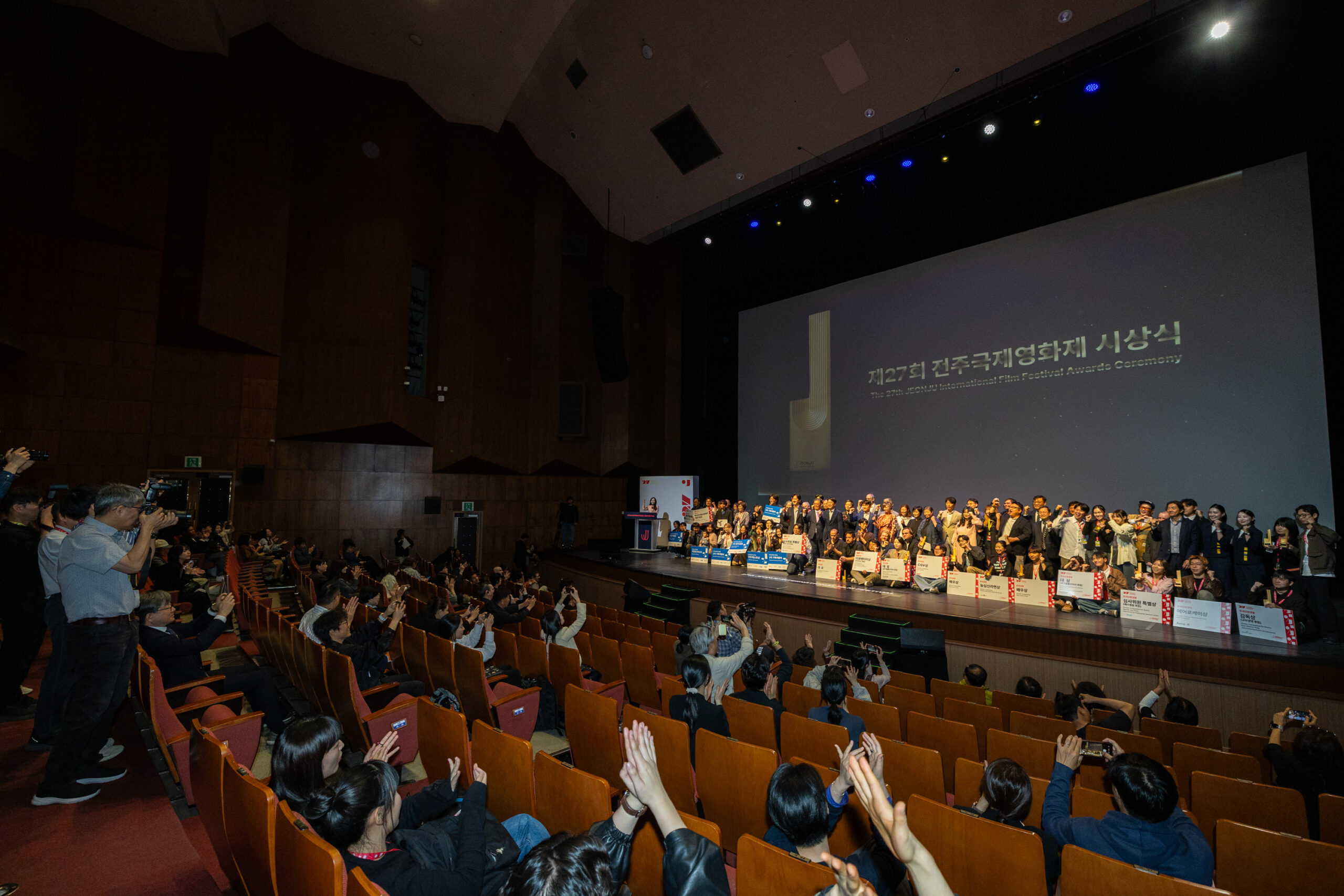
VERDICT: Intense cinephilia, fiery social activism and inventive corporate-backed initiatives converged at the 27th JEONJU International Film Festival, concluding with the stirring political documentary 'The Longest Night: Namtaeryeong'.
It’s not everyday that you hear of cinephiles attending a talk with a K-pop idol, lining up to design a tailor-made pot noodle and then sitting through the entirety of a masterclass about U.S. avant-garde artist Carolee Schneemann and Spanish auteur Pere Portabella – but that’s exactly what happened last week on the “Film Street” of Jeonju.
Rather than ending up a jumble, JEONJU IFF’s wildly diverse events formed a carefully designed constellation. In it, each component – from screenings to sponsorship to seminars featuring activists and unionists – was designed to facilitate its young viewers’ understanding of the historical and political relevance of cinema to mainstream society.
It’s a mission best illustrated by The Longest Night: Namtaeryeong, which wound up the festival on Friday, May 8. Kim Hyun-ji’s documentary offers a riveting account of a standoff between the police and protesters on a highway junction in the southern edge of Seoul on December 21, 2024. Now considered a standout moment during the month-long resistance against then-president Yoon Suk-yeol’s attempt to impose martial law (and thus authoritarian rule) on South Korea, the event was significant in fostering a united front between two very different demographics.
With its many talking-head interviews and stirring scenes punctuated by on-screen pop-ups of social media messages, The Longest Night puts the emphasis on accessibility rather than aesthetic innovation, offering a clarion call for solidarity across class and age lines in a struggle for social justice.
Speaking at a post-screening Q&A session with festival programmer Moon Seok, film director Kim said she was inspired by “all these inspiring ‘adults’” she met while filming at Namtaeryeong – specifically, the farmers who have years of experience fighting for a fair redistribution of land rights in the provinces, and who were travelling in a convoy of tractors to help push back Yoon’s power-grab in Seoul.
“It was such a moving moment where I understood how one person’s love and care touched upon the hearts of so many people and led them to collectively change our world for the better,” said Kim. Through her film, the viewer witnesses how these veteran activists — who admit to not knowing much about, say, feminism and LGBTQ+ — teamed up with Gen Z urbanites who in turn know little about people outside their circle.
These new (and real) friendships anchoring The Longest Night counter the bitter aftertaste of crumbling cross-generational camaraderie in the festival’s opening film, Late Fame. Starring Willem Dafoe as a middle-aged New York City mail sorter whose one single, long-forgotten stab at poetry is somehow “rediscovered” by a group of young hipster-artists posing as the new torch-bearers of the Beats, Kent Jones’s second feature offers an unnerving portrait of the tragic consequences of an uninformed or downright distorted fascination with the past and what the poseurs would call “the old masters”.
Those who sought to understand more about these poseurs could actually hop on to screenings in the thematic section dedicated to real 1960s U.S. maverick filmmakers like Robert Downey, Sr. (with political satires like Putney Swope), Jack Smith (tackling social, sex-related taboos in American society with Flaming Creatures) and Schneemann (with a focus on her collage-heavy films and filmed performances about the human body in Snows and Fuses). This strand is perhaps one of the most aesthetically challenging of the festival this year, and the viewers were given a guide to these films with a “Journey to Cinema” lecture – something which also applied to other similar thematic sections, too.
With JEONJU Forum, which took place at a community-based activity center a few blocks away from the festival hub, the festival organized talks designed to “provide a space to share diverse perspectives and experiences, while exploring the role and possibilities of cinema today”. In one session, independent artists and civil rights experts discussed the legal framework that limits filmmakers’ freedom to record events (such as Yoon’s insurrection in 2024) in the public interest. In another, filmmakers elaborated on the importance of film policy in upcoming local elections. There was also one in which Japanese and Korean producers exchanged ideas about the protection of freelancers and the establishment of a safe working environment on set.
On the other end of the spectrum, the festival offered more accessible approaches in understanding cinema as a cultural entity. Continuing its long-running collaboration with Korean talent agencies, the festival showcased the actors of Ghost Studio through meet-and-greet sessions on an outdoor stage in the center of town, as well as an exhibit at festival headquarters, Jeonju Cinema Complex. This is also where concerts take place, just a stone’s throw away from the installation set up by Universal Studios to promote its summer blockbusters.
The festival’s canniest commercial move was expanding the sponsorship of Nongshim, Korea’s biggest manufacturer of instant noodles. Apart from financing a special award to someone who “demonstrates great potential and creativity” in the Korean competition, Nongshim also provided funds for two directors – the indie documentarian Oh Se-yeon and TV series producer Kim Tae-yeoup – to complete two short films revolving around (what else?) the memories and consumption of the company’s famous spicy instant noodles. Admittedly, the commodity remains front and center in these two short films, but credit is perhaps due for the company – and the festival – to think of recruiting two filmmakers of different backgrounds and styles to tackle the same theme. Which, of course, will be a guaranteed hit in a country where it’s de rigueur for convenience stores to dedicate a whole aisle (or two) to pot and bowl noodles of all kinds.
So it was that JEONJU’s credentials were built, along with intelligent curating and providing a platform for new discoveries in Korean cinema. While most films in the international competition have already been shown elsewhere – the winner, Argentinean filmmaking duo Ezequiel Salinas and Ramiro Sonzini’s black-and-white drama The Night Is Fading Away, bowed in Valdivia last year – the domestic competition was nearly all world premieres.
Limited to first and second features, the Korean competition was won by Lee Seon-yeon’s The Summer That Slipped Away. A road movie of sorts, the film revolves around a family of three travelling around provincial hinterlands to avoid their debtors in Seoul. While the middle-aged couple are basically in denial about their flight and plight – the father listens to music, the mother scavenges for pretty dresses in dumps – their daughter is left to do the heavy lifting, ringing up relatives to borrow money and clocking in shifts at a mobile phone store. A missing box of cellphones eventually lead to a meltdown – a process Lee, in his first feature, portrays with delicacy and style.
Drastically different in style and tone is Kim Myun-woo’s Karma, which won the grand jury prize and also the festival’s best documentary award. Featuring the young director working for his debt-ridden father, the father and son provide legal advice for clients nearing bankruptcy. Kim delivers a harrowing portrait of that part of society overwhelmed by their arrears.
Karma also shows how that tragedy was passed down a generation when the director describes on camera how he once wanted to write “lonely, lofty, solemn” things, and then cuts to a scene where he is talking assets, liquidations and numbers to a client. The pain is palpable, made all the more so with Kim’s decision to punctuate the film with old photos and – in an intriguing twist that merits another movie – visits to his mother who has returned to Buddhist priesthood, after quitting when she got married to Kim’s father.
The Korean competition was certainly very diverse. Alongside other social dramas such as Kim Gyeonggye and Lee Jung-won’s Kino-Eye or So Seong-seop’s scammer-story Insomnia, the lineup included a documentary about the goings-on in contemporary art (Cruel Optimism), another about the legal wranglings around the future of a zoo-bound orangutan (Sandra, the Primate Citizen) and an experimental found-footage piece about women and their representation in society and the moving image in colonial-era Korea (Erotic Blossoms in a Dream). Out of competition, the strongest first feature was Jang Yun-mi’s Miari Texas, about the last days of Seoul’s last-surviving red-light district. All in all, JEONJU IFF offered a glimpse of a generation of Korean cineastes on the move.